Question

Describe Griffith’s transformation experiment.
OR
In the light of Griffith’s experiment, explain the action of two strains of streptococcus pneumoniae and give his conclusion.
Answer

Image

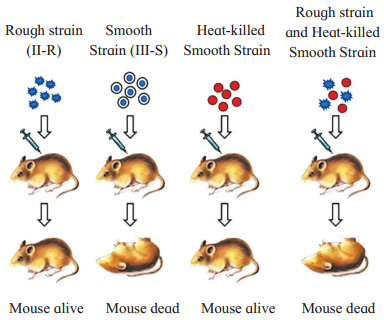
(1) In 1928, Frederick Griffith, carried out experiments with bacterium Streptococcus pneumoniae (which causes pneumonia in humans and other mammals).

(2) Griffith used two strains of Streptococcus pneumonia:

  • S-type (Virulent, smooth, pathogenic and encapsulated).
  • R-type (Non-virulent, rough, non- pathogenic and non-capsulated).

(3) Experiments carried out by E Griffith:

  • Mice were injected with R-strain bacteria and they survived (no pneumonia).
  • Mice injected with S-strain bacteria developed pneumonia and died.
  • When heat-killed S-strain bacteria were injected in mice, the mice survived.
  • On injecting a mixture of heat-killed S-bacteria and live R bacteria, the mice died.

(4) Griffith obtained live S-strain bacteria from the blood of the dead mice.

(5) He concluded that the live R-strain bacteria must have picked up something (which he called transforming principle) from the heat killed S bacterium, and got changed into S-type. Transforming principle allowed R-type to synthesize capsule and it became virulent.

(6) Thus, F. Griffith first demonstrated genetic transformations.

Need a full question paper?

Generate a complete, print-ready paper with questions like this in minutes — across 16+ boards, with answer keys.
Start Generating Free

Similar questions

The following are some well-known abbreviations, which have been used in this chapter. Expand each one to its full form:
  1. MALT.
  2. CMI.
  3. AIDS.
  4. NACO.
  5. HIV.
Give reasons why:
Most zygotes in angiosperms divide only after certain amount of endosperm is formed.
In a biology class, teacher was telling the students that the structures/components and their functions in a watch can be compared with various levels of organisation we find in nature. Radhika was surprised and asked teacher to explain it. Teacher got impressed with Radhika's interest and explained that there is a systematic arrangement of smaller and simpler components into larger one in a hierarchy or pyramid having different levels where each level is formed of components of lower level and itself becomes part of higher level for achieving a common goal.
(i) What are the four levels of biological organisation found in nature?
(ii) What is the basic unit of ecological organisation?
(iii) Define community.
(iv) What values are shown by Radhika?
Habitat loss and fragmentation.
Discuss transgenic animals. Explain any four ways in which such animals can be beneficial for humans.
Describe the signs and symptoms of amoebiasis.
Study the graph given below and answer the questions that follow:
Explain the ovarian events (i), (ii) and (iii) under the influence of hormones ‘X’ and ‘Y’.
Study the illustration given and answer the questions that follow:

Draw a diagram of ‘b’ separately and label the parts:
  • That help its entry into ‘a’;
  • That carry genetic material;
  • That help in its movement.
The following is the illustration of the sequence of ovarian events (a – i) in a human female.
Draw a labelled sketch of the structure of a human ovum prior to fertilisation.
Blood pressure is inversely related to the elasticity of the blood vessels.
