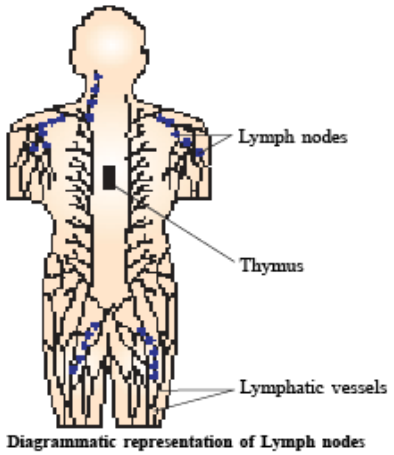
→ The human immune system consists of lymphoid organs, tissues, cells and soluble molecules like antibodies.
→ As you have read, immune system is unique in the sense that it recognises foreign antigens, responds to these and remembers them.
→ The immune system also plays an important role in allergic reactions, auto-immune diseases and organ transplantation
→
Lymphoid organs : These are the organs where origin and/or maturation and proliferation of lymphocytes occur. The primary lymphoid organs are
bone marrow and
thymus where immature lymphocytes differentiate into antigen-sensitive lymphocytes.
→ After maturation the lymphocytes migrate to secondary lymphoid organs like spleen, lymph nodes, tonsils, Peyer's patches of small intestine and appendix.
→ The secondary lymphoid organs provide the sites for interaction of lymphocytes with the antigen, which then proliferate to become effector cells.
→ The location of various lymphoid organs in the human body is shown in the figure above.