Questions

4 Marks Question

🎯

Test yourself on this topic

6 questions · timed · auto-graded

Question 14 Marks
Describe briefly the following. (Diagram is not required)
(i) Simple stirred-tank bioreactor
(ii) Downstream processing
Answer
→ It is less expensive.
→ Oxygen availability is high throughout the bioreactor
→ Having good fermentation capacity.
→ Products are produced on a large scale.
View full question & answer
Question 24 Marks
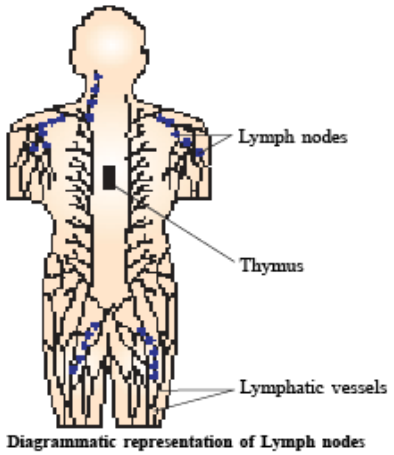
Describe Lymphoid organs.
Answer
→ The human immune system consists of lymphoid organs, tissues, cells and soluble molecules like antibodies.
→ As you have read, immune system is unique in the sense that it recognises foreign antigens, responds to these and remembers them.
→ The immune system also plays an important role in allergic reactions, auto-immune diseases and organ transplantation
Lymphoid organs : These are the organs where origin and/or maturation and proliferation of lymphocytes occur. The primary lymphoid organs are bone marrow and thymus where immature lymphocytes differentiate into antigen-sensitive lymphocytes.
→ After maturation the lymphocytes migrate to secondary lymphoid organs like spleen, lymph nodes, tonsils, Peyer's patches of small intestine and appendix.
→ The secondary lymphoid organs provide the sites for interaction of lymphocytes with the antigen, which then proliferate to become effector cells.
→ The location of various lymphoid organs in the human body is shown in the figure above.
Image
View full question & answer
Question 34 Marks
Explain the process of transcription in bacteria. (Diagram is essential)
Answer
→ After completion of the biosynthetic stage, the product has to be subjected through a series of processes before it is ready for marketing as a finished product.
→ The processes include separation and purification, which are collectively referred to as downstream processing.
→ The product has to be formulated with suitable preservatives.
→ Such formulation has to undergo through clinical trials as in case of drugs.
→ Strict quality control testing for each product is also required.
→ The downstream processing and quality control testing vary from product to product.
View full question & answer
Question 44 Marks
Describe the inheritance of two genes with chart in garden pea.
Answer
→ Mendel also worked with and crossed pea plants that differed in two characters, as is seen in the cross between a pea plant that has seeds with yellow colour and round shape and one that had seeds of green colour and wrinkled shape
→ Mendel found that the seeds resulting from the crossing of the parents, had yellow coloured and round shaped seeds.
→ Yellow colour was dominant over green & round shape was dominant over wrinkled.
→ These results were identical to those that he got when he made separate monohybrid crosses between yellow and green seeded plants and between round and wrinkled seeded plants.
→ Let us use the genotypic symbols Y for dominant yellow seed colour and y for recessive green seed colour. R. for round shaped seeds and r for wrinkled seed shape.
→ The genotype of the parents can then be written as RRYY and rryy.
→ The cross between the two plants can be written down as in Figure (Fig.5) showing the genotypes of the parent plants.
→ The gametes RY and ry unite on fertilisation to produce the hybrid RrYy.
→ When Mendel self hybridised the F1 plants he found that $3 / 4$ of F2 plants had yellow seeds $1 / 4$ and had green.
→ The yellow and green colour segregated in a 3:1 ratio. Round and wrinkled seed shape also segregated in a 3:1 ratio; just like in a monohybrid cross.
View full question & answer
Question 54 Marks
Describe the process of formation of mature gamete in female. (Figure is not required)
Answer
→ The process of formation of a mature female gamete is called oogenesis.
→ It is initiated during the embryonic development stage when a couple of million gamete mother cells (oogonia) are formed within each fetal ovary, no more oogonia are formed and added after birth.
→ These cells (oogonia) start dividing and enter into prophase-I of the meiotic division and get temporarily arrested at that stage, called primary oocytes.
→ Each primary oocyte then gets surrounded by a layer of granulosa cells and is called the primary follicle. A large number of these follicles degenerate during the phase from birth to puberty. Therefore, at puberty only 60,000-80,000 primary follicles are left in each ovary.
→ At puberty the primary follicles get surrounded by more layers of granulosa cells and a new theca and are called secondary follicles.
→ The secondary follicle soon transforms into a tertiary follicle which is characterised by a fluid filled cavity called antrum. The theca layer is organised into an inner theca interna and an outer theca externa.
→ It is at this stage that the primary oocyte within the tertiary follicle grows in size and completes its first meiotic division. It is an unequal division resulting in the formation of a large haploid secondary oocyte and a tiny first polar body.
→ The secondary oocyte retains bulk of the nutrient rich cytoplasm of the primary oocyte.
→ The tertiary follicle further changes into the mature follicle or Graafian follicle.
→ The secondary oocyte forms a new membrane called zona pellucida surrounding it.
→ The Graafian follicle now ruptures to release the secondary oocyte (ovum) from the ovary by the process called ovulation.
View full question & answer
Question 64 Marks
Describe the out breeding devices in angiospermic plants.
Answer
→ A breeder is interested in crossing different species and often genera to combine desirable characters to produce commercially 'superior' varieties. Artificial hybridisation is one of the major approaches of crop improvement programme.
→ In such crossing experiments it is important to make sure that only the desired pollen grains are used for pollination and the stigma is protected from contamination (from unwanted pollen). This is achieved by emasculation and bagging techniques.
→ Emasculation :
→ If the female parent bears bisexual flowers, removal of anthers from the flower bud before the anther dehisces using a pair of forceps is necessary. This step is referred to as emasculation.
→ Bagging :
→ Emasculated flowers have to be covered with a bag of suitable size, generally made up of butter paper, to prevent contamination of its stigma with unwanted pollen. This process is called bagging.
→ Rabagging :
→ When the stigma of bagged flower attains receptivity, mature pollen grains collected from anthers of the male parent are dusted on the stigma, and the flowers are rebagged, and the fruits are allowed to develop.
→ If the female parent produces unisexual flowers, there is no need for emasculation. The female flower buds are bagged before the flowers open.
→ When the stigma becomes receptive, pollination is carried out using the desired pollen and the flower rebagged.
View full question & answer
4 Marks Question - BIOLOGY STD 12 Science Questions - Vidyadip