Question
Describe the cleansing action of detergents.

Answer

Cleansing action of detergents: Oil stains and grease on dirty clothes cannot be removed by simply washing the clothes with water because water does not wet them. By adding detergent or soap to water, the greasy dirt can be easily removed. The cleansing action of detergents can be explained as follows:
i. Soap or detergent molecules have the shape of a hairpin.
ii. When detergent is dissolved in water, the heads of its hairpin shape molecules get attracted to water surface.
iii. When clothes with greasy stains are dipped in water containing detergent, the pointed ends of detergent molecules get attached to the molecules of grease. So a water-grease interface is formed. Thus surface tension is greatly reduced. The greasy dirt is held suspended.
iv. When the clothes are rinsed in water, the greasy dirt is washed away by running water.
So when detergent is added to water, the surface tension of water is reduced, its area of contact with grease is increased and hence its cleansing ability is increased.
Need a full question paper?

Generate a complete, print-ready paper with questions like this in minutes — across 16+ boards, with answer keys.

Start Generating Free

Similar questions

A hospital uses an ultrasonic scanner to locate tumours in a tissue. What is the wavelength of sound in the tissue in which the speed of sound is 1.7km s–1? The operating frequency of the scanner is 4.2 MHz.
If a satellite is revolving around a planet of mass M in an elliptical orbit of semi major axis a, show that orbital speed v of the satellite when at a distance r from the focus will be given by
$\text{v}^2=\text{GM}\Big(\frac{2}{\text{r}}-\frac{1}{\text{a}}\Big)$
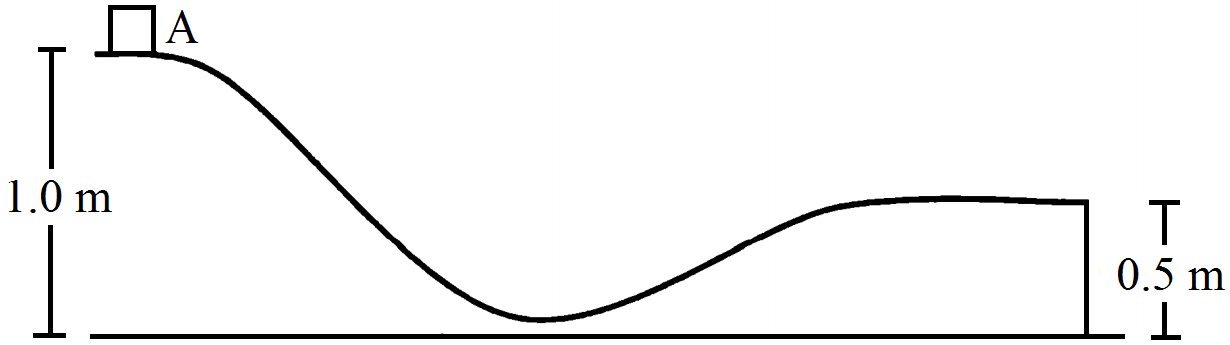
Figure shows a particle sliding on a frictionless track which terminates in a straight horizontal section. If the particle starts slipping from the point A, how far away from the track will the particle hit the ground?

The magnifying power of a simple microscope is given by $1+\frac{\text{D}}{\text{f}},$ where D is the least distance for clear vision. For farsighted persons, D is greater than the usual. Does it mean that the magnifying power of a simple microscope is greater for a farsighted person as compared to a normal person? Does it mean that a farsighted person can see an insect more clearly under a microscope than a normal person?
A block of mass M is pulled along a horizontal surface by applying a force at an angle with horizontal. Coefficient of friction between block and surface is u. If the block travels with uniform velocity, find the work done by this applied force during ú displacement d of the block.
State the first law of thermodynamics. List the sign conventions used in the energy dealt by the law.
What are reversible and irreversible processes? Explain giving one example of each.
A charge of +2.0 × 10⁻⁸C is placed on the positive plate and a charge of -1.0 × 10⁻⁸C on the negative plate of a parallel-plate capacitor of capacitance $1.2\times10^{-3}\mu\text{F}.$ Calculate the potential difference developed between the plates.
A body of mass 12kg is suspended by a coil spring of natural length 50cm and force constant 2.0 × 10Nm3. What is the stretched length of the spring? If the body is pulled down further stretching the spring to a length of 5.9cm and then released, what is the frequency of oscillation of the suspended mass?
(Neglect the mass of the spring.)
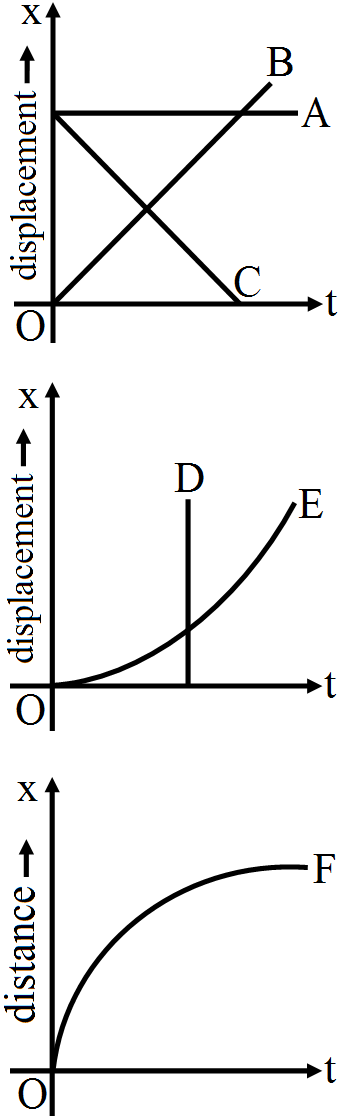
Identify the types of motion in following cases: