Question
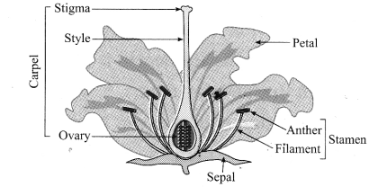
Describe the structure of a flower.
Image

Answer

(1) The structural unit of sexual reproduction in plants is flower. There are total four floral whorls. Of these, two are accessory floral whorls while two are essential floral whorls.
(2) Calyx and corolla are accessory whorls. They are protective in nature.
(3) Members of calyx are known as sepals. They are usually green in colour. They protect the inner whorls.
(4) The members of corolla are called petals. They can be of different colours.
(5) Androecium and gynoecium are essential whorls as they participate in sexual reproduction.
(6) The male whorl androecium is made up of stamens. Each stamen has a filament with anther located at the upper end. In the anther there are four locules. Inside the locules the meiosis takes place forming pollen grains. During suitable time, the pollen grains are released from anther lobes.
(7) Gynoecium is made up of carpels, either in separate form or are united. Each carpel is formed of ovary at the basal end hollow ‘style’ and the stigma at the tip of style. There are one or many ovules inside the ovary.
(8) In bisexual flowers both androecium and gynoecium are located in the same flower, e.g. Hibiscus.
(9) In unisexual flowers, androecium is present in male flowers and gynoecium is present in the female flowers, e.g. Papaya.

Need a full question paper?

Generate a complete, print-ready paper with questions like this in minutes — across 16+ boards, with answer keys.

Start Generating Free

Similar questions

Write short notes on the following: Galvanizing.
Describe the process of fertilisation in humans and development of embryo briefly.
Write Short note: Seed germination.
Renewable energy is, energy produced from sources that do not deplete or can be replenished within a human’s life time. The most common examples include wind, solar, geothermal, biorhass, and hydroelectric power. This is in contrast to non-renewable sources such as fossil fuels. Most renewable energy is derived directly or indirectly from the sun. Sunlight can be captured directly using solar technologies. The sun’s heat drives winds, whose energy is captured with turbines. Plants also rely on the sun to grow and their stored energy can be utilized for bioenergy. Not all renewable energy sources rely on the sun. For example, geothermal energy utilizes the Earth’s internal heat, tidal energy relies on the gravitational pull of the moon, and hydroelectric power relies on the flow of water.
Questions and Answers :
(1) What is renewable energy?
(2) Give the examples of renewable energy.
(3) Why will energy from fossil fuel be over soon?
(4) Name the renewable sources of energy which are not dependent on sun. What are they dependent upon?
(5) Which type of energy do we mostly use in India?
Write a note on Galvanometer.
 Who will spend more electrical energy? 500 W TV set in 30 mins, or 600 W heater in 20 mins?
The human body has an organ A which acts as a double pump. The oxygenated blood coming from the lungs through a blood vessel B enters the upper left chamber C of the double pump. When chamber C contracts, then blood goes into lower left chamber D. The contraction of chamber D forces the blood to go into a blood vessel E which supplies oxygenated blood to all the organs of the body (except the lungs). The deoxygenated blood coming out of the body organs is taken by a blood vessel F to the right upper chamber G of pumping organ. Contraction of chamber G forces the deoxygenated blood into right lower chamber H. And finally the contraction of chamber H sends the deoxygenated blood into lungs through a blood vessel I.
  1. What is organ A?
  2. Name the blood vessel (i) B (ii) E (iii) F, and (iv) I.
  3. What are chambers (i) C, and (ii) D?
  4. What are chambers (i) G and (ii) H?
Write short note: Production of cheese.
Two tungsten bulbs of wattage 100 W and 60 W power work on 220 V potential difference. If they are connected in parallel, how much current will flow in the main conductor?
Sketch, labell and classify: Octopus