Question
Describe the two experiments related to static friction with diagram.

Answer

Image
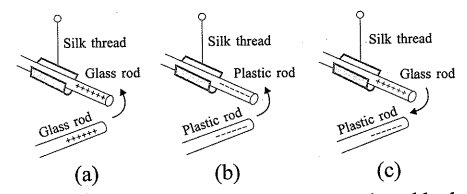
►It was observed that if two glass rods rubbed with wool or silk cloth are brought close to each other, they will repel. [Fig. (a)].
►The two strands of wool or two pieces of silk cloth, with which the rods were rubbed, also repel each other.
►The glass rod and wool are attracted to each other.
►Similarly, two plastic rods rubbed with cat's fur will repell each other [Fig. (b)] but attract the fur.
►On the other hand, the plastic rod attracts the glass rod [Fig. (c)] and repels the silk or wool with which the glass rod is rubbed. The glass rod repels the fur.
Need a full question paper?

Generate a complete, print-ready paper with questions like this in minutes — across 16+ boards, with answer keys.

Start Generating Free

Similar questions

A charged particle oscillates about its mean (equilibrium) position with a frequency of 109Hz. What is the frequency of the electromagnetic waves produced by the oscillator?
Show mathematically how Bohr's postulate of quantization of orbital angular momentum in hydrogen atom is explained by de-Broglie's hypothesis.
The potential difference between the terminals of a 6.0V battery is 7.2V when it is being charged by a current of 2.0A. What is the internal resistance of the battery?
Find the time required to liberate 1.0 litre of hydrogen at STP in an electrolytic cell by a current of 5.0A.
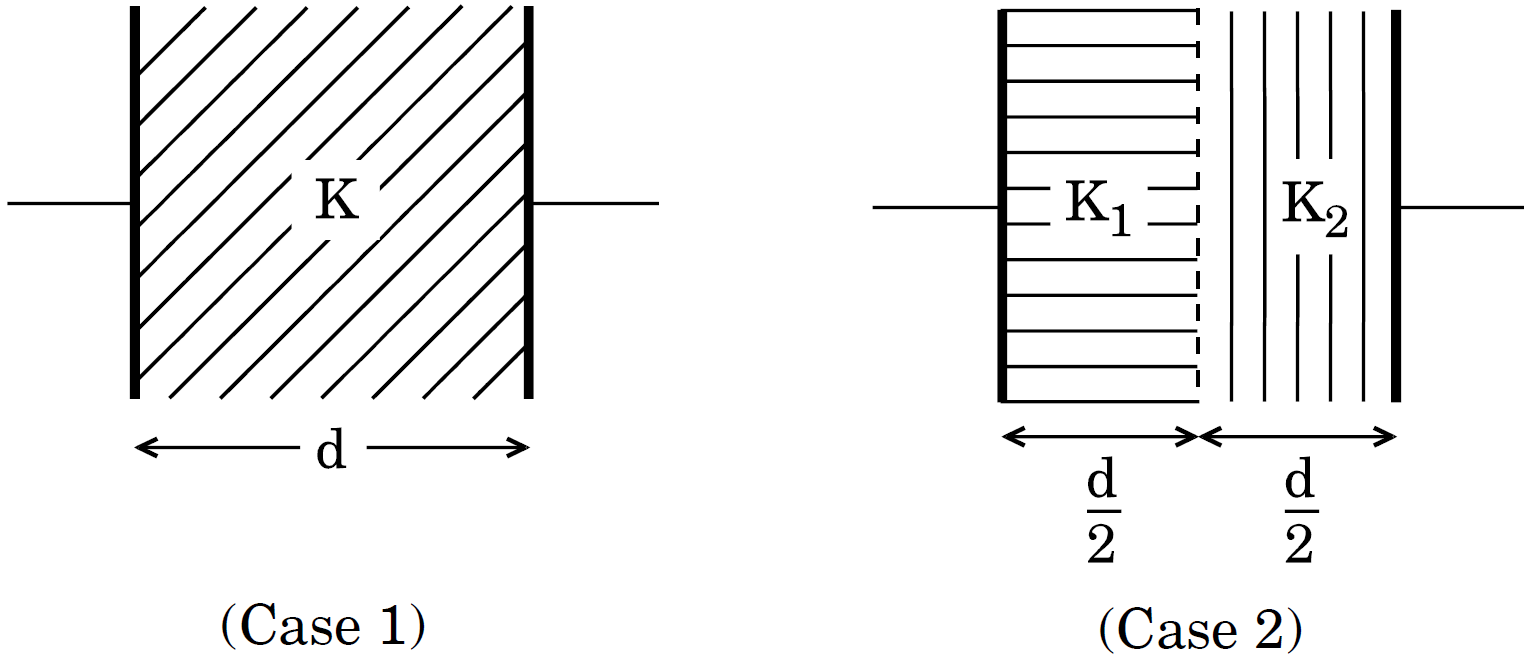
The space between the plates of a parallel plate capacitor is completely filled in two ways. In the first case, it is filled with a slab of dielectric constant K. In the second case, it is filled with two slabs of equal thickness and dielectric constants K1 and K2 respectively as shown in the figure. The capacitance of the capacitor is same in the two cases. Obtain the relationship between K, K1 and K2.

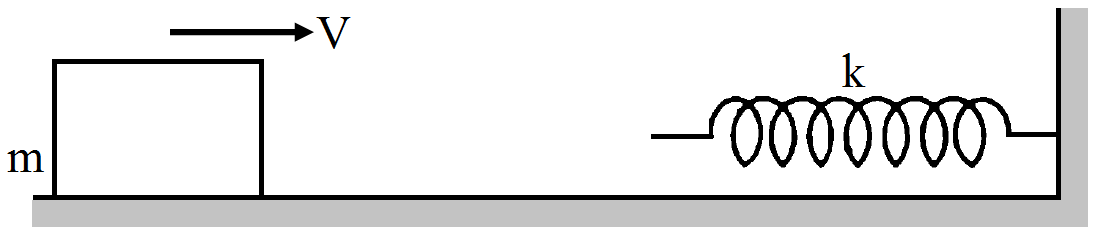
A block of massip, sliding on a smooth horizontal surface with a velocity $\vec{\text{v}}$ meets a long horizontal spring fixed at one end and having spring constant k as shown in figure. Find the maximum compression of tin spring. Will the velocity of the block be the same $\vec{\text{v}}$ when it comes back to the original position shown?

What is the reason, why the diameter of the objective of a telescope should be large for a good resolution?
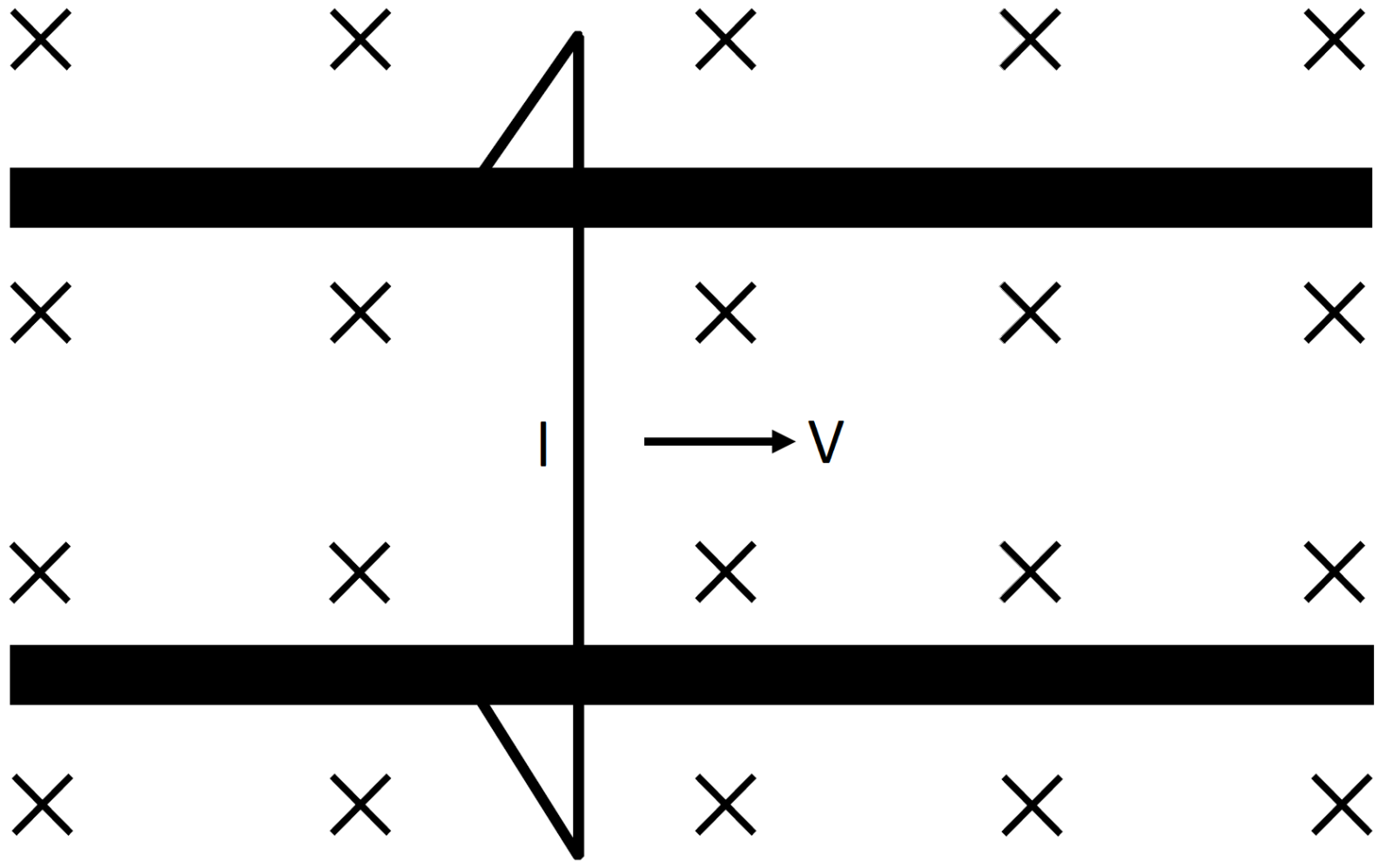
Figure shows a wire sliding on two parallel, conducting rails placed at a separation l. A magnetic field B exists in a direction perpendicular to the plane of the rails. What force is necessary to keep the wire moving at a constant velocity v?

If the intensity of light falling on a metal plate is doubled, what will be the effect on photocurrent and maximum kinetic energy of emitted photoelectrons?
What is a capacitive and an inductive AC circuit? Explain.