Question
Describe tissue culture.

Answer

→ As traditional breeding techniques failed to keep pace with demand and to provide sufficiently fast and efficient systems for crop improvement, another technology called tissue culture got developed.
→ It was learnt by scientists, during 1950s, that whole plants could be regenerated from explants, i.e., any part of a plant taken out and grown in a test tube, under sterile conditions in special nutrient media.
→ This capacity to generate a whole plant from any cell/explant is called totipotency.
→ It is important to stress here that the nutrient medium must provide a carbon source such as sucrose and also inorganic salts, vitamins, amino acids and growth regulators like auxins, cytokinins etc.
→ By application of these methods it is possible to achieve propagation of a large number of plants in very short durations.
→ This called micro-propagation.
→ Each of these plants will be genetically identical to the original plant from which they were grown, i.e., they are somaclones.
→ Many important food plants like tomato, banana, apple, etc., have been produced on commercial scale using this method. Try to visit a tissue culture laboratory with your teacher to better understand and appreciate the process.
→ Another important application of the method is the recovery of healthy pltnts from diseased plants.
→ Even if the plant is infected with a virus, the meristem (apical and axillary) is free of virus.
→ Hence, one can remove the meristem and grow it in vitro to obtain virus-free plants. Scientists have succeeded in culturing meristems of banana. Sugarcane, potato. etc.
Somatic hybridisation :
→ Scientists have even isolated single cells from plants and after digesting their cell walls have been able to isolate naked protoplasts (surrounded by plasm membranes).
→ Isolated protoplasts from two different varieties of plants each having a desirable character - can be fused to get hybrid protoplasts, which can be further grown to form a new plant. These hybrides are called somatic hybrids while the process is called somatic hybridisation.
→ When a protoplast of tomato is fused with that potato, and then they are grown to form new hybrid plants combining tomato and potato characteristics.
→ Well this has been achieved - resulting in formation of pomato; unfortunately this plant did not have all the desired combination of characteristics for its commercial utilisation.
Need a full question paper?

Generate a complete, print-ready paper with questions like this in minutes — across 16+ boards, with answer keys.

Start Generating Free

Similar questions

Microorganisms include bacteria, viruses, fungi and protozoa. In our mind, we presume, most of the time, that microbes are always harmful. Microbes are, of course, the causal agents of many infections diseases of plants and animals including humans but they also have lots of beneficial role. Lactic acid bacteria (LAB) are one of this kind of useful group. These are Gram positive, non-sporulating, either rod-shaped or spherical bacteria. They produce lactic acid in milk products as major metabolic end product of carbohydrate fermentation. LAB are considered as natural fermentors. Lactobacillus is a common LAB which converts lactose sugar of milk into lactic acid, that causes coagulation and partial digestion of milk protein casein. Milk is then changed into curd, yoghurt and cheese. Lactobacillus is also used in probiotics which have potentially beneficial effect on gut ecosystem of humans. Some other probiotic strain used belong to the Genus Bifidobacterium.

  1. Which of the following is not considered as microorganisms?
  1. Bacteriophage.
  2. Streptococcus.
  3. Porphyra.
  4. Staphylococcus.
  1. Select the incorrect option regarding the characteristics of lactic acid bacteria.
  1. They are rod-shaped or spherical.
  2. They are Gram positive.
  3. They take part in carbohydrate fermentation.
  4. They are acid intolerant.
  1. Which of the following is not a lactic acid producing bacteria?
  1. Streptococcus.
  2. Lactococcus.
  3. Saccharomyces.
  4. Enterococcus.
  1. Probiotics are:
  1. Gut friendly live bacteria.
  2. Acid balancing alternated bacteria.
  3. Beneficial amount of dead bacteria.
  4. Gram negative attenuated bacteria.
  1. Assertion: Lactobacillus bacteria do not retain crystal violet stain while staining.

Reason: Lactobacillus have a very thin layer of peptidoglycan layer in their cell wall.

  1. Both assertion and reason are true and reason is the correct explanation of assertion.
  2. Both assertion and reason are true but reason is not the correct explanation of assertion.
  3. Assertion is true but reason is false.
  4. Both assertion and reason are false.
Read the following and answer any four questions from (i) to (v) given below:

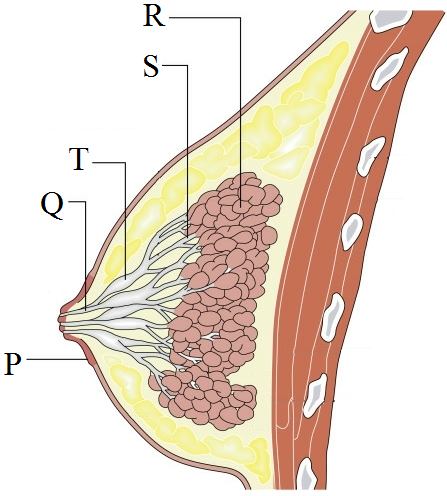
A functional mammary gland is characteristic of all female mammals. Mammary glands are paired structures that contain glandular tissue and variable amount of fat. Refer to the given figure of a mammary gland and answer the following questions.

  1. Mammary glands are modified:
  1. Sweat glands.
  2. Sebaceous glands.
  3. Sudoriferous glands.
  4. Lacrimal glands.
  1. Identify the incorrectly matched pair.
  1. P - Areola.
  2. Q - Lactiferous duct.
  3. S - Mammary duct.
  4. T - Mammary alveoli.
  1. Mammary ducts expand to form:
  1. Mammary alveoli.
  2. Mammary ampullae.
  3. Lactiferous ducts.
  4. Mammary tubules.
  1. What is areola?
  1. Grape-like clusters of milk secreting structures.
  2. Fatty tissue between the mammary lobes.
  3. Circular pigmented area of skin around nipple.
  4. Connective tissue that supports the alveoli and ducts.
  1. Assertion: The size of breast depends on the amount of adipose tissue.

Reason: The adipose tissue supports the alveoli and the ducts.

  1. Both assertion and reason are true, and reason is the correct explanation of assertion.
  2. Both assertion and reason are true, but reason is not the correct explanation of assertion.
  3. Assertion is true, but reason is false.
  4. Both assertion and reason are false.
Read the following and answer any four questions from (i) to (v) given below:
The first menstruation is called menarche, that usually occurs between 12 and 15 years. In human females, menstruation is repeated at an average interval of about 28/29 days and is called menstrual cycle. It is regulated by certain hormones, as pituitary gland is stimulated by releasing factors produced in the hypothalamus. The hormones produced by pituitary gland influence the ovaries. The hormones secreted by the ovaries affect the walls of the uterus.
  1. The breakdown of endometrium is characteristic of:
  1. Proliferative phase.
  2. Luteal phase.
  3. Ovulatory phase.
  4. Menstrual phase.
  1. Which days of the menstrual cycle marks the proliferative phase?
  1. 1-5
  2. 15-28
  3. 6-13
  4. 10-14
  1. Which of the following occurs during secretory phase?
  1. Empty Graafian follicle changes into corpus luteum.
  2. Primary follicle changes into Graafian follicle.
  3. Endometrium rebuilds and estrogen secretion increases.
  4. LH surge, inducing release of an ovum.
  1. Identify the hormones that attain peak level during ovulatory phase.
  1. FSH.
  2. Progesterone.
  3. LH.
  4. Both (a) and (c).
  1. Withdrawal of which hormone causes degeneration of corpus luteum?
  1. FSH.
  2. LH.
  3. Progesterone.
  4. Estrogen.
Write a short note on pollination by wind.
The size of a population for any species is not a static parameter. Explain.###Explain population growth###Explain in brief - population growth.
Read the following and answer any four questions from (i) to (v) given below:

Deoxyribonucleic acid (DNA) and ribonucleic acid (RNA) are the two types of nucleic acids found in the living systems. DNA acts as the genetic material in most of the organisms. Although, RNA also acts as a genetic material in some organisms.

  1. In which of the following organisms, RNA acts as a genetic material?
  1. Escherichia coli
  2. $\text{Q}\beta$ Bacteriophage
  3. Tobacco Mosaic viruses
  4. Both (b) and (c)
  1. What is the reason for the additional stability of DNA in comparison to RNA?
  1. Presence of thymine
  2. Presence of uracil
  3. Presence of OH group
  4. Presence of deoxyribose sugar
  1. Which of the following criteria a molecule must fulfill to act as a genetic material?
  1. It should be able to generate its replica.
  2. It should be stable chemically and structurally.
  3. It should be able to express itself in the form of Mendelian character.
  4. All of these
  1. Assertion: RNA is liable and easily degradable.

Reason: The 2'- OH group present at every nucleotide in RNA is a reactive group

  1. Both assertion and reason are true, and reason is the correct explanation of assertion.
  2. Both assertion and reason are true, but reason is not the correct explanation of assertion.
  3. Assertion is true, but reason is false.
  4. Both assertion and reason are false.
  1. Read the given statement and select the option that correctly fill in the blanks. Pyrimidines present in DNA are (i) and (ii) while pyrimidines present in RNA are (iii) and (iv).
  1. (i)-Adenine (iii)-Guanine (iii)-Cytosine, (iv)-Thymine
  2. (i)-Cytosine (iii)Thymine (iii)-Cytosine, (iv)-Uracil
  3. (i)-Cytosine (iii)-Uracil (iii)-Adenine, (iv)-Guanine
  4. (i)-Cytosine (iii)-Uracil (iii)-Cytosine, (iv)-Thymine
Read the following and answer any four questions from (i) to (v) given below:
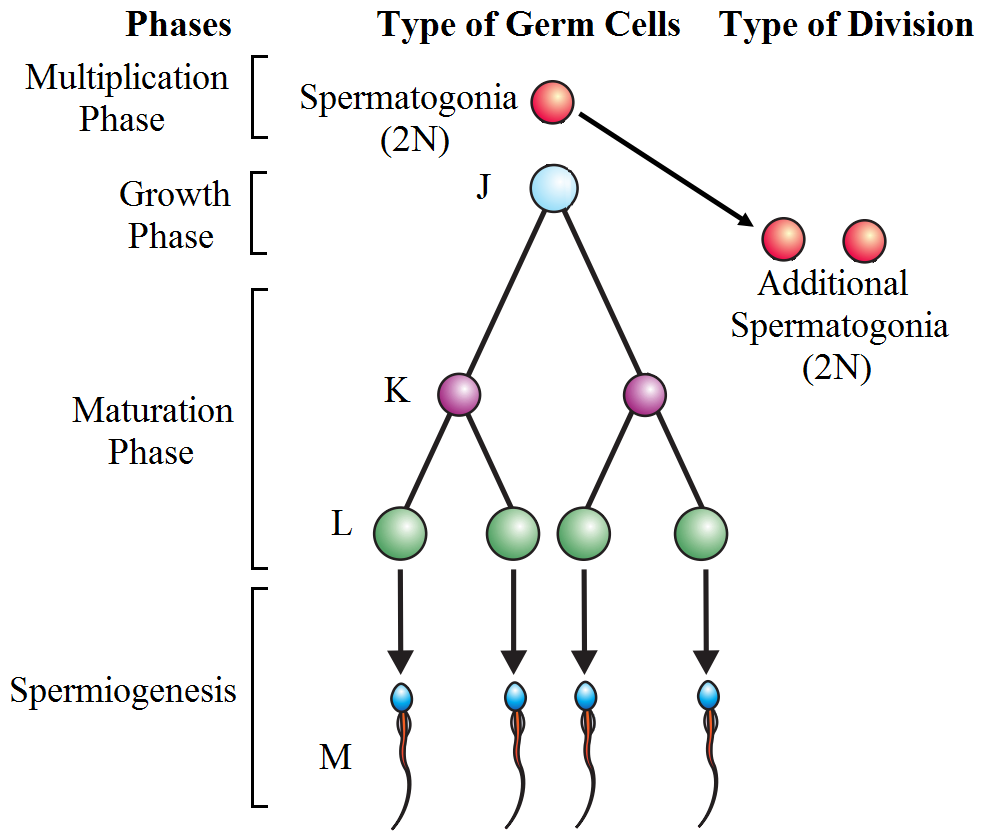
In testis, the immature male germ cells produce sperms by spermatogenesis that begins at puberty. It occurs in the seminiferous tubules of the testes. Seminiferous tubules are lined by germinal epithelium. Study the schematic representation of spermatogenesis and answer the following questions.

  1. Which cell division occurs during multiplication phase?
  1. Mitosis.
  2. Meiosis I.
  3. Meiosis II.
  4. Both (b) and (c).
  1. How many chromosomes are present in secondary spermatocyte and spermatid, respectively?
  1. 46, 23
  2. 46, 46
  3. 23, 23
  4. 23, XY
  1. Transformation of L into M is known as:
  1. Spermiation.
  2. Spermateliosis.
  3. Spermatogenesis.
  4. None of these.
  1. Select the correct option.
  1. Type A spermatogonia grows to larger primary spermatocyte.
  2. One spermatogonium forms two spermatids.
  3. Spenniation is the release of sperms from seminiferous tubules.
  4. Primary spermatocyte undergoes mitosis to form secondary spermatocytes.
  1. Which hormone acts on spermatogonia to stimulate sperm production?
  1. LH.
  2. GnRH.
  3. ABP.
  4. FSH.
What is oogenesis? Give a brief account of oogenesis.###Define or Characterise: (i) Primary oocyte. (ii) Primary follicle. (iii) Secondary follicle. (iv) Tertiary follicle. (v) Antrum. (vi) Secondary oocyte. (vii) Graafian follicle.
Explain packaging of DNA Helix###Explain the formation of nucleosome in Eukaryotic cell
Write a short note on transcription unit.### Explain : Transcription unit