Question
Describe Young’s double slit interference experiment and derive conditions for occurrence of dark and bright fringes on the screen. Define fringe width and derive a formula for it.
Answer


Description of Young’s double-slit interference experiment:
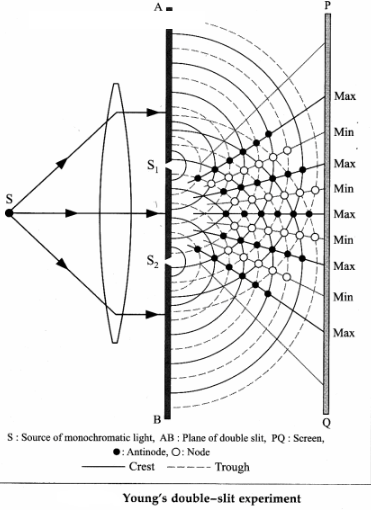
1. A plane wavefront is obtained by placing a linear source $S$ of monochromatic light at the focus of a convex lens. It is then made to pass through an opaque screen $A B$ having two narrow and similar slits $S_1$ and $S_2 \cdot S_1$ and $S_2$ are equidistant from $S$ so that the wavefronts starting simultaneously from $S$ and reaching $S_1$ and $S_2$ at the same time are in phase. A screen PQ is placed at some distance from screen $A B$ as shown in below figure

Image
  1. $S_1$ and $S_2$ act as secondary sources. The crests/-troughs of the secondary wavelets superpose and interfere constructively along straight lines joining the black dots shown in above figure. The point where these lines meet the screen have high intensity and are bright.
  2. Similarly, there are points shown with red dots where the crest of one wave coincides with the trough of the other. The corresponding points on the screen are dark due to destructive interference.
  3. These dark and bright regions are called fringes or bands and the whole pattern is called interference pattern.
Conditions for occurence of dark and bright fringes on the screen :
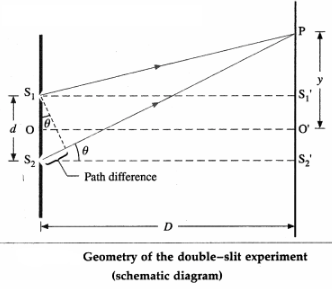
Consider Young's double-slit experimental set up. Two narrow coherent light sources are obtained by wavefront splitting as monochromatic light of wavelength $\lambda$ emerges out of two narrow and closely spaced, parallel slits $S_1$ and $S _2$ of equal widths. The separation $S _1 S_2= d$ is very small. The interference pattern is observed on a screen placed parallel to the plane of and at considerable distance $D(D \gg d)$ from the slits. $O O$ ' is the perpendicular bisector of segment $S_1 S_2$.


Image
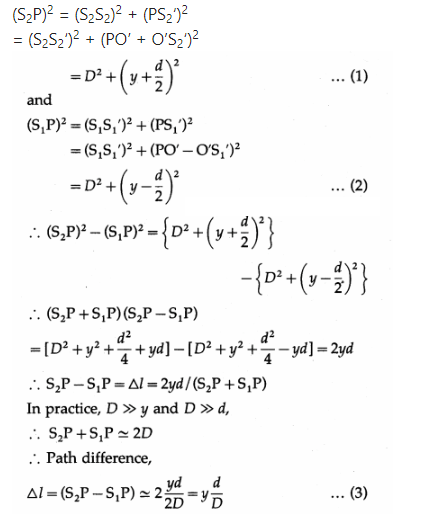
Consider, a point $P$ on the screen at a distance $y$ from $O^{\prime}(y \& D)$. The two light waves from $S_1$ and $S_2$ reach $P$ along paths $S_1 P$ and $S_2 P$, respectively. If the path difference $(\Delta I)$ between $S_1 P$ and $S_2 P$ is an integral multiple of $\lambda$, the two waves arriving there will interfere constructively producing a bright fringe at $P$. On the contrary, if the path difference between $S_1 P$ and $S_2 P$ is half integral multiple of $\lambda$, there will be destructive interference and a dark fringe will be produced at $P$.
From above figure,​​​​​​​
Image
Expression for the fringe width (or band width) : The distance between consecutive bright (or dark) fringes is called the fringe width (or band width) W. Point $P$ will be bright (maximum intensity), if the path difference, $\Delta l = y _{ n } \frac{d}{D}=n \lambda$ where $n=0,1,2,3 \ldots$, Point $P$ will be dark (minimum intensity equal to zero), if $y_m \frac{d}{D}=(2 m-1) \frac{\lambda}{2}$, where, $m=1,2,3 \ldots$, Thus, for bright fringes (or bands),
$y_n=0, \lambda \frac{D}{d}, \frac{2 \lambda D}{d} \ldots \ldots$
and for dark fringes (or bands),
$y_m=\frac{\lambda D}{2}, 3 \frac{\lambda}{2} \frac{D}{d}, 5 \frac{\lambda}{2} \frac{D}{d} \cdots \cdots$
These conditions show that the bright and dark fringes (or bands) occur alternately and are equally - spaced. For Point $O ^{\prime}$, the path difference $\left( S _2 O ^{\prime}- S _1 O ^{\prime}\right)=0$. Hence, point $O ^{\prime}$ will be bright. It corresponds to the centre of the central bright fringe (or band). On both sides of $O^{\prime}$, the interference pattern consists of alternate dark and bright fringes (or band) parallel to the slit.
Let y$_n $and $y_{n + 1},$ be the distances of the nth and $(n + 1)^{th}​​​​​​​$^ bright fringes from the central bright fringe.
$\therefore \frac{y_n d}{D}=n \lambda \quad \therefore y_n=\frac{n \lambda D}{d}$
and $\frac{y_{n+1} d}{D}=(n+1) \lambda \quad \therefore y_{n+1}=\frac{(n+1) \lambda D}{d} \ldots$
The distance between consecutive bright fringes $=y_{n+1}-y_n=\frac{\lambda D}{d}[(n+1)-n]=\frac{\lambda D}{d}$
Hence, the fringe width,
$\therefore W=\Delta y=y_{n+1}-y_n=\frac{\lambda D}{d} \text { (for bright fringes) } \ldots$
Alternately, let $y_m$ and $y_{m+1}$ be the distances of the $m$ th and $(m+1)^{\text {th }}$ dark fringes respectively from the central bright fringe.
$ \therefore \frac{y_m d}{D}=(2 m-1) \frac{\lambda}{2} \text { and }$
$\frac{y_{m+1} d}{D}=[2(m+1)-1] \frac{\lambda}{2}=(2 m+1) \frac{\lambda}{2}$
$\therefore y_m=(2 m-1) \frac{\lambda D}{2 d} \text { and }$
$y_{m+1}=(2 m+1) \frac{\lambda D}{2 d} $
$\therefore$ The distance between consecutive dark fringes,
$ y_{m+1}-y_m=\frac{\lambda D}{2 d}[(2 m+1)-(2 m-1)]=\frac{\lambda D}{d}$
$\therefore W=y_{m+1}-y_m$
$=\frac{\lambda D}{d} \text { (for dark fringes) }$
Eqs. $(7)$ and $(11)$ show that the fringe width is the same for bright and dark fringes.
[Note: In the first approximation, the path difference is $d \sin \theta$.]


Need a full question paper?

Generate a complete, print-ready paper with questions like this in minutes — across 16+ boards, with answer keys.

Start Generating Free

Similar questions

With a neat labelled diagram, show that all harmonics are present in an air column contained in a pipe open at both the ends. Define end correction.
The angular position of a rotating object is given by $\theta(t)=\left(1.55 t^2-7.75 t+2.87\right)$ rad, where $t$ is measured in second.
(i) When is the object momentarily at rest?
(ii) What is the magnitude of its angular acceleration at that time?
The speed of sound in air at room temperature is $350 m / s$. A pipe is $35 cm$ in length. Find the frequency of the third overtone in the pipe when it is
(i) closed at one end
(ii) open at both ends. Ignore the end correction.
What is the current flowing through the shunt resistance?
How does an air conditioner differ from a refrigerator? Define the coefficient of performance of an air conditioner and express it in terms of heat current.
Explain the concept of displacement current.
Calculate the energy radiated in one minute by a blackbody of surface area $100 cm^2$ when it is maintained at $227^{\circ} C$. (Take Stefen's constant $\sigma=5.67 \times 10^{-8} J m ^{-2} s^{-1} K^{-4}$ )
 
A standing wave is produced in a tube open at both ends. The fundamental frequency is $300\ Hz$. What is the length
of tube in the fundamental mode? (speed of the sound $= 340 m s^{-1}$​​​​​​​).
Represent graphically intensity distribution in
(a) Young’s double-slit interference
(b) single- slit diffraction and
(c) double-slit diffraction
Explain the working of an atomizer.
OR
A perfume bottle or atomizer sprays a fluid that is in the bottle. How does the fluid rise up in the vertical tube in the bottle?