Question
  1. Despite having an aldehyde group, glucose does not give 2,4-DNP test. What does this indicate?
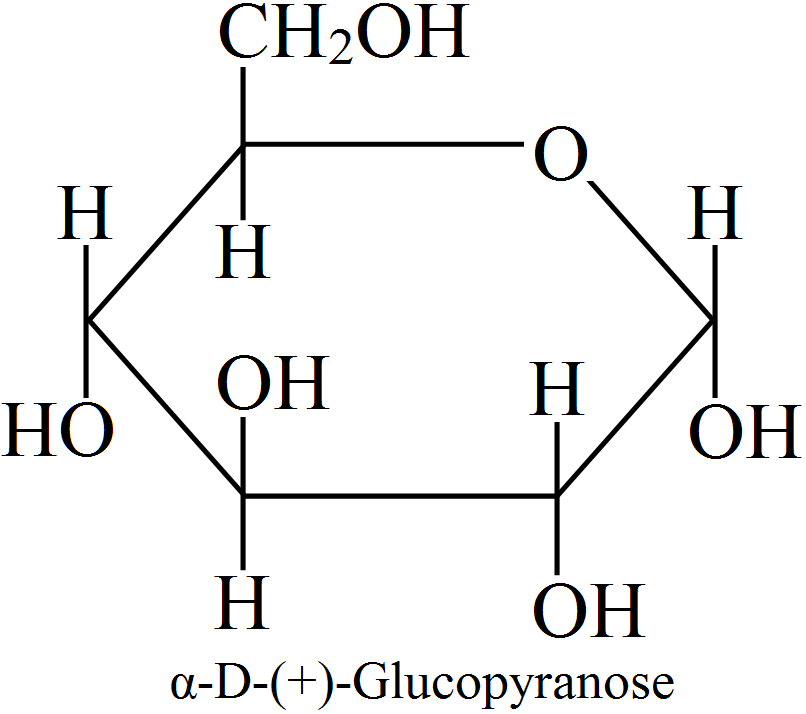
  2. Draw the Haworth structure of a-D-(+)-Glucopyranose.
  3. What is the significance of D and (+) here?
Answer

  1. This indicates that the aldehyde group in glucose is not free.
  2.  

  1. ‘D’ gives the configuration, i.e., the -OH group at C-5 is on the right hand side. (+) sign indicates that the isomer is dextrorotatory.

Need a full question paper?

Generate a complete, print-ready paper with questions like this in minutes — across 16+ boards, with answer keys.

Start Generating Free

Similar questions

Derive integrated rate equation for zero order reaction and also explain how the rate constant can be determine with help of graph.
A solution of KMnO4 on reduction yields either a colourless solution or a brown precipitate or a green solution depending on pH of the solution. What different stages of the reduction do these represent and how are they carried out?
Explain the following:
  1. Solution of chloroform and acetone is an example of maximum boiling azeotrope.
  2. A doctor advised a person suffering from high blood pressure to take less quantity of common salt.
Define isomerism and tell its types.
  1. The cell in which the following reaction occurs:

2 Fe3+ (aq) + 2 I- (aq) $\longrightarrow$ 2 Fe2+ (aq) + I2(s)

has $\text{E}^0_{\text{cell}}$ = 0·236 V at 298 K. Calculate the standard Gibbs energy of the cell reaction. (Given : 1 F = 96,500 C mol-1)

  1. How many electrons flow through a metallic wire if a current of 0·5 A is passed for 2 hours? (Given : 1 F = 96,500 C mol-1)
If 200 mol of $H _2$ (at NTP) and 0.60 g of Cu are obtained by passing electric current in the solution of acidified water and $CuSO _4$ respectively in two electrolytic cell connected in series, then what will be the equivalent weight of Cu ?
E° values of Mn, Ni and Zn are more negative than expected.
  1. Out of (CH3)3C–Br and (CH3)3C–I, which one is more reactive towards SN1 and why?
  2. Write the product formed when p-nitrochlorobenzene is heated with aqueous NaOH at 443K followed by acidification.
  3. Why dextro and laevo–rotatory isomers of Butan-2-ol are difficult to separate by fractional distillation?
Using Raoult’s law explain how the total vapour pressure over the solution is related to mole fraction of components in the following solutions.
NaCl(s) and H2O(l)
Give reactions taking place at the two electrodes if these are made up of Ag.