Question
Determine, by drawing graphs, whether the following system of linear equations has a unique solution or not:
2y = 4x - 6, 2x = y + 3.

Answer

The given equations are,
2y = 4x - 6 ........(i)
2x = y + 3 ..........(ii)
From (i), $\text{y}=\frac{4\text{x}-6}{2}\ .....(\text{iii})$
When x = 0, y = -3
x = 1, y = -1
x = 2, y = 1
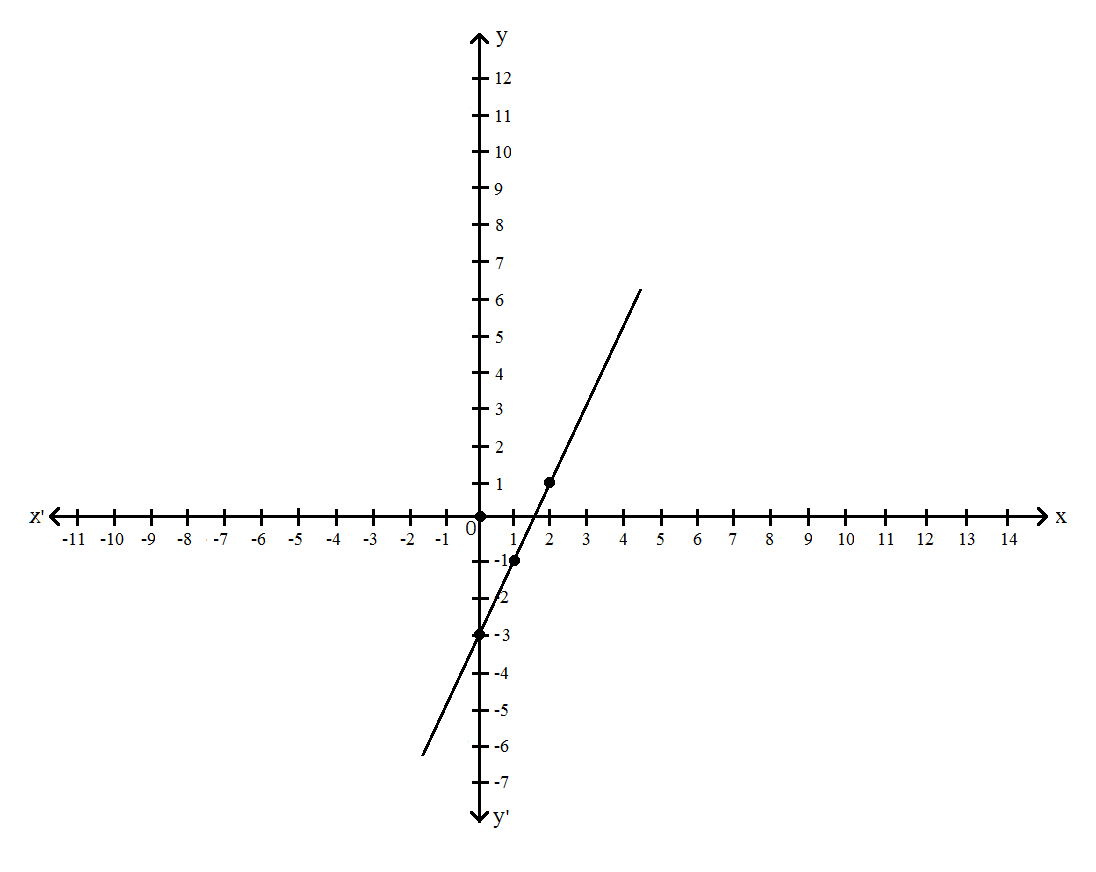
P lot these points A(0, -3), B(1, -1) and C(2, 1) on graph paper and join then,
From (ii), y = 2x - 3 ......(iv)
When x = 0, y = -3
x = 1, y = -1
x = 2, y = 1
P lot these points P(0, -3), Q(1, -1) and R(2, 1) on graph paper and join then.

We observe that points A, B, C and P, Q, R on same line so the syatem of equation has infinitaly many solutions.

Need a full question paper?

Generate a complete, print-ready paper with questions like this in minutes — across 16+ boards, with answer keys.
Start Generating Free

Similar questions

Solve the following systems of equations:
x + y = 5xy,
3x + 2y = 13xy, $\text{x}\neq0,\text{y}\neq0.$
All integers from $1$ to $500$ which are multiplies of $2$ or $5$.
Red queens and black jacks are removed from a pack of 52 playing cards. A card is drawn at random from the remaining cards, after reshuffling them. Find the probability that the card drawn is:
  1. A king.
  2. Of red colour.
  3. A face card.
  4. A queen.
In an A.P. sum of three consecutive terms is 27 and their product is 504 find the terms? (Assume that three consecutive terms in A.P. are a – d, a, a + d.)
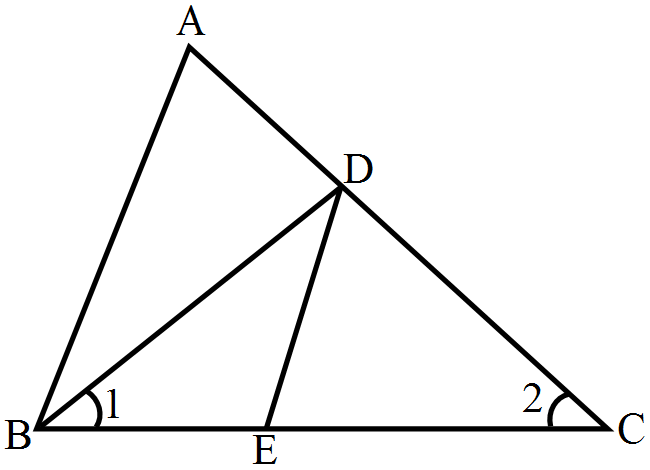
In the given figure, $\angle1=\angle2$ and $\frac{\text{AC}}{\text{BD}}=\frac{\text{CB}}{\text{CE}}$
Prove that $\triangle\text{ACB}\sim\triangle\text{DCE}.$
D is the mid-point of side BC of a $\triangle\text{ABC}.$ AD is bisected at the point E and BE produced cuts AC at the point X. Prove that BE = EX = 3 : 1.
If cos $A =\frac{2 \sqrt{m}}{m+1}$ then Prove that cosec A = $\frac{m+1}{m-1}$
The $10^{\text {th }}$ term and the $18^{\text {th }}$ term of an A.P. are $25$ and $41$ respectively then find $38^{\text {th }}$ term of that A.P., similarly if $n^{\text {th }}$ term is $99$ . Find the value of $n$.
The weight of a bucket is 15 kg , when it is filled with water upto $\frac{3}{5}$ of its capacity. And the weight is 19 kg , if it is filled with water upto $\frac{4}{5}$ of its capacity. Find the weight of bucket, if it is completely filled with water.
A dealer sells an article for $Rs. 24$ and gains as much percent as the cost price of the article. Find the cost price of the article.