Question
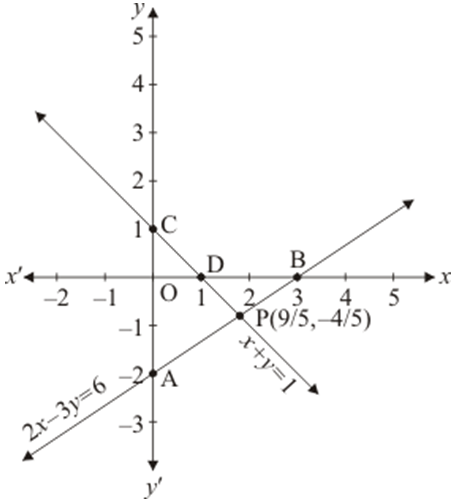
Determine, by drawing graphs, whether the following system of linear equations has a unique solution or not:
2x - 3y = 6, x + y = 1.

Answer

The given equations are
2x - 3y = 6 .......(i)
x + y = 1 ..........(ii)
Putting x = 0 in equation (i), we get,
⇒ 2 × 0 - 3y = 6
⇒ y = -2
⇒ x = 0, y = -2
Putting y = 0 in equation (i), we get,
⇒ 2x - 3 × 0 = 6
⇒ x = 3
⇒ x = 3, y = 0
Use the following table to draw the graph.
x
0
3
y
-2
0
Draw the graph by plotting the two points A(0, -2), B(3, 0) from table.

Graph of the equation.
x + y = 1 .......(ii)
Putting x = 0 in equation (ii), we get,
⇒ 0 + y = 1
⇒ y = 1
$\therefore$ x = 0, y = 1
Putting y = 0 in equation (ii), we get,
⇒ x + 0 =1
⇒ x = 1
⇒ x = 1, y = 0
Use the following table to draw the graph.
x
0
1
y
1
0
Draw the graph by plotting the two points C(0, 1), D(1, 0) from table. The two lines intersect at point $\text{P}\Big(\frac{9}{5},\frac{-4}{5}\Big).$
Hence the equations have unique solution.

Need a full question paper?

Generate a complete, print-ready paper with questions like this in minutes — across 16+ boards, with answer keys.

Start Generating Free

Similar questions

In $\triangle\text{ABC}, AD$ is median. Prove that $AB^2 + AC^2 = 2AD^2 + 2DC^2.$
Two customers Sumit and Amit are visiting a particular shop in the same week (Tuesday to Saturday). Each is equally likely to visit the shop on any day as on another day. What is the probability that both will visit the shop on: (i) the same day (ii) different days (iii) Consecutive days.
Prove the following identities:
$\frac{1-\tan^2\theta}{1+\tan^2\theta}=\big(\cos^2\theta-\sin^2\theta\big)$
Compare the modal ages of two groups of students appearing for an entrance test:
Age (in years)
16-18
18-20
20-22
22-24
24-26
Group A
50
78
46
28
23
Group B
54
89
40
25
17
Find the middle term of sequence formed by all three digit numbers which leave a remainder 3 when divided by 4. Also find sum of all numbers on both sides of the middle term.
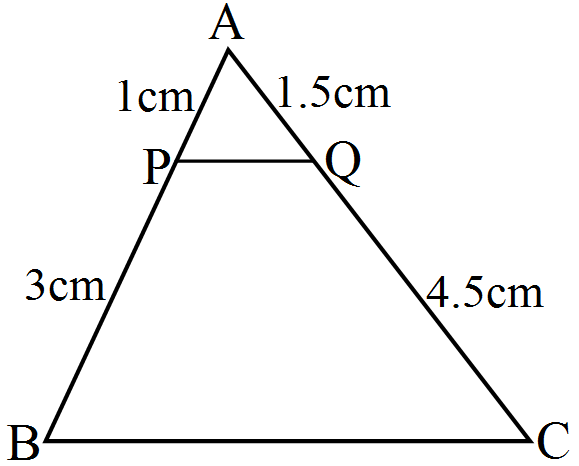
In the given figure, ABC is a triangle and PQ is a straight line meeting AB in P and AC in Q. If AP = 1cm. PB = 3cm, AQ = 1.5cm, QC = 4.5cm, Prove that area of $\triangle\text{APQ}$ is $\frac{1}{16}$ of the area of $\triangle\text{ABC}.$
The mean of the following data is 42, find the missing frequencies x and y if the sum of the frequencies is 100.
Class interval 0-10 10-20 20-30 30-40 40-50 50-60 60-70 70-80
Frequency 7 10 x 13 y 10 14 9
There are 25 trees at equal distances of 5 metres in a line with a well, the distance of the well from the nearest tree being 10 metres. A gardener water all the trees separately starting from the well and he returns to the well after watering each tree to get water for the next. Find the total distance the gardener will cover in order to eater all the trees.
The sum of the squares of two consecutive positive integers is $365$. Find the integers.
Draw the graphs of the equations 5x - y = 5 and 3x - y = 3. Determine the co-ordinates of the vertices of the triangle formed by these lines and y-axis. Calculate the area of the triangle so formed.