Question
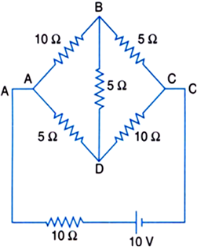
Determine the current in each branch of the network shown in Fig.:
Answer

Get the step-by-step solution for this question inside the Vidyadip app.

Get the answer in the app

Need a full question paper?

Generate a complete, print-ready paper with questions like this in minutes — across 16+ boards, with answer keys.
Start Generating Free

Similar questions

Describe the potential energy of an electric dipole in an external field in different positions also draw the diagram.
Write Einstein's photoelectric equation and explain any two observations related to the photoelectric effect.
A $20\mu\text{F}$ capacitor is joined to a battery of emf 6.0V through a resistance of $100\Omega.$ Find the charge on the capacitor 2.0ms after the connections are made.
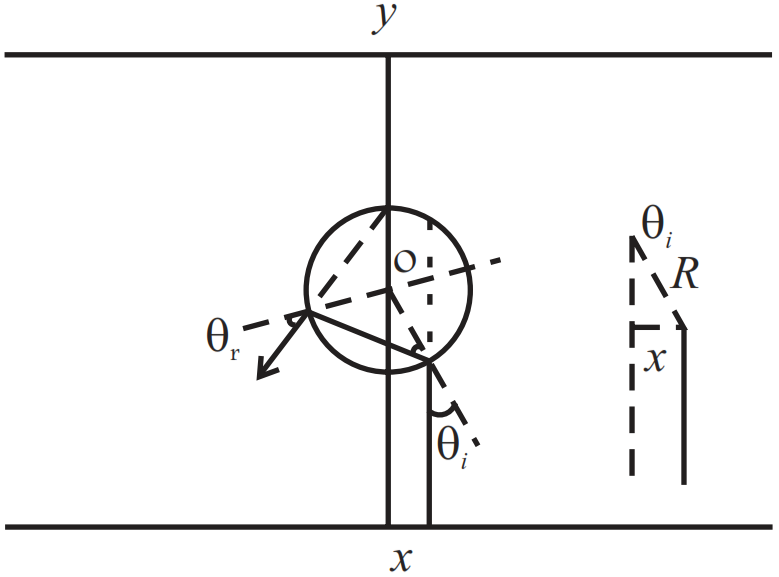
An infinitely long cylinder of radius R is made of an unusual exotic material with refractive index -1 (Fig). The cylinder is placed between two planes whose normals are along the y direction. The center of the cylinder O lies along the y-axis. A narrow laser beam is directed along the y direction from the lower plate. The laser source is at a horizontal distance x from the diameter in the y direction. Find the range of x such that light emitted from the lower plane does not reach the upper plane.

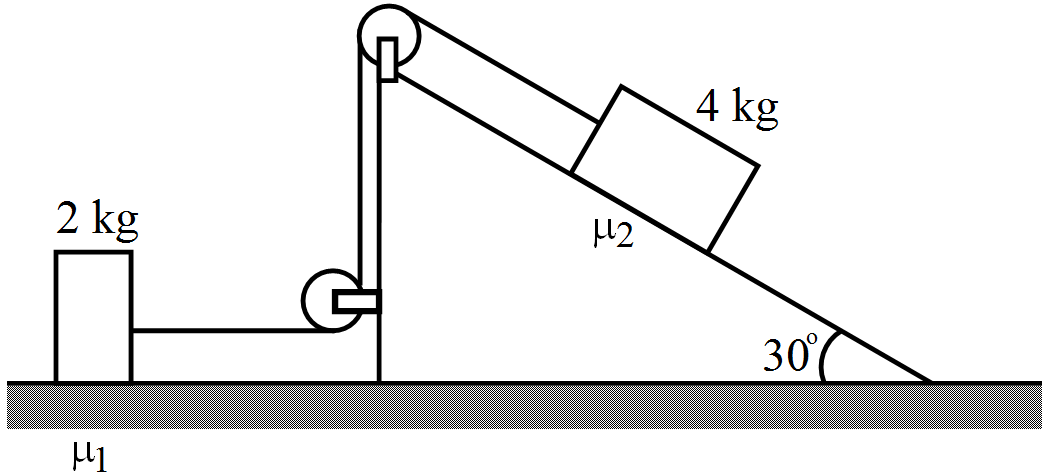
If the tension in the string in figure is 16N and the acceleration of each block is 0.5m/s2, find the friction coefficients at the two contacts with the blocks.

i. Describe, with the help of a suitable diagram, the working principle of a step-up transformer. Obtain the relation between input and output voltages in terms of the number of turns of primary and secondary windings and the currents in the input and output circuits.
i. Given the input current 15 A and the input voltage of 100 V for a step-up transformer having 90% efficiency, find the output power and the voltage in the secondary if the output current is 3 A.
Answer the following Questions.

  1. Find expressions for the force and torque on an electric dipole kept in a uniform electric field.

OR

An electric dipole is held in a uniform electric field. (i) Using suitable diagram show that it does not undergo any translatory motion, and (ii) derive an expression for torque acting on it and specify its direction.

  1. Derive an expression for the work done in rotating a dipole from the angle $\theta_0$ to $\theta_1$ in a uniform electric field E.

​​​​​​​OR

  1. Define torque acting on a dipole of dipole moment $\vec{\text{p}}$ placed in a uniform electric field $\vec{\text{E}}.$ Express it in the vector form and point out the direction along which it acts.
  2. What happens if the field is non-uniform?
  3. What would happen if the external field $\vec{\text{E}}$ is increasing (i) parallel to $\vec{\text{p}}$ and (ii) anti-parallel to $\vec{\text{p}}?$
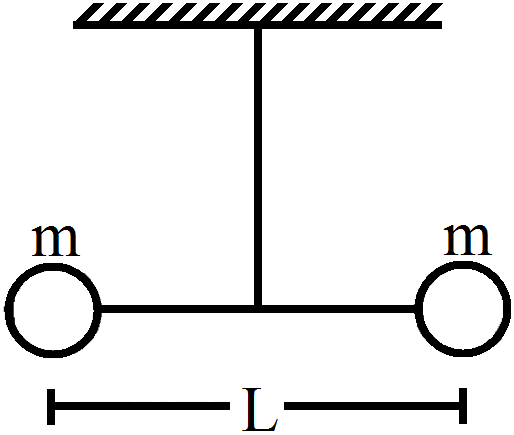
Two small balls, each of mass m are connected by a light rigid rod of length L. The system is suspended from its centre by a thin wire of torsional constant k. The rod is rotated about the wire through an angle $\theta_0$ and released. Find the tension in the rod' as the system passes through the mean position.

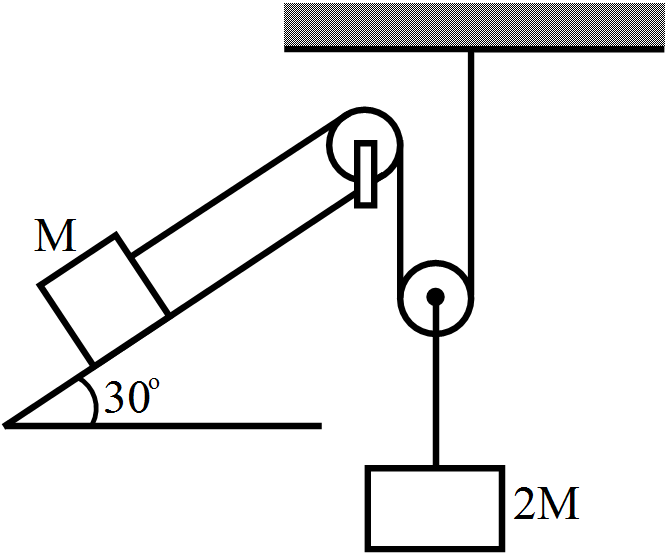
Find the acceleration of the block of mass M in the situation shown in figure. All the surfaces are frictionless and the pulleys and the string are light.

Use the mirror equation to deduce that:
  1. an object placed between f and 2f of a concave mirror produces a real image beyond 2f.
  2. a convex mirror always produces a virtual image independent of the location of the object.
  3. the virtual image produced by a convex mirror is always diminished in size and is located between the focus and the pole.