Question
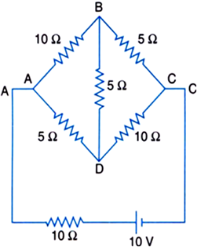
Determine the current in each branch of the network shown in Fig.:

Answer

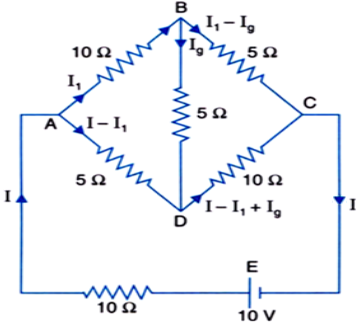
Consider the mesh ABDA, Now, Applying Kirchhoff's loop rule we get, $-10\text{I}_1-5\text{I}_\text{g}+(\text{I}-\text{I}_1)5=0$ $\Rightarrow\ \ 3\text{I}_1-\text{I}+\text{I}_\text{g}=0\ \ ...\text{(i)}$

Consider the mesh BDCB, Again, applying Kirchhoff's loop rule we get,
$-5\text{I}_\text{g}-10(1-\text{I}_\text{l}+\text{I}_\text{g})+5(\text{I}_\text{I}-\text{I}_\text{g})=0$
$\Rightarrow\ \ 3\text{I}_1-2\text{I}-4\text{I}_\text{g}=0\ \ ...\text{(ii)}$
Applying Kirchhoff's loop rule to the mesh ABCEA, $-10\text{I}_1-5(\text{I}_1-\text{I}_\text{g})-10\text{I}+10=0$$\text{or}\ \ 3\text{I}_1+2\text{I}-\text{I}_\text{g}=2\ \ ...{(\text{iii})}$
Equations (i), (ii) and (iii) are simultaneous equations. On solving these equations,
we will find the unknown values of current.
Adding (i) and (iii), we get $6\text{I}_\text{1}+\text{I}=2\ \ ...(\text{iv})$ Multiplying (i) by 4 and adding in (ii),
we get $15\text{I}_\text{1}-6\text{I}0=0\ \ ...\text{(v)}$
Solving equations (iv) and (v), we get $\text{I}_1=\frac{4}{17}\text{A}=0.235\ \text{A}$
So, current in branch AB is 0.235 A.
Putting the value of $I_1$ in equation (v) and simplifying,
we get Total current, $\text{I}=\frac{10}{17}=0.588\ \text{A}$
Putting the values of I and $ I_1$ in equation (iii) and simplifying,
we get $\text{I}_\text{g}=\frac{2}{17}\text{A}=-0.118\ \text{A}$
The negative sign indicates that the direction of current is opposite to that shown in Fig.
above. So, current in branch BD is -0.118 A.
Current in branch BC is $(\text{I}_1-\text{I}_\text{g})\text{i.e}.,\frac{4}{17}-\Big(-\frac{2}{17}\Big)$
$\text{i.e.,}\frac{6}{17}\ \text{or}\ 0.353\ \text{A}.$
Current in branch AD is $(I - I_1)$
$\text{i.e.,}\Big(\frac{10}{17}-\frac{4}{17}\Big)\text{A i.e.,}\ \frac{6}{17}\text{A or}\ 0.353\ \text{A}$
Current in branch DC is $(I_1 - I_1 + I_g)$
$\text{i.e.,}\frac{6}{17}+\Big(-\frac{2}{17}\Big)​​\text{A or}\ \frac{4}{17}\text{A or}\ 0.235\ \text{A}.$

Need a full question paper?

Generate a complete, print-ready paper with questions like this in minutes — across 16+ boards, with answer keys.
Start Generating Free

Similar questions

  1. An electron moves along a circle of radius 1m in a perpendicular magnetic field of strength 0.50T. What would be its speed? Is it reasonable?
  2. If a proton moves along a circle of the same radius in the same magnetic field, what would be its speed?
Coulomb's law for electrostatic force between two point charges and Newton's law for gravitational force between two stationary point masses, both have inverse-square dependence on the distance between the charges and masses respectively. (a) Compare the strength of these forces by determining the ratio of their magnitudes (i) for an electron and a proton and (ii) for two protons. (b) Estimate the accelerations of electron and proton due to the electrical force of their mutual attraction when they are $1 \mathring A\left(=10^{-10} m \right)$ apart? $\left(m_p=1.67 \times\right.$ $\left.10^{-27} kg , m_e=9.11 \times 10^{-31} kg \right)$
Assuming an electron is confined to a 1nm wide region , find the uncertainty in momentum using Heisenberg Uncertainty principle (Ref Eq 11.12 of NCERT Textbook). You can assume the uncertainty in position $\Delta\text{x}$ as 1nm. Assuming $\text{p}\Box\Delta\text{p}$, find the energy of the electron in electron volts.
$i.$ Draw a ray diagram showing the image formation by a compound microscope. Hence obtain the expression for total magnification when the image is formed at least distance of distinct vision.
$iii.$ A compound microscope consists of an objective lens of focal length $2.0 \ cm$ and an eyepiece of focal length $6.0 \ cm$. If they are separated by a distance of $24 \ cm$, find the total magnification when the image is formed at infinity.
A particle is moving at a constant speed V from a large distance towards a concave mirror of radius R along its principal axis. Find the speed of the image formed by the mirror as a function of the distance x of the particle from the mirror.
A thin prism of angle $6.0^\circ,\omega=0.07$ and $\mu_\text{y}=1.50$ is combined with another thin prism having $\omega=0.08$ and $\mu_\text{y}=1.60.$ The combination produces no deviation in the mean ray.
  1. Find the angle of the second prism.
  2. Find the net angular dispersion produced by the combination when a beam of white light passes through it.
  3. If the prisms are similarly directed, what will be the deviation in the mean ray
  4. Find the angular dispersion in the situation described in (c).
When a dielectric is placed in an electric field, it gets polarized. The electric field in a polarized material is less than the applied field. When a paramagnetic substance is kept in a magnetic field, the field in the substance is more than the applied field. Explain the reason of this opposite behaviour.
Define the capacitance of a capacitor. Obtain an expression for the capacitance of a parallel plate capacitor. And explain on what factors the does capacitance depend?
A given coin has a mass of 3.0 g. Calculate the nuclear energy that would be required to separate all the neutrons and protons from each other. For simplicity assume that the coin is entirely made of $^{63}_{29}\text{Cu}$ atoms (of mass 62.92960 u).
The 2.0Ω resistor shown in the figure is dipped into a calorimeter containing water. The heat capacity of the calorimeter together with water is $2000JK^{-1}.$
  1. If the circuit is active for 15 minutes, what would be the rise in the temperature of the water?
  2. Suppose the 6.0Ω resistor gets burnt. What would be the rise in the temperature of the water in the next 15 minutes?