Question
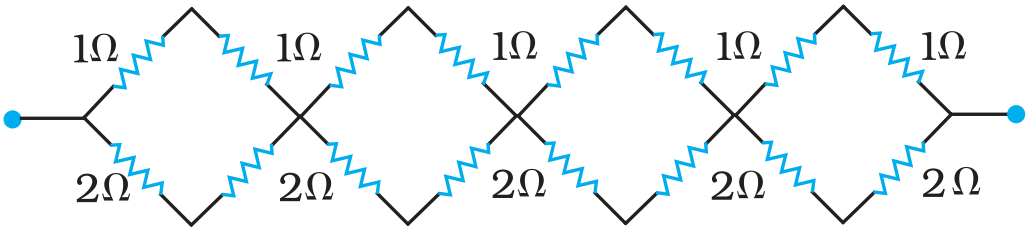
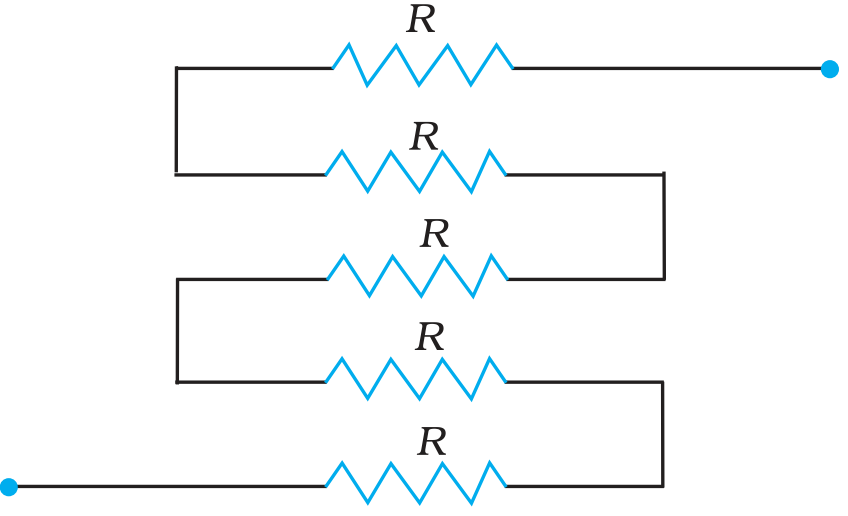
Determine the equivalent resistance of networks shown in Fig.

Answer

  1. It can be observed from the given circuit that in the first small loop, two resistors of resistance $1\ \Omega$ each are connected in series.
Hence, their equivalent resistance $=(1+1)=2\ \Omega$
It can also be observed that two resistors of resistance $2\ \Omega$ each are connected in series.
Hence, their equivalent resistance $=(2+2)=4\ \Omega$
Therefore, the circuit can be redrawn as

It can be observed that $2\ \Omega\ \text{and}\ 4\ \Omega$ resistors are connected in parallel in all the four loops. Hence, equivalent resistance (R') of each loop is given by,
$\text{R}=\frac{2\times4}{2+4}=\frac{8}{6}=\frac{4}{3}\Omega$
The circuit reduces to,

All the four resistors are connected in series.
Hence, equivalent resistance of the given circuit is $\frac{4}{3}\times4=\frac{16}{3}\Omega$
  1. It can be observed from the given circuit that five resistors of resistance R each are connected in series.
Hence, equivalent resistance of the circuit = R + R + R + R + R
= 5 R

Need a full question paper?

Generate a complete, print-ready paper with questions like this in minutes — across 16+ boards, with answer keys.
Start Generating Free

Similar questions

Use Moseley's law with b = 1 to find the frequency of the $\text{K}_\alpha$ X-ray of La(Z = 57) if the frequency of the $\text{K}_\alpha$ X-ray of Cu(Z = 29) is known to be $1.88 \times 10^{18}Hz.$
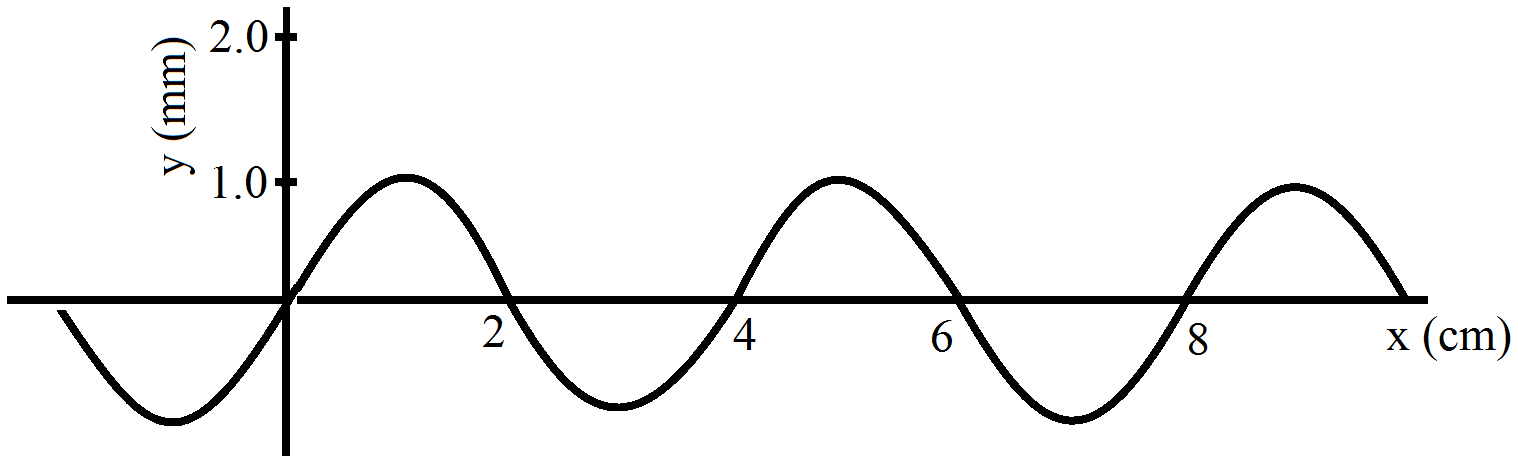
Figure shows a plot of the transverse displacements of the particles of a string at t = 0 through which a travelling wave is passing in the positive x-direction. The wave speed is 20cm/s. Find-
  1. The amplitude
  2. The wavelength
  3. The wave number
  4. The frequency of the wave.
A spherical tungsten piece of radius 1.0cm is suspended in an evacuated chamber maintained at 300K. The piece is maintained at 1000K by heating it electrically. Find the rate at which the electrical energy must be supplied. The emissivity of tungsten is 0.30 and the Stefan constant $\sigma$ is $6.0 \times 10^{-8}Wm^{-2}K^{-4}.$
A proton projected in a magnetic field of 0.020T travels along a helical path of radius 5.0cm and pitch 20cm. Find the components of the velocity of the proton along and perpendicular to the magnetic field. Take the mass of the proton $= 1.6 \times 10^{-27}kg$
Find the change in the internal energy of 2 kg of water as it is heated from $0^{\circ} \mathrm{C}$ to $4^{\circ} \mathrm{C}$. The specific heat capacity of water is $4200 \mathrm{Jgg}^{-1} \mathrm{~K}^{-1}$ and its densities at $0^{\circ} \mathrm{C}$ and $4^{\circ} \mathrm{C}$ are $999.9 \mathrm{kgm}^{-3}$ and $1000 \mathrm{kgm}^{-3}$ respectively. Atmospheric pressure $=10^{-6} \mathrm{~Pa}$.
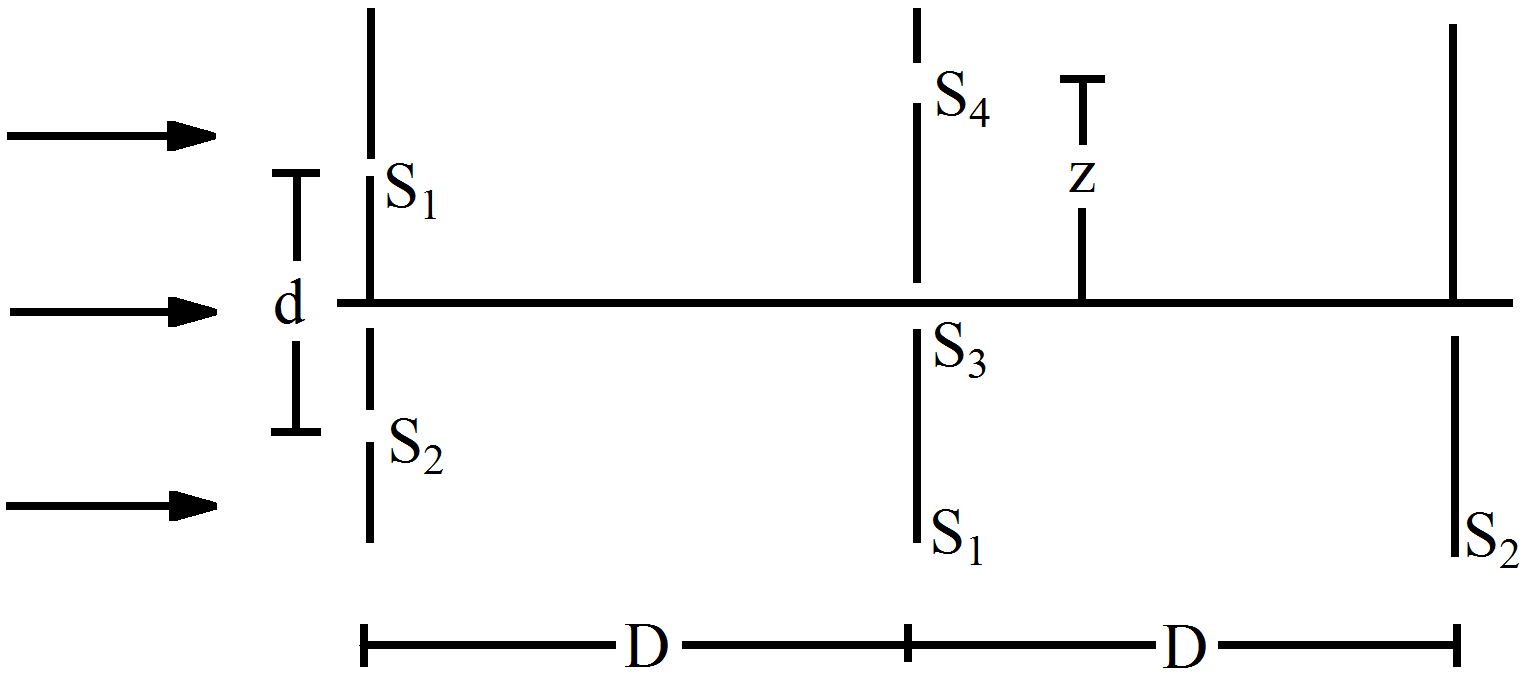
Consider the situation shown in figure (17-E6). The two slits $S_1$ and $S_2 $ p laced symmetrically around the central line are illuminated by a monochromatic light of wavelength $\lambda$. The separation between the slits is d . The light transmitted by the slits falls on a screen $E_1$ placed at a distance $D$ from the slits. The slit $\mathrm{S}_3$ is at the central line and the slit $S_4$ is at a distance $z$ from $S_3$. Another screen $\sum_2$ is placed a further distance $D$ away from $\sum_1$. Find the ratio of the maximum to minimum intensity observed on $\sum_2$, if $z$ is equal to,
  1. $\text{z}=\frac{\lambda\text{D}}{2\text{d}}$
  2. $\frac{\lambda\text{D}}{\text{d}}$
  3. $\frac{\lambda\text{D}}{4\text{d}}$
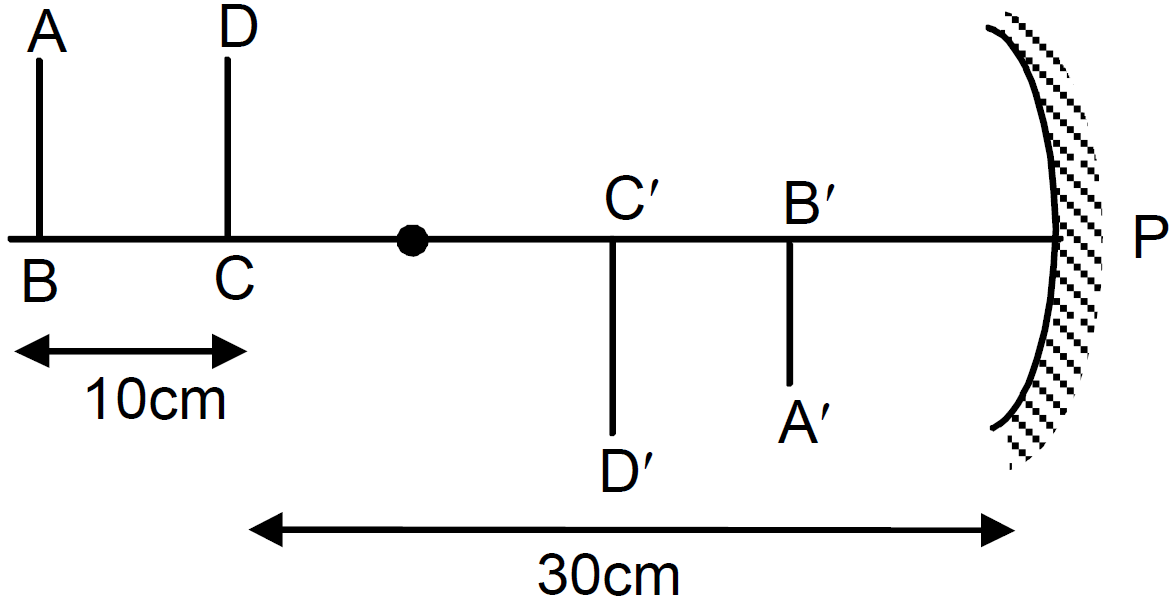
A U-shaped wire is placed before a concave mirror having radius of curvature 20cm. Find the total length of the image.
A compound microscope has a magnifying power of 100 when the image is formed at infinity. The objective has a focal length of 0.5cm and the tube length is 6.5cm. Find the focal length of the eyepiece.
Classically, an electron can be in any orbit around the nucleus of an atom. Then what determines the typical atomic size? Why is an atom not, say, thousand times bigger than its typical size? The question had greatly puzzled Bohr before he arrived at his famous model of the atom that you have learnt in the text. To simulate what he might well have done before his discovery, let us play as follows with the basic constants of nature and see if we can get a quantity with the dimensions of length that is roughly equal to the known size of an atom $(~ 10^{–10}m).$
  1. Construct a quantity with the dimensions of length from the fundamental constants e, $m_e$, and c. Determine its numerical value.
  2. You will find that the length obtained in (a) is many orders of magnitude smaller than the atomic dimensions. Further, it involves c. But energies of atoms are mostly in non-relativistic domain where c is not expected to play any role. This is what may have suggested Bohr to discard c and look for ‘something else’ to get the right atomic size. Now, the Planck’s constant h had already made its appearance elsewhere. Bohr’s great insight lay in recognising that h, me, and e will yield the right atomic size. Construct a quantity with the dimension of length from h, $m_e,$ and e and confirm that its numerical value has indeed the correct order of magnitude.
An electron makes $3 \times 10^5$ revolutions per second in a circle of radius 0.5 angstrom. Find the magnetic field B at the centre of the circle.