Question
Determine the volume contraction of a solid copper cube, $10cm$ on an edge, when subjected to a hydraulic pressure of $7.0 \times 10^6 Pa$.

Answer

Given: L = 10cm = 0.1m K = bulk modulus of $Cu = 140 \times 10^9Pa P = 7 \times 10^6 Pa \Delta\text{V}=$ Volume contraction of solid copper cube = ? $\therefore V = L^3 = (0.1)^3 = 0.001m^3$. Using formula, $\text{K}-\frac{\text{P}}{\big(\frac{\Delta\text{V}}{\text{V}}\big)}$ We get $\Delta\text{V}=-\frac{\text{PV}}{\text{K}}=\frac{7\times10^6\times0.001}{140\times10^9}\text{m}^3$
$=-\frac{1}{20}\times10^{-6}\text{m}^3$
$=-0.05\times10^{-6}\text{m}^3$
$=-5\times10^{-2}\text{cm}^3$ Here negative sign shows volume contraction.

Need a full question paper?

Generate a complete, print-ready paper with questions like this in minutes — across 16+ boards, with answer keys.
Start Generating Free

Similar questions

 A highway motorist travels at a constant velocity of $45 km / h ^{-1}$ in a $30 km / h ^{-1}$ zone. A motor-cyclist police officer has been watching from behind a bill board and at the same moment the speeding motorist passes the bill board, the police officer accelerates uniformly from rest to overtake her. If the acceleration of the police officer is $10 km / h ^{-2}$, how long does he take to reach the motorist?
A stone dropped from the top of a tower of height 300 m splashes into the water of a pond near the base of the tower. When is the splash heard at the top given that the speed of sound in air is $340 m s ^{-1} ?\left(g=9.8 m s ^{-2}\right)$
A bullet fired at an angle of 30° with the horizontal hits the ground 3km away. By adjusting its angle of projection, can one hope to hit a target 5km away? Assume the muzzle speed to be fixed, and neglect air resistance. (Take $g = 10ms^{-2}$)
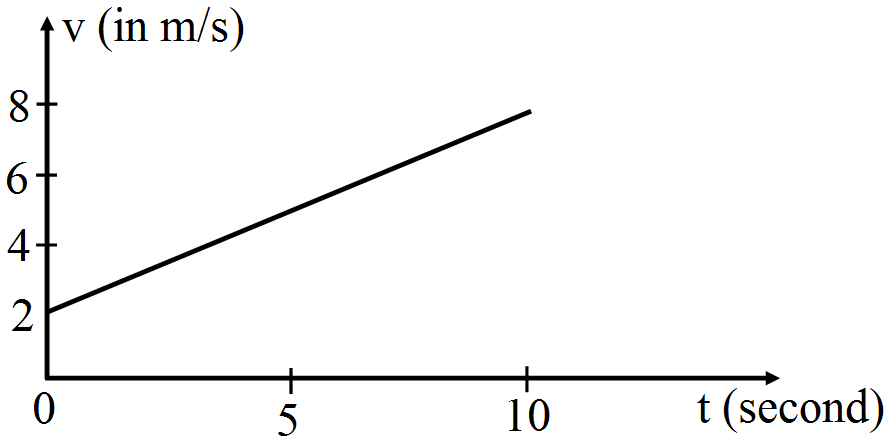
Figure shows the graph of velocity versus time for a particle going along the $X-$axis. Find:
  1. The acceleration.
  2. The distance travelled in $0$ to $10s.$
  3. The displacement in $0$ to $10s$.
A ship is moving at a speed of $56km/ h^{-1}$. One second later, it is moving at a speed of $58km/ h^{-1}$. What is its acceleration?
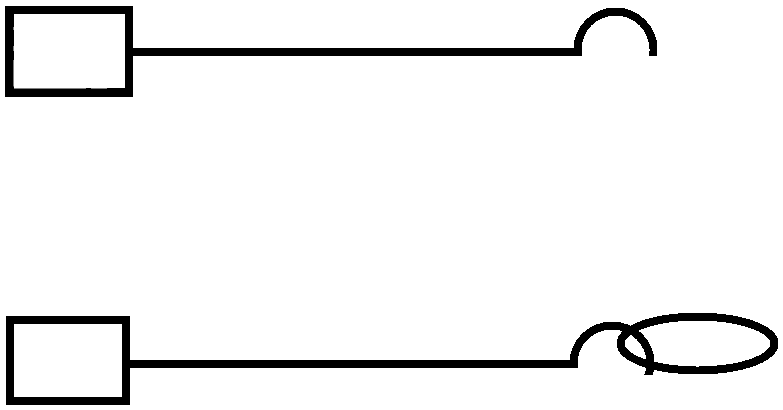
Figure shows a light rod of length l rigidly attached to a small heavy block at one end and a hook at the other end. The system is released from rest with the rod in a horizontal position. There is a fixed smooth ring at a depth h below the initial position of the hook and the hook gets into the ring as it reaches there. What should be the minimum value of h so that the block moves in a complete circle about the ring?
Solve the previous problem if the paperweight is inverted at its place so that the spherical surface touches the paper.
Prove for an adiabatic process:
  1. $\text{TV}^{\gamma-1}=\text{constant}.$
  2. $\text{P}^{1-\gamma}\text{T}^\gamma=\text{constant.}$
A body is moved along a closed loop. Is the work done in moving the body necessarily zero? If not, state the condition under which work done over a closed path is always zero.
A solid sphere of mass 2kg is rolling down an inclined plane of angle of inclination 30°. What is the agent which supplies the external torque for the rotational motion of the sphere? Calculate its value. Also find the value of the torque if radius of sphere is 40cm.