Question
A body is moved along a closed loop. Is the work done in moving the body necessarily zero? If not, state the condition under which work done over a closed path is always zero.

Answer

Work done by a body moving along closed loop can be zero if only conservative force acting on the body during motion. Work done by a body moving along a loop is not zero if any non-conservative force, i.e., frictional, electrostatic, magnetic force are acting on body.

Need a full question paper?

Generate a complete, print-ready paper with questions like this in minutes — across 16+ boards, with answer keys.
Start Generating Free

Similar questions

A body starting from rest accelerates uniformly at the rate of $10 cms ^{-2}$ and retards uniform $y$ at the rate of 20 $cms ^{-2}$. Find the least time in Which it can complete the journey of 5 km if the maximum velocity attained by the body is $72 kmh ^{-1}$.
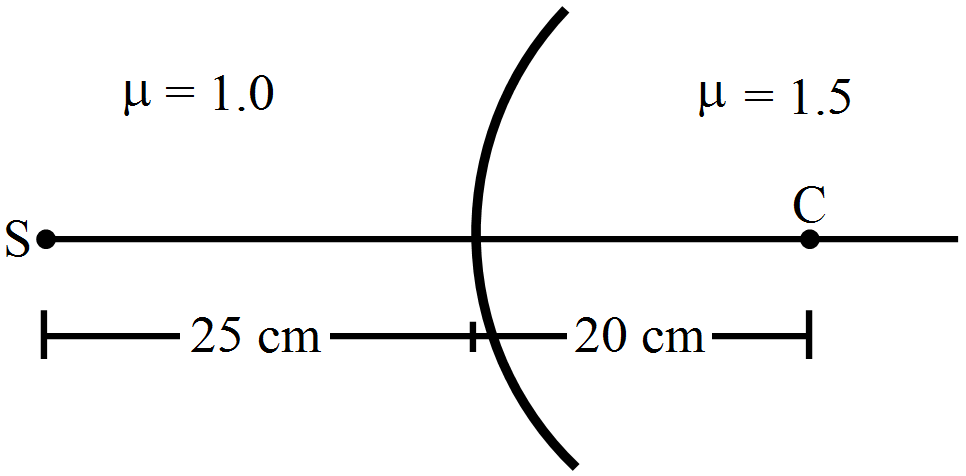
Locate the image formed by refraction in the situation shown in figure.
A charged capacitor of capacitance C is discharged through a resistance R. A radioactive sample decays with an average-life $\tau.$ Find the value of R for which the ratio of the electrostatic field energy stored in the capacitor to the activity of the radioactive sample remains constant in time.
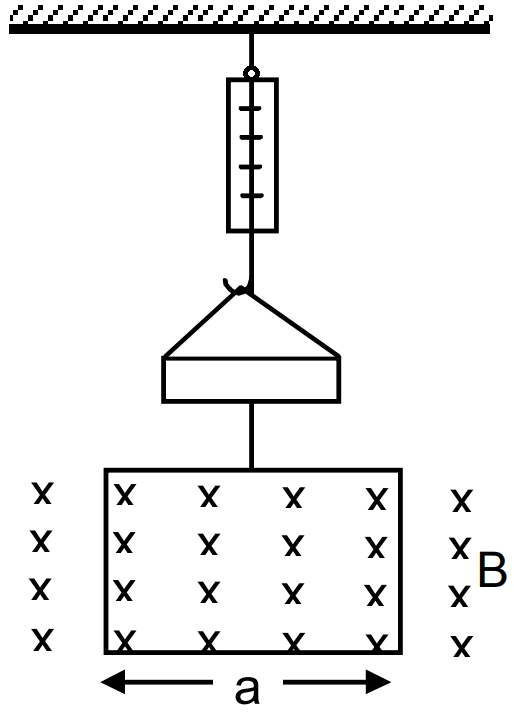
A rectangular wire loop of width a is suspended from the insulated pan of a spring balance, as shown in A current i exists in the anti-clockwise direction in the loop. A magnetic field Bexists in the lower region. Find the change in the tension of the spring if the current in the loop is reversed.
QUESIION A bat emits ultrasonic sound of frequency 1000 kHz in air. If the sound meets a water surface, what is the wavelength of (a) the reflected sound, (b) the transmitted sound? Speed of sound in air is $340 m s ^{-1}$ and in water $1486 m s ^{-1}$.
The planet Mars has two moons, phobos and Deimos.
  1. Phobos has a period $7$ hours, $39$ minutes and an orbital radius of $9.4 \times 10^3km$. Calculate the mass of mars.
  2. Assume that earth and mars move in circular orbits around the sun, with the Martian orbit being $1.52$ times the orbital radius of the earth. What is the length of the Martian year in days?
Find the angular velocity of a body rotating with an acceleration of $2 \mathrm{rev} / \mathrm{s}^2$ as it completes the $5^{\text {th }}$ revolution after the start.
What is the pressure inside a drop of mercury of radius 3.0 mm at room temperature? Surface tension of mercury at that temperature $\left(20^{\circ} \mathrm{C}\right)$ is $4.65 \times 10^{-1} \mathrm{Nm}^{-1}$. The atmospheric pressure is $1.01 \times 10^5 \mathrm{~Pa}$. Also give the excess pressure inside the drop.
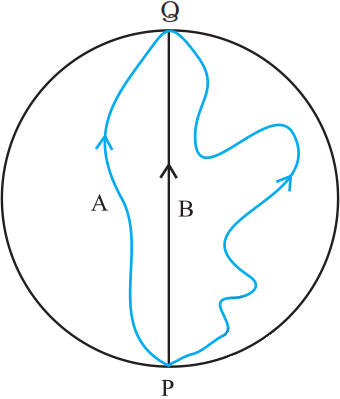
Three girls skating on a circular ice ground of radius 200m start from a point P on the edge of the ground and reach a point Q diametrically opposite to P following different paths as shown in Fig. What is the magnitude of the displacement vector for each? For which girl is this equal to the actual length of path skate?
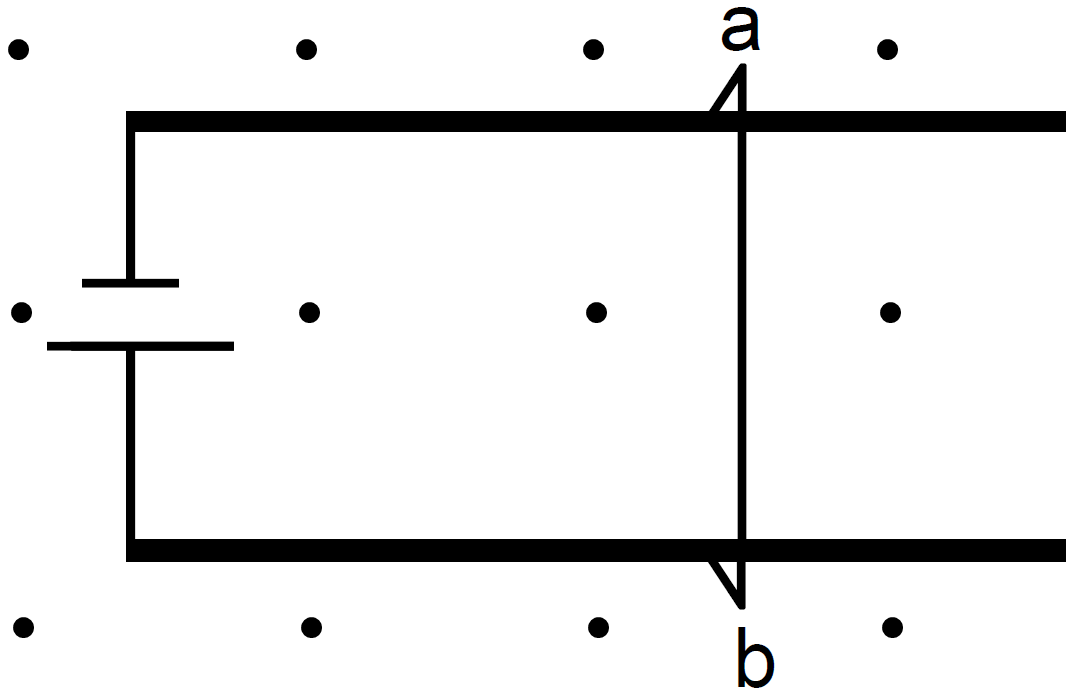
Figure shows a smooth pair of thick metallic rails connected across a battery of $\text{emf} \in$ having a negligible internal resistance. A wire $ab$ of length $l$ and resistance $r$ can slide smoothly on the rails. The entire system lies in a horizontal plane and is immersed in a uniform vertical magnetic field $B.$ At an instant $t,$ the wire is given a small velocity $u$ towards right.
  1. Find the current in it at this instant. What is the direction of the current?
  2. What is the force acting on the wire at this instant?
  3. Show that after some time the wire $ab$ will slide with a constant velocity. Find this velocity.