MCQ
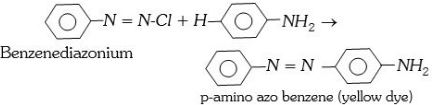
Diazo-coupling is useful to prepare some
  • Dyes
  • B
    Proteins
  • C
    Pesticides
  • D
    Vitamins

Answer

Correct option: A.
Dyes
a
(a)Diazo-coupling is useful to prepare some dyes.


Need a full question paper?

Generate a complete, print-ready paper with questions like this in minutes — across 16+ boards, with answer keys.
Start Generating Free

Similar questions

The freezing point of equimolal aqueous solution will be highest for
Maximum solubility of alcohol in water is due to
For a reaction ,$A + {B^2}\, \to \,B + {A^{ + 2}};\,\,{E^o} = 0.2955\,\,V$ Hence equilibrium constant of the reaction is at $25\,^oC$
$3$ moles of $P$ and $2$ moles of $Q$ are mixed, what will be their total vapour pressure in the solution if their partial vapour pressures are $80$ and $60$ torr respectively?
The order of the oxidation state of the phosphorus atom in $\mathrm{H}_3 \mathrm{PO}_2, \mathrm{H}_3 \mathrm{PO}_4, \mathrm{H}_3 \mathrm{PO}_3$, and $\mathrm{H}_4 \mathrm{P}_2 \mathrm{O}_6$ is
Which of the following expressions correctly represents the equivalent conductance at are the equivalent conductances infinite dilution of $Al_2(SO_4)_3 .$ Given that $\mathop {{\Lambda _{A{l^{3 + }}}}}\limits^{o\,\,\,\,\,\,\,\,\,\,\,\,\,} $ and $\mathop {{\Lambda _{SO_4^{2 - }}}}\limits^{o\,\,\,\,\,\,\,\,\,\,\,} $ are the equivalent conductances at infinite dilution of the respective ions?
In which of the following method of purification, metal is converted to its volatile compound which is decomposed to give pure metal?
$a.$ Heating with stream of carbon monoxide.
$b.$ Heating with iodine
$c.$ Liquation.
$d.$ Distillation.
Arrange these haloalkanes in correct order of density:
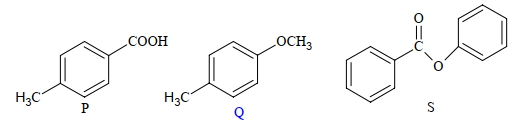
The compounds $\mathrm{P}, \mathrm{Q}$ and $\mathrm{S}$ $Image$ were separately subjected to nitration using $\mathrm{HNO}_3 / \mathrm{H}_2 \mathrm{SO}_4$ mixture. The major product formed in each case respectively, is
For the cell reaction $C{u^{2 + }}_{({C_1}aq)} + Zn(s) \Rightarrow Z{n^{2 + }}_{({C_2}aq)} + Cu(s)$ of an electrochemical cell, the change in free energy at a given temperature is a function of