MCQ
Dielectrics are _____________?
- AConducting substances.
- BNon-conducting substances.
- CSemi-conducting substances.
- DNone of the option.
Explanation:
Dielectrics are non-conducting substances.
Generate a complete, print-ready paper with questions like this in minutes — across 16+ boards, with answer keys.
If in a photoelectric experiment, the wavelength of incident radiation is reduced from 6000 Å to 4000 Å then
|
(a) Stopping potential will decrease |
|
(b) Stopping potential will increase |
|
(c) Kinetic energy of emitted electrons will decrease |
|
(d) The value of work function will decrease |
The electron in a hydrogen atom makes a transition from an excited state to the ground state. Which of the following statements is true
|
(a) Its kinetic energy increases and its potential and total energies decrease |
|
(b) Its kinetic energy decreases, potential energy increases and its total energy remains the same |
|
(c) Its kinetic and total energies decrease and its potential energy increases |
|
(d) Its kinetic, potential and total energies decreases |
The minimum wavelength of the X-rays produced by electrons accelerated through a potential difference of V volts is directly proportional to
(a) 
|
(b) 
|
(c) 1/
|
(d) 1/V |
The S.I. unit of electric flux is
|
(a) Weber |
(b) Newton per coulomb |
|
(c) Volt × metre |
(d) Joule per coulomb |
The variation of anode current in a triode corresponding to a change in grid potential at three different values of the plate potential is shown in the diagram. The mutual conductance of the triode is
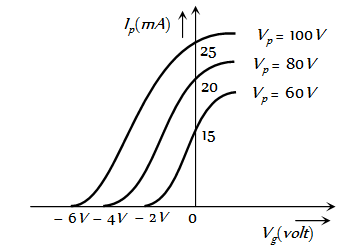
| (a) 2.5 m mho | (b) 5.0 m mho |
(c) 7.5 m mho |
(d) 10.0 m mho |
In the figure a capacitor is filled with dielectrics. The resultant capacitance is
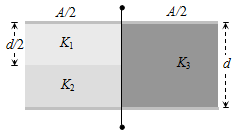
|
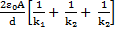
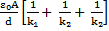
(a) |
(b) |
(c) |
(d) None of these |
Two bulbs are working in parallel order. Bulb A is brighter than bulb B. If  and
and  are their resistance respectively then
|
(a) |
(b) |
(c) |
(d) None of these |