Question
Different points in earth are at slightly different distances from the sun and hence experience different forces due to gravitation. For a rigid body, we know that if various forces act at various points in it, the resultant motion is as if a net force acts on the c.m. (centre of mass) causing translation and a net torque at the c.m. causing rotation around an axis through the c.m. For the earthsun system (approximating the earth as a uniform density sphere).
  1. The torque is zero.
  2. The torque causes the earth to spin.
  3. The rigid body result is not applicable since the earth is not even approximately a rigid body.
  4. The torque causes the earth to move around the sun.
Answer

  1. The torque is zero.

Explanation:

As the earth is revolving around the sun in a circular motion (approximately in actual the path of earth around the sun is elliptical) due to gravitational attraction. When we consider the earth-sun as a single system and we are taking earth as a sphere of uniform density. Then the gravitational force (F) will be of radial nature, i.e. angle between position vector r and force F is zero. So, torque

$|\vec{\tau}|=|\vec{\text{r}}\times\vec{\text{F}}|=\text{r F}\sin0^0=0.$

Need a full question paper?

Generate a complete, print-ready paper with questions like this in minutes — across 16+ boards, with answer keys.

Start Generating Free

Similar questions

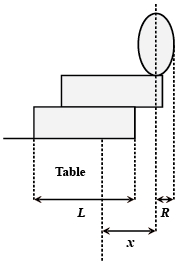
Two identical uniform rectangular blocks (with longest side $L$ ) and a solid sphere of radius $R$ are to be balanced at the edge of a heavy table such that the centre of the sphere remains at the maximum possible horizontal distance from the vertical edge of the table without toppling as indicated in the figure. If the mass of each block is $M$ and of the sphere is $M / 2$, then the maximum distance $x$ that can be achieved is
A block of mass $5\,kg$ is placed at rest on a table of rough surface. Now, if a force of $30\,N$ is applied in the direction parallel to surface of the table, the block slides through a distance of $50\,m$ in an interval of time $10\,s$. Coefficient of kinetic friction is (given, $g =10\,ms ^{-2}$)
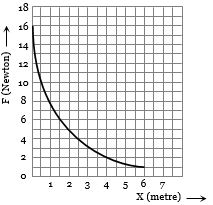
The relation between the displacement $X$  of an object produced by the application of the variable force $F$ is represented by a graph shown in the figure. If the object undergoes a displacement from $X = 0.5\,m$ to $X = 2.5\,m$ the work done will be approximately equal to .............. $J$
lfa simple pendulum has significant amplitude (up to a factor of $1/e$ of original) only in the period between $t = 0\ s$ to $t = \tau \ s$, then $\tau$ may be called the average life of the pendulum. When the spherical bob of the pendulum suffers a retardation ( due to viscous drag) proportional to its velocity with $b$ as the constant of proportionality, the average life time of the pendulum is (assuming damping is small) in seconds
Two equal masses $m$ and $m$ are hung from a balance whose scale pans differ in vertical height by $'h'$. The error in weighing in terms of density of the earth $\rho $ is
A cork is submerged in water by a spring attached to the bottom of a bowl. When the bowl is kept in an elevator moving with acceleration downwards, the length of spring
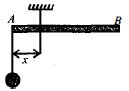
A uniform rod $AB$ is suspended from a point $X$, at a variable distance from $x$ from $A$, as shown. To make the rod horizontal, a mass $m$ is suspended from its end $A$. A set of $(m, x)$ values is recorded. The appropriate variable that give a straight line, when plotted, are
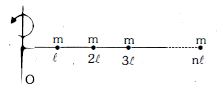
Find moment of inertia about axis $OA$
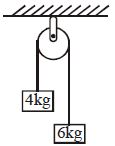
For the pulley system the kinetic energy of the $6\,kg$ block after $5\,s$ is ............ $\mathrm{J}$
A monatornic gas at a pressure $P,$ having a volume $V$ expands isothermally to a volume $2\, V$ and then adiabatically to a volume $16\, V.$ The final pressure of the gas is $(\,Take \,\gamma = 5/3)$