MCQ
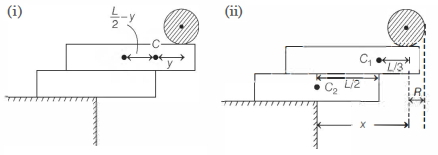
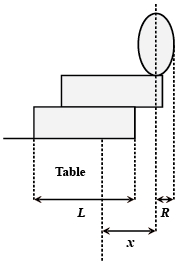
Two identical uniform rectangular blocks (with longest side $L$ ) and a solid sphere of radius $R$ are to be balanced at the edge of a heavy table such that the centre of the sphere remains at the maximum possible horizontal distance from the vertical edge of the table without toppling as indicated in the figure. If the mass of each block is $M$ and of the sphere is $M / 2$, then the maximum distance $x$ that can be achieved is
  • $8 L / 15$
  • B
    $5 L / 6$
  • C
    $(3 L / 4+R)$
  • D
    $(7 L / 15+R)$

Answer

Correct option: A.
$8 L / 15$
a
(a)

For system to be in equilibrium without toppling, following conditions must be fulfilled.

$(i)$ Centre of mass $C_1$ of sphere and upper block must lie inside the edge of lower block.

Taking origin of axes choosen at $C$, we have

$\frac{M}{2} \times y=M\left(\frac{L}{2}-y\right)$

$\Rightarrow \frac{y}{2}+y=\frac{L}{2} \text { or } y=\frac{L}{3}$

$(ii)$ Centre of mass of both of block and sphere must lie inside the edge of table.

So, again taking centre of mass $C_2$ as origin,

$\frac{3 M}{2}\left(x-\frac{L}{3}\right)+M\left(x-\frac{L}{3}-\frac{L}{2}\right)=0$

$\Rightarrow \frac{3 x}{2}-\frac{L}{2}+x-\frac{L}{3}-\frac{L}{2}=0$

$\Rightarrow \frac{5 x}{2}=\frac{4 L}{3}$

$\Rightarrow x =\frac{8 L}{15}$

Need a full question paper?

Generate a complete, print-ready paper with questions like this in minutes — across 16+ boards, with answer keys.

Start Generating Free

Similar questions

The trajectory of a projectile in a vertical plane is $y =\alpha x -\beta x ^{2},$ where $\alpha$ and $\beta$ are constants and $x \& y$ are respectively the horizontal and vertical distances of the projectile from the point of projection. The angle of projection $\theta$ and the maximum height attained $H$ are respectively given by :-
Two particles are executing S.H.M. The equation of their motion are ${y_1} = 10\sin \left( {\omega \,t + \frac{{\pi T}}{4}} \right),$ ${y_2} = 25\sin \,\left( {\omega \,t + \frac{{\sqrt 3 \pi T}}{4}} \right)$. What is the ratio of their amplitude
The velocity of projection of a body is increased by $2 \% .$ Other factors remaining unchanged, what will be the percentage change in the maximum height attained ? (in $\%$)
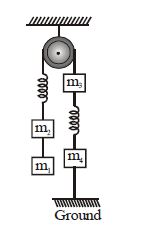
For the system shown in figure, $m_1>m_2>m_3 >m_4$ . Initially, the system is at rest in equilibrium condition. If the string joining $m_4$ and ground is cut, then just after the string is cut :

Statement $I$ $m_1$ ,$m_2$ ,$m_3$ remain stationary.

Statement $II$ The value of acceleration of all the $4$ blocks can be determined.

Statement $III$ Only $m_4$ remains stationary.

Statement $IV$ Only $m_4$ accelerates.

Statement $V$ All the four blocks remain stationary.

Now, choose the correct option.

Two identical beakers $A$ and $B$ contain equal volumes of two different liquids at $60\,^oC$ each and left to cool down. Liquid in $A$ has density of $8 \times10^2\, kg / m^3$ and specific heat of $2000\, Jkg^{-1}\,K^{-1}$ while liquid in $B$ has density of $10^3\,kgm^{-3}$ and specific heat of $4000\,JKg^{-1}\,K^{-1}$ . Which of the following best describes their temperature versus time graph schematically? (assume the emissivity of both the beakers to be the same)
$Newton/metr{e^{\rm{2}}}$ is the unit of
The weight of man in a lift moving with same acceleration upwards is $608\,N$ , while the weight of the same man in the life moving down wards with the same acceleration is $368\,N$ . His normal weight is ............ $N$
A string of length $1\,\,m$ and linear mass density $0.01\,\,kgm^{-1}$ is stretched to a tension of $100\,\,N.$ When both ends of the string are fixed, the three lowest frequencies for standing wave are $f_1, f_2$ and $f_3$. When only one end of the string is fixed, the three lowest frequencies for standing wave are $n_1, n_2$ and $n_3$. Then
As the mass number A increases, the binding energy per nucleon in a nucleus:
  1. Increases.
  2. Decreases.
  3. Remains the same.
  4. Varies in a way that depends on the actual value of A.
A manometer connected to a closed tap reads $4.5 \times {10^5}$ pascal. When the tap is opened the reading of the manometer falls to $4 \times {10^5}$ pascal. Then the velocity of flow of water is ........  $m{s^{ - 1}}$