Question
Differentiate between average and instantaneous velocity.

Answer

Average velocity: Average velocity is the displacement divided by the time interval in which the displacement occurs.
$\vec{\text{v}}_{\text{av}}=\frac{\Delta\vec{\text{x}}}{\Delta\text{t}}$
Instantaneous velocity: Instantaneous velocity is defined as the limit of the average velocity as the time interval $\Delta\text{t}$ becomes infinitesimally small.
$\vec{\text{v}}=\lim\limits_{\Delta\text{t} \rightarrow 0}\frac{\Delta\vec{\text{x}}}{\Delta\text{t}}=\frac{\text{dx}}{\text{dt}}$

Need a full question paper?

Generate a complete, print-ready paper with questions like this in minutes — across 16+ boards, with answer keys.
Start Generating Free

Similar questions

The density p of a piece of metal of a mass m and volume V is given by the formula = $\frac{\text{M}}{\text{V}}.,$
 If $\text{m} = 375.32  \pm0.01\text{g},$ and $\text{V} = 136.41\pm  0.01\text{cm}^3$ Find % error in $\rho$
A spherical shell made of plastic, contains a charge Q distributed uniformly over its surface. What is the electric field inside the shell? If the shell is hammered to deshape it without altering the charge, will the field inside be changed? What happens if the shell is made of a metal?
The speed of sound in air is 332m/s. Is it advisable to define the length 1m as the distance travelled by sound in $\frac{1}{332}\text{s}$?
A wave pulse is travelling on a string of linear mass density 1.0g/cm under a tension of 1kg wt. Calculate time taken by the pulse to travel a distance of 50cm on the string. Take g = 10m/s2.
For an oscillating pendulum, establish the relation, $\frac{\text{d}^2\theta}{\text{dr}^2}+\omega^2=\theta=0,$ Where $\omega^2=\frac{\text{g}}{\text{l}}$ and $\theta$ is small angular displacement.
Find the angular velocity of a body rotating with an acceleration of 2 rev/s2 as it completes the 5th revolution after the start.
Two bodies make an elastic head-on collision on a smooth horizontal table kept in a car. Do you expect a change in the result if the car is accelerated on a horizontal road because of the noninertial character of the frame? Does the equation "Velocity of separation = Velocity of approach" remain valid in an accelerating car? Does the equation "Final momentum = Initial momentum" remain valid in the accelerating car?
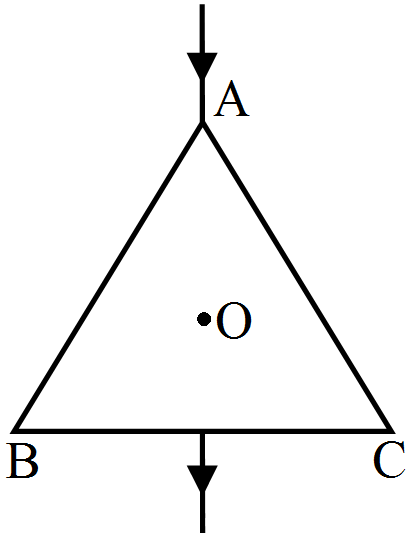
The. wire ABC shown in figure forms an equilateral triangle. Find the magnetic field B at the centre O of the triangle assuming the wire to be uniform.

Estimate the average mass density of a sodium atom assuming its size to be about $2.5 \mathring{\text{A}}.$ (Use the known values of Avogadro’s number and the atomic mass of sodium). Compare it with the mass density of sodium in its crystalline phase: 970kg m–3. Are the two densities of the same order of magnitude? If so, why?
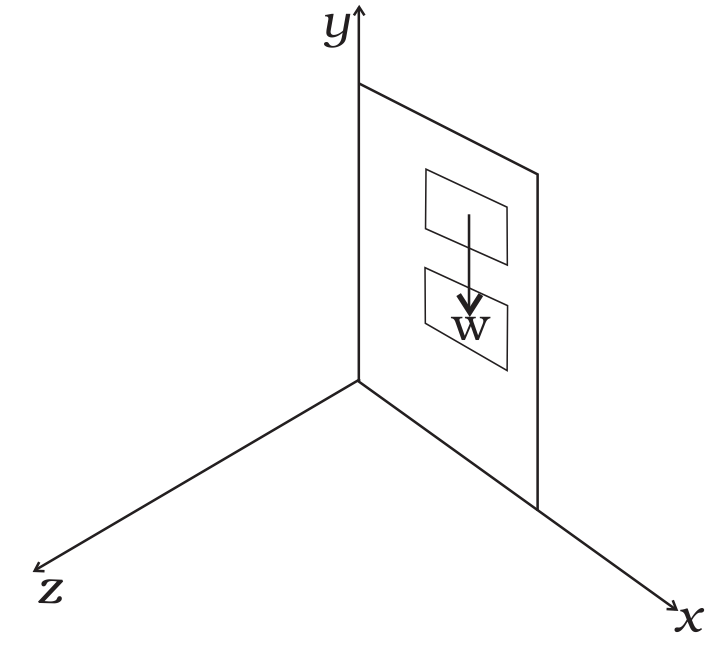
A door is hinged at one end and is free to rotate about a vertical axis. Does its weight cause any torque about this axis? Give reason for your answer.