Question
Differentiate between census survey and sample survey.

Answer

Differences between census survey and sample survey are:
S. No.
Basis
Census Survey
Sample Survey
1.
Coverage
The whole universe is taken for collection of data in census survey.
Only representative sample is taken for collection of data in sample survey.
2.
Suitability
This method is suitable when the area under investigation is relatively small.
This method is suitable when the area under investigation is large.
3.
Accuracy
Since, all items are studied under census survey, highest degree of accuracy is possible.
Since only representative samples are studied under sample survey, it is less accurate.
4.
Time
Census survey is very time consuming as all items are studied.
Sample survey is less time consuming as only samples are studied.
5.
Nature of Items
Census survey is suitable when items in the universe have diverse characteristics.
Sample survey is suitable when items in the universe are homogeneous.
 

Need a full question paper?

Generate a complete, print-ready paper with questions like this in minutes — across 16+ boards, with answer keys.

Start Generating Free

Similar questions

The size of land holdings of 380 families in a village is given below. Find the median size of land holdings.
Size of Land Holdings (in acres)
Less than
100
100-200
200-300
300-400
400 and above
Number of families
40
89
148
64
39
 
Give three mathematical properties of Arithmetic Mean. Describe any one by taking hypothetical data.

From the following table prepare demand schedule for household B, given demand schedule of household A, C and market demand schedule.

Price (₹)Household A (Units)Household B (Units)Household C (Units)Market Demand (Units)
76-1126
68-1636
512-2251
417-3071
324-4298
Differentiate between Simple table and complex table with examples.
Direction Read the following case study and answer questions (i) to (v). on the basis of the same. Mr. Viaan’s is head of human resources in ABC Limited. His job is to see if his company’s employees are being paid relatively equally based on their responsibilities. He needs to review all employee records floor by floor. The third-floor manager, supervisor, casual labourers to go first. Mr. Viaan surveyed the salaries of all the third-floor staff and finds the following monthly salaries as ₹ 5,000, ₹ 4,200, ₹ 3,000, ₹ 4,200, ₹ 8,000, ₹ 10,000 and ₹ 9,000.
  1. Mean wage of ABC Limited will be equal to .......
  1. ₹ 5,000
  2. ₹ 6,200
  3. ₹ 6,500
  4. Can't be determined
  1. What is the median of the given data?
  1. ₹ 3,000
  2. ₹ 4,200
  3. ₹ 5,000
  4. Can't be determined
  1. What will be the value of mode?
  1. ₹ 3,000
  2. ₹ 4,200
  3. ₹ 5,000
  4. Can't be determined
  1. If the monthly salary of each staff is increased by:
  1. ₹ 6,200
  2. ₹ 6,700
  3. ₹ 7,200
  4. Can't be determined
  1. What will be the new median if each employee gets a boost of:
  1. ₹ 5000
  2. ₹ 5,500
  3. ₹ 6,000
  4. Can't be determined
Find the standard deviation from the following data:
Marks: $0-10$ $10-20$ $20-30$ $30-40$ $40-50$
No. of Students: $10$ $15$ $10$ $10$ $5$
Direction Read the following case study and answer questions 1 to 5 on the basis of the same.
Collection of data is the first step in a statistical analysis. Data can be collected either from primary source or secondary source. Primary data is original as it is being collected for the first time. After collecting the data, next step is to organise the data as raw data cannot be used for further statistical analysis. There are various methods of classification of data based upon the nature of quantitative data.
  1. Time series graphs are presented on the basis of general characteristics of a data. Choose from the options below.
  1. True
  2. False
  3. Partially true
  4. Incomplete statement
  1. Classification of data based on time period is known as ......... classification.
  1. Chronological
  2. Temporal
  3. Spatial
  4. Both (a) and (b)
  1. Data are grouped with reference to the attributes is referred to as ... classification.
  1. Qualitative
  2. Quantitative
  3. Both (a) and (b)
  4. Neither (a) nor (b)
  1. In which of the following method of frequency distribution, the upper limit of each class is excluded from the series but equal to the lower limit of the succeeding series?
  1. Continuous exclusive frequency distribution.
  2. Continuous inclusive frequency distribution.
  3. Continuous cumulative frequency distribution.
  4. None of the above.
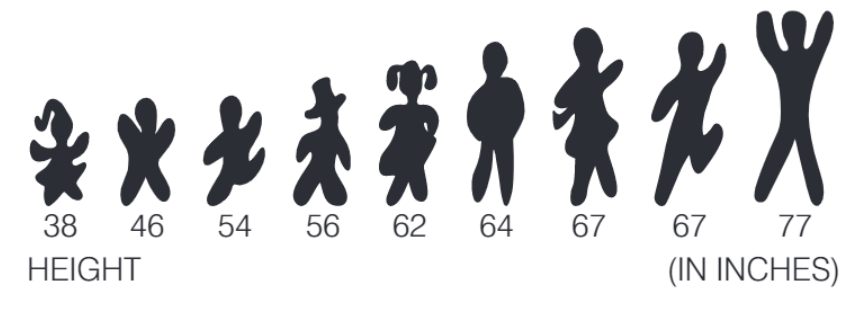
Direction Analyse the following case study graph and answer questions (i) to (v) on the basis of the same.
  1. What is the mean height of the above students?
  1. 54
  2. 59
  3. 62
  4. 67
  1. Median of a given series divides the data into ......... parts.
  1. Two
  2. Three
  3. Four
  4. None of these
  1. What will be the median value of the above figure?
  1. 52
  2. 56
  3. 62
  4. 65
  1. If we reverse the data in decreasing order, value of median will be:
  1. 52
  2. 55
  3. 64
  4. None of the above
  1. What will be the mode value in the above series?
  1. 54
  2. 59
  3. 67
  4. Can't be determined
The percentage marks obtained by $100$ students of a class are given below. Calculate the first and third quartiles.
Marks: 30-35 35-40 40-45 45-50 50-55 55-60 60-65
No. of Students: 14 16 18 23 18 8 3
From the following data, calculate coefficient of quartile deviation.
Wages less than: 10 20 30 40 50 60 70
No. of Workers: 5 8 15 20 30 33 35