Question
Differentiate between globular and fibrous proteins.
| Fibrous protein | Globular protein | |
| 1. | It is a fibre-like structure formed by the polypeptide chain. These proteins are held together by strong hydrogen and disulphide bonds. | The polypeptide chain in this protein is folded around itself, giving rise to a spherical Structure. |
| 2. | It is usually insoluble in water, but soluble in strong acids and bases. | It is usually soluble in water, acids, bases and salts. |
| 3. | They have comparatively stronger intermolecular forces of attraction. | They have weak intermolecular hydrogen bonding. |
| 4. | Example: Collagen, fibroin, myosin, hair, skin,silk, wool, etc. | Egg, albumin, casein of milk, insulin. |
Generate a complete, print-ready paper with questions like this in minutes — across 16+ boards, with answer keys.
Match the structures of compounds given in Column I with the classes of compounds given in Column II.
| Column I | Column II | ||
| (i) | $\text{CH}_3-\text{CH}-\text{CH}_3\\ \ \ \ \ \ \ \ \ \ \ \ \ \ |\\ \ \ \ \ \ \ \ \ \ \ \ \ \text{X}$ | (a) | Aryl halide |
| (ii) | $\text{CH}_2==\text{CH}-\text{CH}_2-\text{X}$ | (b) | Alkyl halide |
| (iii) | 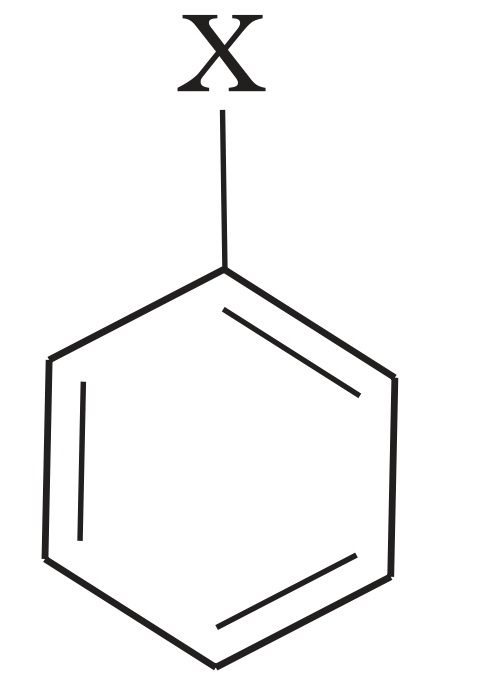 | (c) | Vinyl halide |
| (iv) | $\text{CH}_2==\text{CH}-\text{X}$ | (d) | Allyl halide |