Question
Differentiate between globular and fibrous proteins.

Answer

Difference between globular protein and fibrous protein:
 
Fibrous protein
Globular protein
1.
It is a fibre-like structure formed by the polypeptide chain. These proteins are held together by strong hydrogen and disulphide bonds.
The polypeptide chain in this protein is folded around itself, giving rise to a spherical Structure.
2.
It is usually insoluble in water, but soluble in strong acids and bases.
It is usually soluble in water, acids, bases and salts.
3.
They have comparatively stronger intermolecular forces of attraction.
They have weak intermolecular hydrogen bonding.
4.
Example: Collagen, fibroin, myosin, hair, skin,silk, wool, etc.
Egg, albumin, casein of milk, insulin.

Need a full question paper?

Generate a complete, print-ready paper with questions like this in minutes — across 16+ boards, with answer keys.

Start Generating Free

Similar questions

Identify the compounds A, B and C in the following reaction.
$\text{CH}_3-\text{Br}\xrightarrow{\text{Mg}/\text{ether}}\text{(A)}\xrightarrow[(\text{ii})\text{Water}]{(\text{i})\text{CO}_2}\text{(B)}\xrightarrow[\triangle]{\text{CH}_3\text{OH/}\text{H}^+}\text{(C)}$
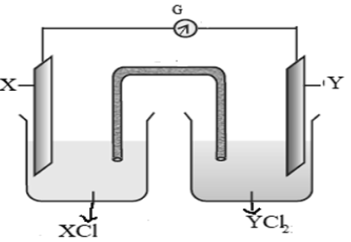
Observe the following cell and answer the questions that follow:
Image
a. Represent the cell shown in the figure.
b. Name the carriers of the current in the salt bridge
c. Write the reaction taking place at the anode.
Compare the general characteristics of the first series of the transition metals with those of the second and third series metals in the respective vertical columns. Give special emphasis on the following points:
Oxidation states
Image
In the above reaction sequence, write the chemical formula and IUPAC name of X and Y.
For the reaction:
2A + B → A2B
The rate = k[A][B]2 with k = 2.0 × 10–6 mol–2 L2 s–1. Calculate the initial rate of the reaction when [A] = 0.1 mol L–1, [B] = 0.2 mol L–1. Calculate the rate of reaction after [A] is reduced to 0.06 mol L–1.
In the reaction $2 A( g )+ B ( g ) \rightleftharpoons 2 C ( g )$, what will be the effect on the reaction rate if the volume of the vessel is increased to its initial volume and what will be the change in order of the reaction due to the change in volume?
Write the equations of the following changes :
(i) $C _2 H _5 I$ to $C H _3 C H _2 C O O H$
(ii) $C H _3 Cl$ to $C H _3 C O N H _2$
(iii) $CH _3- CH _2- Cl$ to $CH _3- CH _2- CH _2- NH _2$
(iv) $CH _3 Cl$ to $CH _3 CHO$
Explain reverse osmosis for purification of water.
How would you determine the standard electrode potential of the system Mg2+|Mg?
Explain the reaction of alcohols with hydrogen halides. ### Short note: Lucas test