Question
Differentiate between:
Keystone species and endangered species.

Answer

S. No.
Keystone species
Endangered species
(i)
It is a species of lower abundance that plays vital role in sustaining the community.
It is a species of lower abundance that may or may not have a vital role in sustaining the community.
(ii)
The species is not threatened, e.g., Ficus.
The species is at high risk of extinction in near future, e.g., Red Panda.

Need a full question paper?

Generate a complete, print-ready paper with questions like this in minutes — across 16+ boards, with answer keys.
Start Generating Free

Similar questions

  1. Give the scientific name of the soil bacterium which produces crystal (Cry) proteins.
  2. How are these proteins useful in agriculture?
  3. What do the differently written terms ‘Cry’ and ‘cry’ represent respectively?
There are many animals that have become extinct in the wild but continue to be maintained in Zoological parks.
  1. What type of biodiversity conservation is observed in this case?
  2. Explain any other two ways which help in this type of conservation.
Differentiate the following and give examples:
Active and passive immunity.
What is the significance of the slope of regression in a species-area relationship?
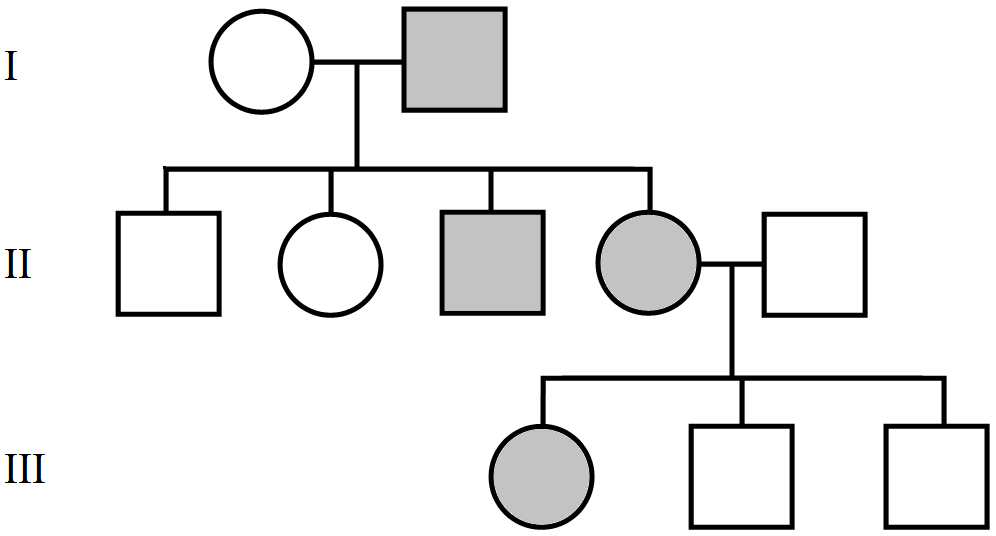
Study the given pedigree chart and answer the questions that follow.
  1. Is the trait recessive or dominant?
  2. Is the trait sex linked or autosomal?
  3. Give the genotypes of the parents shown in generation I and their III child shown in generation II and the first grandchild shown in generation III.
How is PCR technique beneficial in biotechnology? How are the developed countries related to biopiracy cases? Explain with an example.
Where is an operator' located in a prokaryotic DNA? How does an operator regulate gene expression at transcription level in a prokaryote? Explain.
Co-extinction and introduction of alien species too are responsible for the loss of biodiversity. Explain, how.
It is established that RNA is the first genetic material. Explain giving three reasons.
  1. Explain the principle on the basis of which DNA is separated by the technique of Gel electrophoresis.
  2. How is the separated DNA visualised?