Question
Differentiate between progressive and non- progressive waves.

Answer

SELF

Need a full question paper?

Generate a complete, print-ready paper with questions like this in minutes — across 16+ boards, with answer keys.
Start Generating Free

Similar questions

The current in a discharging LR circuit without the battery drops from 2.0A to 1.0A in 0.10s.
  1. Find the time constant of the circuit.
  2. If the inductance of the circuit is 4.0H, what is its resistance?
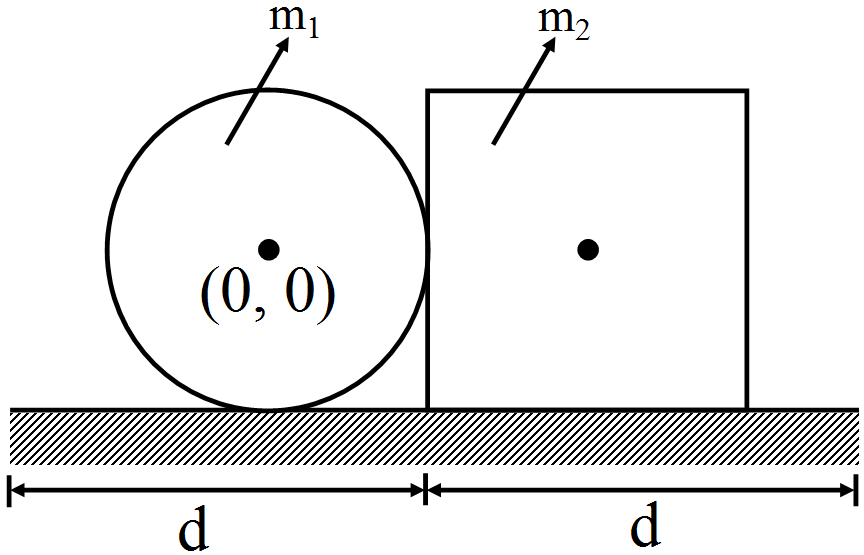
A square plate of edge d and a circular disc of diameter d are placed touching each other at the midpoint of an edge of the plate as shown in figure. Locate the centre of mass of the combination, assuming same mass per unit area for the two plates.

A rod of negligible heat cafacity has length 20cm, area of cross section 1.0cm and thermal conductivity 200Wm-1°C-1. The temperature of one end is maintained at 0°C and that of the other end is slowly and linearly varied from 0°C to 60°C in 10 minutes. Assuming no loss of heat through the sides, find the total heat transmitted through the rod in these 10 minutes.
A car moving at 108km/h finds another car in front of it going in the same direction at 72km/h. The first car sounds a horn that has a dominant frequency of 800Hz. What will be the apparent frequency heard by the driver in the front car? Speed of sound in air = 330m/s.
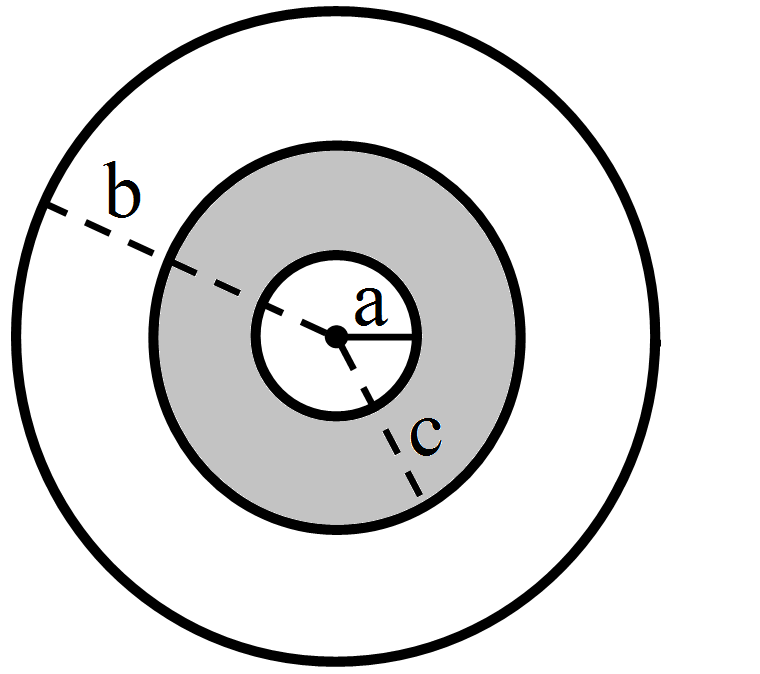
A sphercial capacitor is made of two conducting spherical shells of radii a and b. The space between the shells is filled with a dielectric of dielectric constant K up to a radius c as shown in figure. Calculate the capacitance.

A spring balance reads 10kg when a bucket of water is suspended from it. What is the reading on the spring balance when:
  1. An ice cube of mass 1.5kg is put into the bucket?
  2. An iron piece of mass 7.8kg suspended by another string is immersed with half its volume inside the water in the bucket (Relative density of iron = 7.8)?
Obtain expressions for the velocity and acceleration of the particle in simple harmonic motion and show their transformation graphs.
The electric field at a point associated with a light wave is $\text{E}=\big(100\frac{\text{v}}{\text{m}}\big)\sin[(3.0\times10^{15}\text{s}^{-1})\text{t]sin[(6.0}\times10^{15}\text{s}^{-1})\text{t}].$ If this light falls on a metal surface having a work function of 2.0eV, what will be the maximum kinetic energy of the photoelectrons?
  1. Define viscosity. Write SI units of coefficient of viscosity.
  2. Define terminal velocity. Establish an expression for it.
For the wave described in Exercise 15.8, plot the displacement (y) versus (t) graphs for x = 0, 2 and 4cm. What are the shapes of these graphs? In which aspects does the oscillatory motion in travelling wave differ from one point to another: amplitude, frequency or phase?