Question
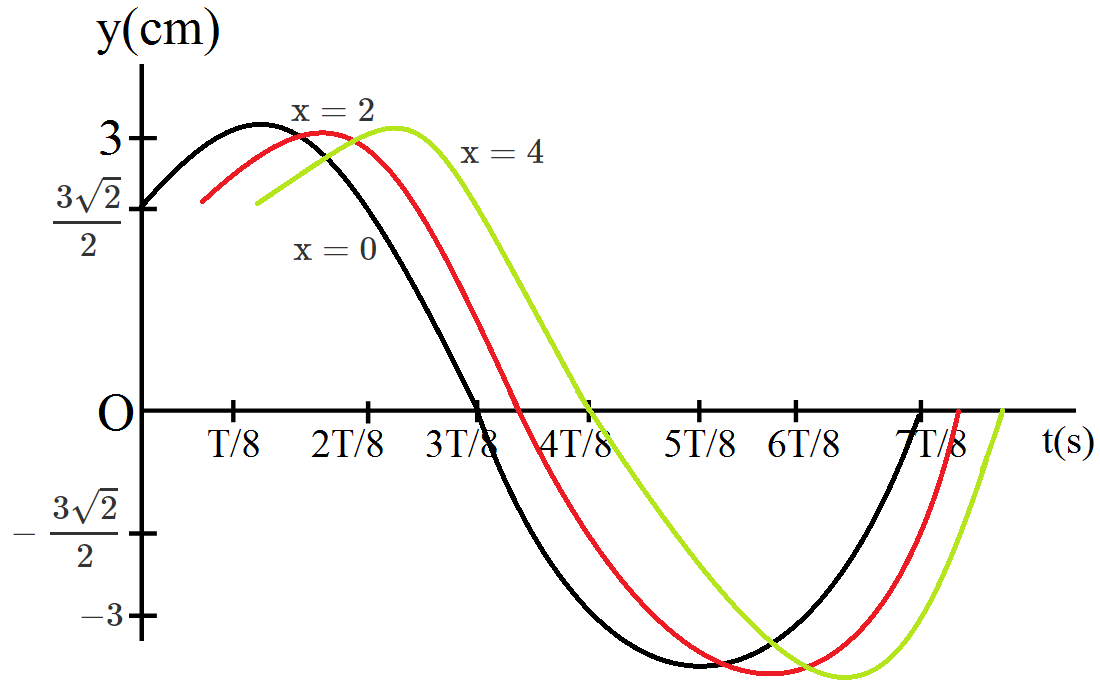
For the wave described in Exercise 15.8, plot the displacement (y) versus (t) graphs for x = 0, 2 and 4cm. What are the shapes of these graphs? In which aspects does the oscillatory motion in travelling wave differ from one point to another: amplitude, frequency or phase?
Answer

All the waves have different phases.

The given transverse harmonic wave is:

$\text{y}(\text{x, t})=3.0\sin\Big(36\text{t}+0.018\text{x}+\frac{\pi}{4}\Big)\ \dots(\text{i})$

For x = 0, the equation reduces to:

$\text{y}(\text{x, t})3.0\sin\Big(36\text{t}+\frac{\pi}{4}\Big)$

Also,

$\omega=\frac{2\pi}{\text{t}}=36\text{ rad/s}^{-1}$

$\therefore\ \text{t}=\frac{\pi}{18}\text{s}$

Now, plotting y vs. t graphs using the different values of t, as listed in the given table

t (s)

0

T/8

2T/7

3T/8

4T/8

5T/8

6T/8

7T/8

y (cm)

$\frac{3}{\sqrt{2}}$

3

$\frac{3}{\sqrt{2}}$

0

$-\frac{3}{\sqrt{2}}$

–3

$-\frac{3}{\sqrt{2}}$

0

Need a full question paper?

Generate a complete, print-ready paper with questions like this in minutes — across 16+ boards, with answer keys.

Start Generating Free

Similar questions

A body executing linear SHM has a velocity of 3cms-1 when its displacement is 4cm and a velocity of 4cms-1 when its displacement is 3cm.
  1. Find the amplitude and period of the oscillation.
  2. If the mass of the body is 50g, calculate the total energy of oscillation.
A constant force acting on a body of mass 3.0kg changes its speed from 2.0ms-1 to 3.5ms-1 in 25s. The direction of the motion of the body remains unchanged. What is the magnitude and direction of the force?
A block of mass m moving with speed v compresses a spring through a distance x before its speed is halved. What is the value of spring constant?
What are the methods of heat transmission? Describe them and explain their practical applications.
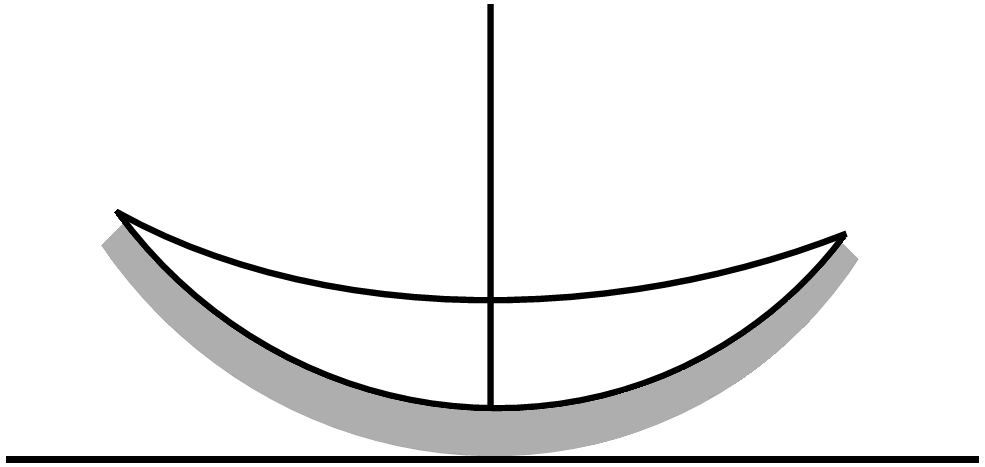
The convex surface of a thin concavo-convex lens of glass of refractive index 1.5 has a radius of curvature 20cm. The concave surface has a radius of curvature 60cm. The convex side is silvered and placed on a horizontal surface as shown in figure.

  1. Where should a pin be placed on the axis so that its image is formed at the same place?
  2. If the concave part is filled with water $\Big(\mu=\frac{4}{3}\Big),$ find the distance through which the pin should be moved so that the image of the pin again coincides with the pin.

  1. Prove the theorem of perpendicular axes.

(Hint: Square of the distance of a point (x, y) in the x - y plane from an axis through the origin and perpendicular to the plane is x+ y2).

  1. Prove the theorem of parallel axes.

(Hint: If the centre of mass of a system of n particles is chosen to be the origin $\sum\text{m}_{\text{i}}\text{r}_\text{i}=0)$ 

An object of mass 0.2kg executes simple harmonic oscillations along the x-axis with a frequency of $\frac{25}{\pi}$ Hertz. At the position x = 0.04m, the object has kinetic energy of 0.5J and potential energy of 0.4J. Find the amplitude of oscillations.
In a Young's double slit experiment, the separation between the slits = 2.0mm, the wavelength of the light = 600nm and the distance of the screen from the slits = 2.0m. If the intensity at the centre of the central maximum is 0.20W/ m2, what will be the intensity at a point 0.5cm away from this centre along the width of the fringes?
To what height a mass can go, when sent up with a velocity half of the escape velocity?
Two identical pith balls are charged by rubbing against each other. They are suspended from a horizontal rod through two strings of length 20cm each, the separation between the suspension points being 5cm. In equilibrium, the separation between the balls is 3cm. Find the mass of each ball and the tension in the strings. The charge on each ball has a magnitude 2.0 × 10-8C.