Question
Differentiate between self induction and mutual induction with examples.

Answer

Self Induction : "The phenomenon of electromagnetic induction in which on changing the main current in a coil, an induced current is developed in the same coil, is called self induction."
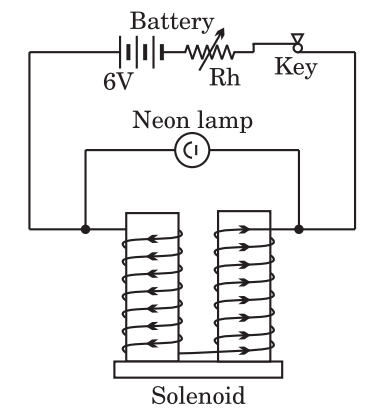
Example : A solenoid having a large number of turns of insulated wire wound over soft iron core is connected in series with a 6 V battery, a rheostat and a tapping key.
Image
A neon lamp is connected in parallel with the solenoid. First press the tapping key and adjust the current in the circuit with the help of rheostat such that the lamp glows faintly. Now, as the tapping is stopped, the lamp glows brightly for a moment and then goes out. This is due to the fact that as the circuit is broken suddenly the magnetic flux linked with the coil of solenoid suddenly vanishes i.e. the rate of change of magnetic flux linked with the solenoid i.e. self induced emf is very large. Hence a large self induced current flows in the circuit which makes the bulb glow brightly for a moment.
Mutual Induction : "It is the phenomenon of electromagnetic induction in which induced emf is produced in the another coil placed near by a coil in which the magnetic flux is changed by changing the current in this coil."
The coil in which the magnetic flux is changed by passing an electric current through it or by changing the current already passing through it or by stopping the current already flowing through it is called the primary coil while the other coil in which the induced emf is produced is called secondary coil.
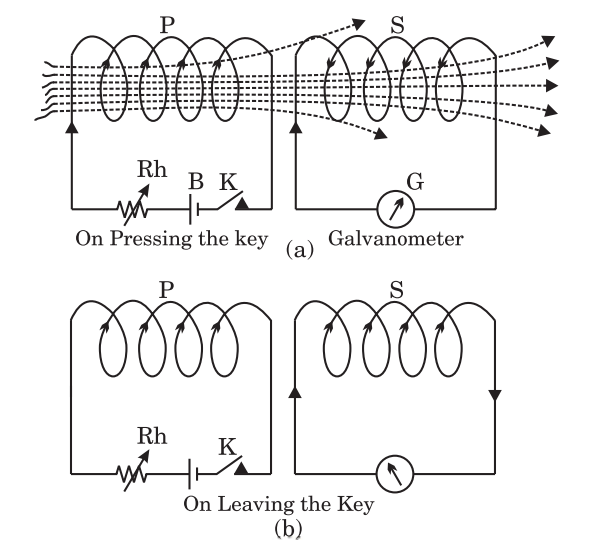
Example : P is primary coil T and S is the secondary coil placed close to each other. The coil P is connected to a battery B, tapping key K and a rheostat Rh. The coil S is connected to a galvanometer G. As the key K in primary coil P circuit is closed a momentary deflection is seen in the galvanometer connected in secondary coil circuit. This is due to the fact that when the key K is pressed, current passes in the coil P and a magnetic field is produced around it. Some of the magnetic flux lines pass through S also. Thus on pressing the key K the number of flux lines passing through S increases from 0 to a definite value. Due to this change in the number of magnetic flux lines i.e. the magnetic flux an emf is induced in the coil S and its corresponding induced current flowing through S produces momentary deflection in galvanometer G. According to Lenz's law the induced current in S opposes the change in magnetic flux in P. hence the direction of induced current in S will be opposite to the direction of main current in the primary coil P [Fig. (a)].
When the key K in primary coil is released then again a momentary deflection is seen in the galvanometer G in secondary coil but now in the direction opposite to the previous direction. This is due to the fact that on releasing the key the current flowing through P reduces from its steady value to zero and hence the flux lines passing through S become zero. Hence again an induced emf is generated in S and corresponding induced current flows through it giving deflection in G. But according to Lenz's law this current opposes the decrease in magnetic flux in P, hence it tends to maintain the flux lines in S. Therefore now the direction of induced current in S flows in the same direction of current as was in P [Fig. (b)].
Image
Similarly, when the current flowing through P is varied (increased or decreased) with the help of rheostat Rh, there is a change in magnetic flux lines around it and also linked with S. Hence so long as the current in P is changing an induced current in S flows.
All of this is due to mutual induction between P and S.

Need a full question paper?

Generate a complete, print-ready paper with questions like this in minutes — across 16+ boards, with answer keys.
Start Generating Free

Similar questions

Two samples $A$ and $B,$ of the same gas have equal volumes and pressures. The gas in sample $A$ is expanded isothermally to double its volume and the gas in $B$ is expanded adiabatically to double its volume. If the work done by the gas is the same for the two cases, show that $\gamma$ satisfies the equation $1-2^{1-\gamma}=(\gamma-1)\text{ln}2.$
A long straight cable of length $l$ is placed symmetrically along z-axis and has radius $a(< < l)$. The cable consists of a thin wire and a co $-$ axial conducting tube. An alternating current $\text{I}(\text{t})=\text{I}_0\sin(2\pi\text{vt})$ flows down the central thin wire and returns along the co $-$ axial conducting tube. The induced electric field at a distance s from the wire inside the cable is $\text{E}(\text{s},\text{t})=\mu_0\text{I}_0\text{v}\cos(2\pi\text{vt})\text{In}\Big(\frac{\text{s}}{\text{a}}\Big)\hat{\text{k}}$.
  1. Calculate the displacement current density inside the cable.
  2. Integrate the displacement current density across the crosssection of the cable to find the total displacement current $I^d.$
  3. Compare the conduction current $I_0$ with the dispalcement current $\text{I}_0^\text{d}$.
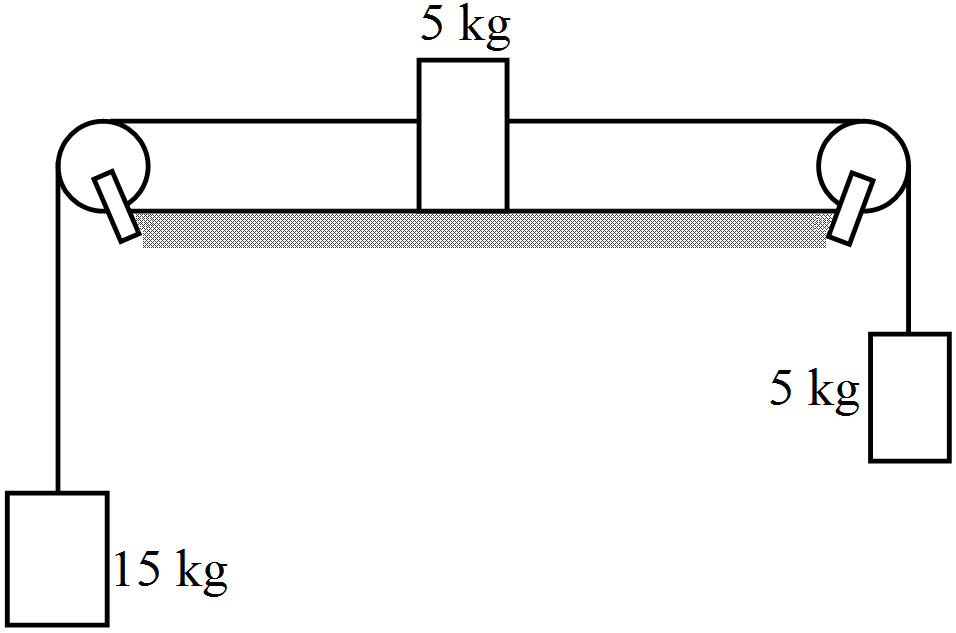
The friction coefficient between the table and the block shown in figure is 0.2. Find the tensions in the two strings.
$Fe^+$ ions are accelerated through a potential difference of $500V$ and are injected normally into a homogeneous magnetic field $B$ of strength $20.0\ mT.$ Find the radius of the circular paths followed by the isotopes with mass numbers $57$ and $58.$ Take the mass of an ion $= A (1.6 \times 10^{-27})kg,$ where $A$ is the mass number.
What is radioactivity? State the laws of $\alpha$-rays and $\beta$-rays.
What is Zener diode? Give its symbolic diagram. Draw its (I-V) characteristic curve. Explain its use as a voltage regulator ?
A $20\ cm$ long conducting rod is set into pure translation with a uniform velocity of $10\ cm/s^{-1}$ perpendicular to its length. A uniform magnetic field of magnitude $0.10T$ exists in a direction perpendicular to the plane of motion.
  1. Find the average magnetic force on the free electrons of the rod.
  2. For what electric field inside the rod, the electric force on a free elctron will balance the magnetic force? How is this electric field created?
  3. Find the motional emf between the ends of the rod.
Test if the following equations are dimensionally correct:
  1. $\text{h}=\frac{2\text{S}\cos\theta}{\rho\text{rg}}$
  2. $\text{u}=\sqrt{\frac{\text{P}}{\rho}}$
  3. $\text{V}=\frac{\pi\text{Pr}^4\text{t}}{8\eta l}$
  4. $\text{v}=\frac{1}{2\pi}\sqrt{\frac{\text{mg}l}{\text{I}}}$
where h = height, S = surface tension, $\rho$ = density, P = pressure, V = volume, $\eta$ = coefficient of viscosity, v = frequency and I = moment of inertia.
When a light ray passes from the atmosphere (a) through the combination of two mediums water (b) and glass (c), then find the relationship between the refractive indices of the three mediums.
A particle of mass $100g $ moving at an initial speed $u$ collides with another particle of same mass kept initially at rest. If the total kinetic energy becomes $0.2J$ after the collision, what could be the minimum and the maximum value of $u$.