Question
Test if the following equations are dimensionally correct:
  1. $\text{h}=\frac{2\text{S}\cos\theta}{\rho\text{rg}}$
  2. $\text{u}=\sqrt{\frac{\text{P}}{\rho}}$
  3. $\text{V}=\frac{\pi\text{Pr}^4\text{t}}{8\eta l}$
  4. $\text{v}=\frac{1}{2\pi}\sqrt{\frac{\text{mg}l}{\text{I}}}$
where h = height, S = surface tension, $\rho$ = density, P = pressure, V = volume, $\eta$ = coefficient of viscosity, v = frequency and I = moment of inertia.

Answer

  1. $\text{h}=\frac{2\text{S}\cos\theta}{\rho\text{rg}}$
$\text{LHS}=[\text{L}]$
Surface tension $=\text{S}=\frac{\text{F}}{\text{I}}=\frac{\text{MLT}^{-2}}{\text{L}}=[\text{MT}^{-2}]$
Density $=\rho=\frac{\text{M}}{\text{V}}=[\text{ML}^{-3}\text{T}^{0}]$
Radius $=\text{r}=[\text{L],g = [LT}^{-2}]$
$\text{RHS}=\frac{2\text{S}\cos\theta}{\rho\text{rg}}=\frac{[\text{MT}^{-2}]}{[\text{ML}^{-3}\text{T}^0][\text{L}][\text{LT}^{-2}]}=[\text{M}^0\text{L}^1\text{T}^0]=[\text{L}]$
$\text{LHS = RHS}$
So, the relation is correct
  1. $\text{v}=\sqrt{\frac{\text{P}}{\rho}}$ where v = velocity
$\text{LHS = Dimension of v = [LT}^{-1}]$
Dimension of $\text{p}=\frac{\text{F}}{\text{A}}=[\text{ML}^{-1}\text{T}^{-2}]$
Dimension of $\rho=\frac{\text{m}}{\text{v}} = \text{[ML}^{-2}]$
$\text{RHS}=\sqrt{\frac{\text{p}}{\rho}}=\sqrt{\frac{[\text{ML}^{-1}\text{T}^{-2}]}{[\text{ML}^{-3}]}}=[\text{L}^2\text{T}^{-2}]^{\frac{1}{2}}=[\text{LT}^{-1}]$
So, the relation is correct.
  1. $\text{V}=\frac{(\pi\text{pr}^4\text{t})}{(8\eta\text{I})}$
$\text{LHS = Dimension of V = [L}^3]$
Dimension of $\text{p}=[\text{ML}^{-1}\text{T}^{-2}],\text{r}^4=[\text{L}^4],\text{t}=[\text{T}]$
Coefficient of viscosity $=[\text{ML}^{-1}\text{T}^{-1}]$
$\text{RHS}=\frac{\pi\text{pr}^4\text{t}}{8\eta\text{I}}=\frac{[\text{ML}^{-1}\text{T}^{-2}][\text{L}^4][\text{T}]}{[\text{ML}^{-1}\text{T}^{-1}][\text{L}]}$
So, the relation is correct.
  1. $\text{v}=\frac{1}{2\pi}\sqrt{(\text{mgI}/\text{I})}$
$\text{LHS = dimension of v = [T}^{-1}]$
$\text{RHS}=\sqrt{(\text{mgI}/\text{I})}=\sqrt{\frac{[\text{M}][\text{LT}^{-2}][\text{L}]}{[\text{ML}^2]}}=[\text{T}^{-1}]$
$\text{LHS = RHS}$
So, the relation is correct.

Need a full question paper?

Generate a complete, print-ready paper with questions like this in minutes — across 16+ boards, with answer keys.

Start Generating Free

Similar questions

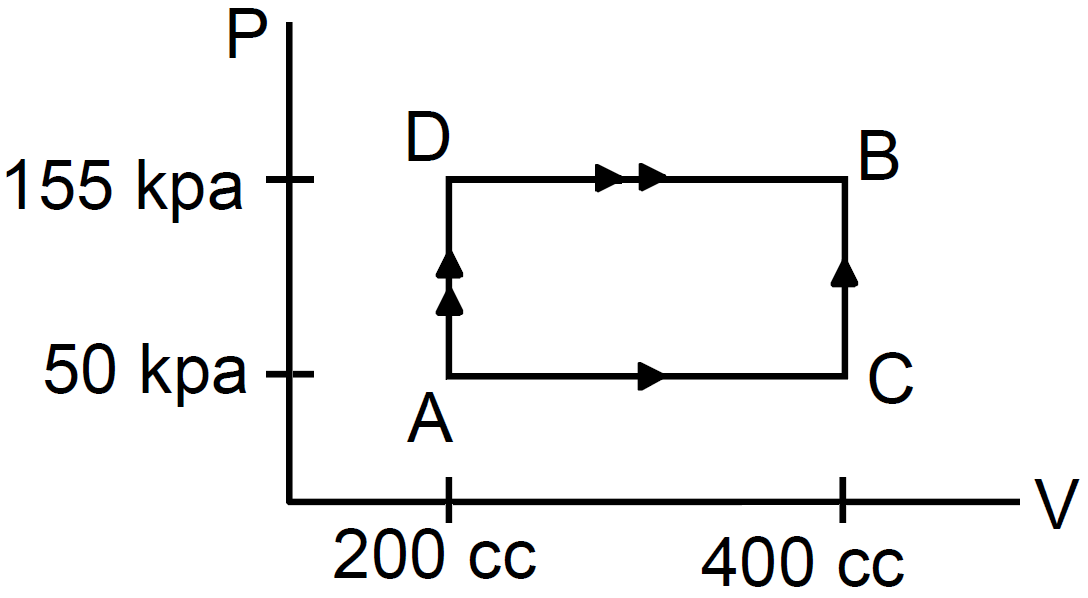
$50\ cal$ of heat should be supplied to take a system from the state $A$ to the state $B$ through the path $\text{ACB}$ as shown in figure. Find the quantity of heat to be supplied to take it from $A$ to $B$ via $\text{ADB.}$
A current of 1.0A is established in a tightly wound solenoid of radius 2cm having 1000 turns/ metre. Find the magnetic energy stored in each metre of the solenoid.
Natural water contains a small amount of tritium $\big(\text{ }^3_1\text{H}\big).$ This isotope beta-decays with a half-life of $12.5$ years. A mountaineer while climbing towards a difficult peak finds debris of some earlier unsuccessful attempt. Among other things he finds a sealed bottled of whisky. On returning, he analyses the whisky and finds that it contains only $1.5$ per cent of the $\text{}^3_1\text{H}$ radioactivity as compared to a recently purchased bottle marked $'8$ years old$'.$ Estimate the time of that unsuccessful attempt.
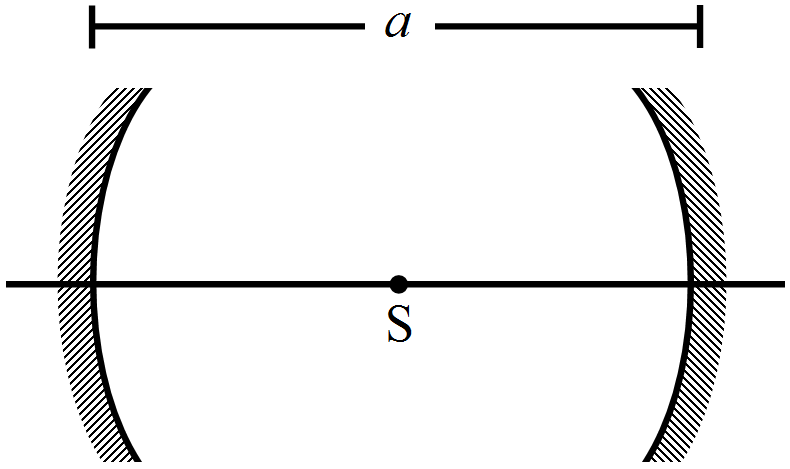
A point source S is placed midway between two converging mirrors having equal focal length f. Find the values of d for which only one image is formed.
Find the magnetic field B at the centre of a rectangular loop of length l and width b, carrying a current i.
Explain Davisson and Germer experiment to demonstrate the wave nature of electron.
Quite often, connecting wires carrying currents in opposite directions are twisted together in using electrical appliances. Explain how it avoids unwanted magnetic fields.
A rectangular loop of sides $25\ cm$ and $10\ cm$ carrying a current of $15A$ is placed with its longer side parallel to a long straight conductor $2.0\ cm$ apart carrying a current of $25A ($fig$)$. What is the net force on the loop?
A glass surface is coated by an oil film of uniform thickness $1.00 \times 10^{-4}cm.$ The index of refraction of the oil is $1.25$ and that of the glass is $1.50.$ Find the wavelengths of light in the visible region $(400\ nm - 750\ nm)$ which are completely transmitted by the oil film under normal incidence.