Question
Differentiate the following functions with respect to x:
$\Big(\text{x}+\frac{1}{\text{x}}\Big)^\text{x}+\text{x}^{\Big(1+\frac{1}{\text{x}}\Big)}$

Answer

Let $\text{y}=\Big(\text{x}+\frac{1}{\text{x}}\Big)^\text{x}+\text{x}^{\Big(1+\frac{1}{\text{x}}\Big)}$
Also, let $\Big(\text{x}+\frac{1}{\text{x}}\Big)^\text{x}$ and $\text{v}=\text{x}^{\Big(1+\frac{1}{\text{x}}\Big)}$
$\therefore\text{y}=\text{u}+\text{v}$
$\Rightarrow\frac{\text{dy}}{\text{dx}}=\frac{\text{du}}{\text{dx}}+\frac{\text{dv}}{\text{dx}}....(1)$
Then, $\text{u}=\Big(\text{x}+\frac{1}{\text{x}}\Big)^\text{x}$
$\Rightarrow\log\text{u}=\log\Big(\text{x}+\frac{1}{\text{x}}\Big)^\text{x}$
$\Rightarrow\log\text{u}=\text{x}\log\Big(\text{x}+\frac{1}{\text{x}}\Big)$
Differentiating both sides with respect to x, we obtain,
$\frac{1}{\text{u}}\cdot\frac{\text{du}}{\text{dx}}=\frac{\text{d}}{\text{dx}}(\text{x})\times\log\Big(\text{x}+\frac{1}{\text{x}}\Big)+\text{x}\times\frac{\text{d}}{\text{dx}}\Big[\log\Big(\text{x}+\frac{1}{\text{x}}\Big)\Big]$
$\frac{1}{\text{u}}\frac{\text{du}}{\text{dx}}=1\times\log\Big(\text{x}+\frac{1}{\text{x}}\Big)+\text{x}\times\frac{1}{\Big(\text{x}+\frac{1}{\text{x}}\Big)}\cdot\frac{\text{d}}{\text{dx}}\Big(\text{x}+\frac{1}{\text{x}}\Big)$
$\Rightarrow\frac{\text{du}}{\text{dx}}=\Big(\text{x}+\frac{1}{\text{x}}\Big)^\text{x}\Big[\log\Big(\text{x}+\frac{1}{\text{x}}\Big)+\frac{\text{x}^2-1}{\text{x}^2+1}\Big]$
$\Rightarrow\frac{\text{du}}{\text{dx}}=\Big(\text{x}+\frac{1}{\text{x}}\Big)^\text{x}\Big[\frac{\text{x}^2-1}{\text{x}^2+1}+\log\Big(\text{x}+\frac{1}{\text{x}}\Big)\Big]$
$\text{v}=\text{x}^{\Big(1+\frac{1}{\text{x}}\Big)}$
$\Rightarrow\log\text{v}=\log\Bigg[\text{x}^{\Big(1+\frac{1}{\text{x}}\Big)}\Bigg]$
$\Rightarrow\log\text{v}=\Big(1+\frac{1}{\text{x}}\Big)\log\text{x}....(2)$
Differentiating both sides with respect to x, we obtain
$\frac{1}{\text{v}}\cdot\frac{\text{dv}}{\text{dx}}=\Big[\frac{\text{d}}{\text{dx}}\Big(1+\frac{1}{\text{x}}\Big)\Big]\times\log\text{x}+\Big(1+\frac{1}{\text{x}}\Big)\cdot\frac{\text{d}}{\text{dx}}\log\text{x}$
$\Rightarrow\frac{1}{\text{v}}\frac{\text{dv}}{\text{dx}}=\Big(-\frac{1}{\text{x}^2}\Big)\log\text{x}+\Big(1+\frac{1}{\text{x}}\Big)\cdot\frac{1}{\text{x}}$
$\Rightarrow\frac{1}{\text{v}}\frac{\text{dv}}{\text{dx}}=-\frac{\log\text{x}}{\text{x}^2}+\frac{1}{\text{x}}+\frac{1}{\text{x}^2}$
$\Rightarrow\frac{\text{dv}}{\text{dx}}=\text{v}\Big[\frac{-\log\text{x}+\text{x}+1}{\text{x}^2}\Big]$
$\Rightarrow\frac{\text{dv}}{\text{dx}}=\text{x}^{\big(1+\frac{1}{\text{x}}\big)}\Big(\frac{\text{x}+1-\log\text{x}}{\text{x}^2}\Big) .....(3)$
Therefore, from (i), (ii) and (iii), we obtain
$\frac{\text{dy}}{\text{dx}}=\Big(\text{x}+\frac{1}{\text{x}}\Big)^\text{x}\Bigg[\frac{\text{x}^2-1}{\text{x}^2+1}+\log\Big(\text{x}+\frac{1}{\text{x}}\Big)\Bigg]+\text{x}^{\big(1+\frac{1}{\text{x}}\big)}\Big(\frac{\text{x+1}-\log\text{x}}{\text{x}^2}\Big)$

Need a full question paper?

Generate a complete, print-ready paper with questions like this in minutes — across 16+ boards, with answer keys.
Start Generating Free

Similar questions

The function $y=a \log x+b x^2+x$ has extreme values at $x=1$ and $x=2$. Find $a$ and $b$.
Solve the following differential equation:
$\text{x}^2\frac{\text{dy}}{\text{dx}}=\text{x}^2-2\text{y}^2+\text{xy}$
An airline agrees to charter planes for a group. The group needs at least 160 first class seats and at least 300 tourist class seats. The airline must use at least two of its model 314 planes which have 20 first class and 30 tourist class seats. The airline will also use some of its model 535 planes which have 20 first class seats and 60 tourist class seats. Each flight of a model 314 plane costs the company Rs 100,000 and each flight of a model 535 plane costs Rs 150,000. How many of each type of plane should be used to minimize the flight cost? Formulate this as a LPP.
If $\text{f(x)}=\begin{cases}\frac{\cos^2\text{x}-\sin^2\text{x}}{\sqrt{\text{x}^2+1}-1},&\text{x}\neq0\\\text{k},&\text{x}=0\end{cases}$ is continuous at x = 0, find k.
Evaluate the following integrals:$\int\limits^1_{-1}\log\Big(\frac{2-\text{x}}{2+\text{x}}\Big)\text{dx}$
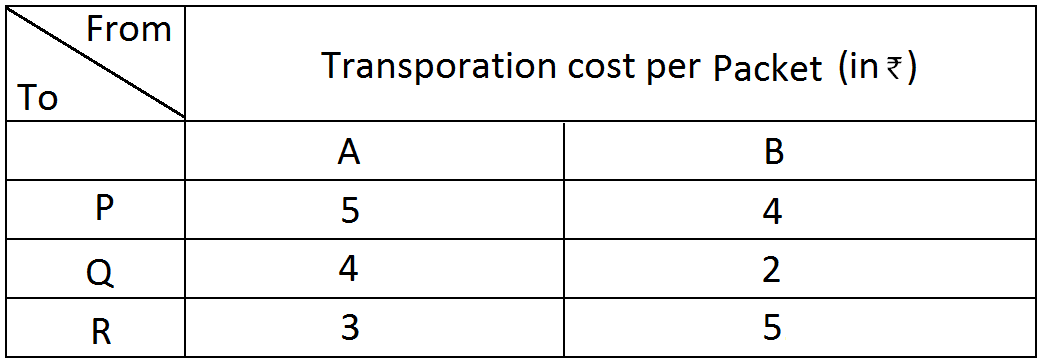
A medical company has factories at two places, A and B. From these places, supply is made to each of its three agencies situated at P, Q and R. The monthly requirements of the agencies are respectively 40, 40 and 50 packets of the medicines, while the production capacity of the factories, A and B, are 60 and 70 packets respectively. The transportation cost per packet from the factories to the agencies are given below:
How many packets from each factory be transported to each agency so that the cost of transportation is minimum? Also find the minimum cost?
Find the vector equation of the line passing through $(1, 2, 3)$ and parallel to the planes $\vec{\text{r}}\cdot(\hat{\text{i}}-\hat{\text{j}}+2\hat{\text{k}})=5$ and $\vec{\text{r}}\cdot(3\hat{\text{i}}+\hat{\text{j}}+\hat{\text{k}})=6.$
Evaluate the following intregals:
$\int\frac{\text{x}+1}{\sqrt{4+5\text{x}-\text{x}}}\text{ dx}$
Given $\text{A}=\begin{bmatrix}2&2&-4\\-4&2&-4\\2&-1&5\end{bmatrix},\text{B}=\begin{bmatrix}1&-1&0\\2&3&4\\0&1&2\end{bmatrix}$ , find BA and use this to solve the system of equations $y + 2z = 7, x - y = 3, 2x + 3y + 4z = 17$
Prove that: $\begin{vmatrix}(a+1)(a+2)&(a+2)&1\\(a+2)(a+3)&(a+3)&1\\(a+3)(a+4)&(a+4) &1\end{vmatrix}=-2$