MCQ
Diffusion current in a p-n junction is greater than the drift current in magnitude:
  • If the junction is forward-biased.
  • B
    If the junction is reverse-biased.
  • C
    If the junction is unbiased.
  • D
    In no case.

Answer

Correct option: A.
If the junction is forward-biased.
In the forward biassing of a p−n junction, the positive terminal of the battery is connected to the p side of the p−n junction and the negative terminal of the battery is connected to the n side of the p−n junction. As a result, electrons in the n side of the p−n junction are repelled by the negative terminal of the battery and move to the p side, where the positive terminal of the battery attracts the electrons. Similarly, holes from the p side of the p−n junction are repelled by the positive terminal of the battery and move to the nside, where the negative terminal of the battery attracts the holes. Thus, they give diffusion current across the p−n junction.
In case of reverse biassing, no conduction takes place across the junction because of the diffusion of majority carriers. Hence, there is no diffusion current.
If the junction is unbiased, then diffusion current is initially maximum. But at equilibrium, diffusion current becomes equal to drift current.
Need a full question paper?

Generate a complete, print-ready paper with questions like this in minutes — across 16+ boards, with answer keys.

Start Generating Free

Similar questions

The difference between the apparent frequency of a source of sound as perceived by an observer during its approach and recession is $2\%$ of the natural frequency of the source. If the velocity of sound in air is $300 \,m/sec,$ the velocity of the source is ... $m/sec$ (It is given that velocity of source $<<$ velocity of sound)
Which of the following quantities do not change when a resistor connected to a battery is heated due to the current?
The force exerted by the floor of an elevator on the foot of a person standing there is more than the weight of the person if the elevator is:
During the motion of a lift, apparent weight of a body becomes twice its actual weight when,
A body is vibrating in simple harmonic motion with an amplitude of $0.06\, m$ and frequency of $15\, Hz$. The velocity and acceleration of body is
Two passenger trains moving with a speed of $108\, km/hour$ cross each other. One of them blows a whistle whose frequency is $750 Hz.$ If sound speed is $330 m/s,$ then passengers sitting in the other train, after trains cross each other will hear sound whose frequency will be .... $Hz$
Which of the following statements are true for wave motion:
The temperature of $3.00\, {mol}$ of an ideal diatomic gas is increased by $40.0^{\circ} {C}$ without changing the pressure of the gas. The molecules in the gas rotate but do not oscillate. If the ratio of change in internal energy of the gas to the amount of workdone by the gas is $\frac{{x}}{10} .$ Then the value of ${x}$ (round off to the nearest integer) is ..... . $\left(\right.$ Given $\left.{R}=8.31\, {J} {mol}^{-1} {K}^{-1}\right)$
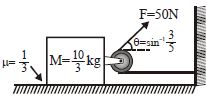
In the given figure the acceleration of $M$ is $(g = 10 \,ms^{-2})$
The electric field and the electric potential at a point are E and V respectively.