MCQ
Dimensions of coefficient of viscosity are
  • A
    $M{L^2}{T^{ - 2}}$
  • B
    $M{L^2}{T^{ - 1}}$
  • $M{L^{ - 1}}{T^{ - 1}}$
  • D
    $MLT$

Answer

Correct option: C.
$M{L^{ - 1}}{T^{ - 1}}$
c
(c) $F = - \eta \,.\,A\frac{{dv}}{{dx}} \Rightarrow [\eta ]\, = \,[M{L^{ - 1}}{T^{ - 1}}]$

Need a full question paper?

Generate a complete, print-ready paper with questions like this in minutes — across 16+ boards, with answer keys.

Start Generating Free

Similar questions

A wire suspended vertically from one of its ends is stretched by attaching a weight of $200N$ to the lower end. The weight stretches the wire by $1\ mm.$ Then the elastic energy stored in the wire is:
Two forces are such that the sum of their magnitudes is $18 \,N$ and their resultant is perpendicular to the smaller force and magnitude of resultant is $12\, N$. Then the magnitudes of the forces are
Two satellites $A$ and $B$ , having ratio of masses $3 : 1$ are in circular orbits of radius $r$ and $4r$ . Calculate the ratio of total mechanical energy of $A$ and $B$
Given that; $A = B = C$. If $\vec A + \vec B = \vec C,$ then the angle between $\vec A$ and $\vec C$ is $\theta _1$. If $\vec A + \vec B+ \vec C = 0,$ then the angle between $\vec A$ and $\vec C$ is $\theta _2$. What is the relation between $\theta _1$ and $\theta _2$ ?
An air bubble of volume $1\,cm ^3$ rises from the bottom of a lake $40\,m$ deep to the surface at a temperature of $12^{\circ}\,C$. The atmospheric pressure is $1 \times 10^5 Pa$, the density of water is $1000\,kg / m ^3$ and $g =10\,m / s ^2$. There is no difference of the temperature of water at the depth of $40\,m$ and on the surface. The volume of air bubble when it reaches the surface will be $..........\,cm^{3}$
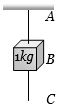
A mass of $1 kg$ is suspended by a string $A$. Another string $C$ is connected to its lower end (see figure). If a sudden jerk is given to $C$, then
Let E, G and N represent the magnitudes of electromagnetic gravitational and nuclear forces between two electrons at a given separation. Then:
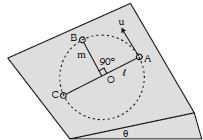
A small sphere of mass $m$ is suspended by a light and inextensible string of length $l$ from a point $O$ fixed on a smooth inclined plane of inclination $\theta $ with the horizontal. The sphere is moving in a circle on the incline as shown. If the sphere has a velocity $u$ at the top most position $A$ . Then,
The number of molecules per unit volume in the sample is $20.$ The mass of each molecule is $10-20\ kg.$ The mean of speed squared is $4\ m^2/s^2$. What is the value of internal energy of the gas? Assume volume of container is $0.02m^3$.
Consider the following two equations:
$A. \text{L}=\text{I}\omega$
$B. \frac{\text{dL}}{\text{dt}}=\Gamma$
In noninertial frames: