MCQ
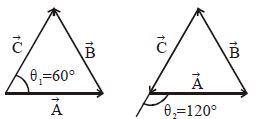
Given that; $A = B = C$. If $\vec A + \vec B = \vec C,$ then the angle between $\vec A$ and $\vec C$ is $\theta _1$. If $\vec A + \vec B+ \vec C = 0,$ then the angle between $\vec A$ and $\vec C$ is $\theta _2$. What is the relation between $\theta _1$ and $\theta _2$ ?
  • A
    $\theta _1=\theta _2$
  • $\theta _1=\theta _2/2$
  • C
    $\theta _1=2\theta _2$
  • D
    None of these

Answer

Correct option: B.
$\theta _1=\theta _2/2$
b

Need a full question paper?

Generate a complete, print-ready paper with questions like this in minutes — across 16+ boards, with answer keys.

Start Generating Free

Similar questions

A vector is not changed if:
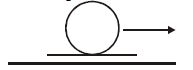
A ball rests upon a flat piece of paper on a table top. The paper is pulled horizontally but quickly towards right as shown. Relative to its initial position with respect to the table, the ball

$(A)$ Remains stationary if there no friction between the paper and the ball

$(B)$ Moves to the left and starts rolling backwards, $i.e.$, to the left if there is a friction between the paper and the ball

$(C)$ Moves foward, $i.e.$ in the direciton in 'which the paper is pulled

Here, the correct statements is/are

Moment of a force of magnitude $20 \,N$ acting along positive $x$ direction at point $(3 \,m , 0,0)$ about the point $(0,2,0)$ (in $Nm$ ) is ...........
The velocity of the centre of mass of a rigid rod with respect to an observer $O$ is $\vec v = \left( {2\hat i + 3\hat j} \right) ms^{-1}$ . The rod has an angular velocity about its centre of mass given by $\vec \omega$  =$\left( {3\hat j + 4\hat k} \right) s^{-1}$ . Let A be a point on the rod with position vector $2\left( {\hat i + \hat k} \right) m$ with respect to the centre of mass. The velocity of the point $A$ with respect to $O$ is
An electric motor creates a tension of  $4500$  newton in a hoisting cable and reels it in at the rate of $2 m/sec. $ What is the power of electric motor
The motion of a particle of mass m is given by $\text{x}=0$ for $\text{t} < 0\ \text{s},$ $\text{x}(\text{t})=\text{A}\sin4\text{p}\ \text{t}$ for $0<\text{t}<(1/ 4)\ \text{s}(\text{A}>\text{o}),$ and $\text{x}=0$ for $\text{t}>(1/4)\ \text{s}.$ Which of the following statements is true?
The potential energy of a particle varies with distance $x$ from a fixed origin as $V = \frac{{A\sqrt x }}{{x + B}}$,where
$A$ and $B$ are constants. The dimensions of $AB$ are
A particle of mass $m$ is executing oscillation about the origin about the origin on the $x-$axis, its potential energy is $U = kx^3$, where $k$ is a positive constant. If the amplitude of oscillation is a, then its time period $T$ is:
The shear strain is possible in .............
A solid sphere of volume V and density $\rho$ floats at the interface of two immiscible liquids of densities $\rho_1$ and $\rho_2$ respectively. If $\rho_1<\rho<\rho_2$, then the ratio of the volume of the parts of the sphere in upper and lower liquids is