MCQ
Dimensions of $CR$ are those of
  • A
    Frequency
  • B
    Energy
  • Time period
  • D
    Current

Answer

Correct option: C.
Time period
c
(c) Capacity $ \times $ Resistance = $\frac{{{\rm{Charge}}}}{{{\rm{Potential}}}} \times \frac{{{\rm{Volt}}}}{{{\rm{amp}}}}$

= $\frac{{{\rm{amp}} \times {\rm{second}} \times {\rm{Volt}}}}{{{\rm{Volt}} \times {\rm{amp}}}} = {\rm{Second}}$

Need a full question paper?

Generate a complete, print-ready paper with questions like this in minutes — across 16+ boards, with answer keys.
Start Generating Free

Similar questions

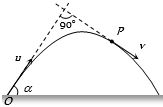
A body is projected with velocity $u$ making an angle $\alpha$ with the horizontal. Its velocity when it is perpendicular to the initial velocity vector $u$ is
The dimensions of angular momentum , latent heat and capacitance are, respectively.
At what temperature velocity of sound is double than that of at $0°C$
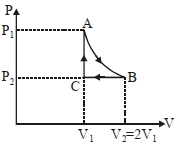
$n$ mole a perfect gas undergoes a cyclic process $ABCA$ (see figure) consisting of the following processes.

$A \rightarrow B :$ Isothermal expansion at temperature $T$ so that the volume is doubled from $V _{1}$ to $V _{2}=2 V _{1}$ and pressure changes from $P _{1}$ to $P _{2}$

$B \rightarrow C :$ Isobaric compression at pressure $P _{2}$ to initial volume $V _{1}$

$C \rightarrow A$ : Isochoric change leading to change of pressure from $P _{2}$ to $P _{1}$

Total workdone in the complete cycle $ABCA$ is
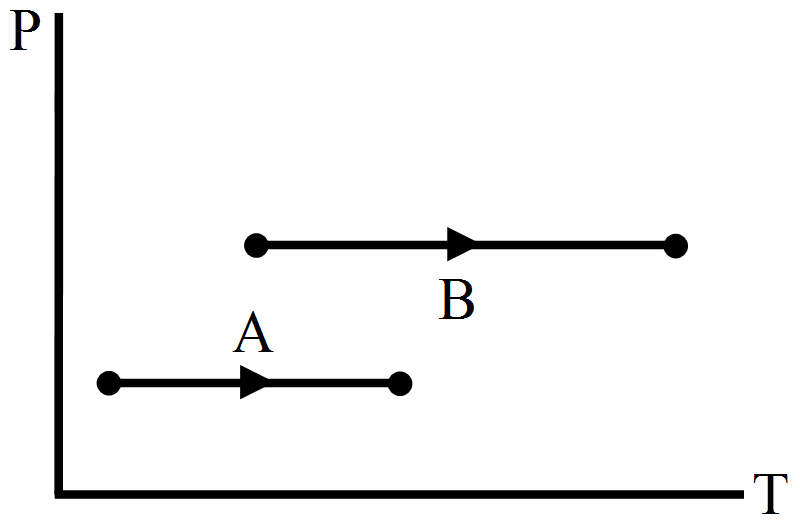
Consider two processes on a system as shown in figure.

The volumes in the initial states are the same in the two processes and the volumes in the final states are also the same. Let $\Delta\text{W}_1$ and $\Delta\text{W}_2$ be the work done by the system in the processes $A$ and $B$ respectively.
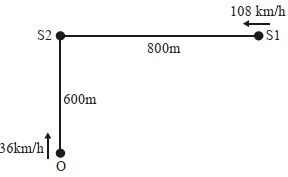
A train $S1$, moving with a uniform velocity of $108 km / h$, approaches another train $S 2$ standing on a platform. An observer $O$ moves with a uniform velocity of $36 km / h$ towards $S 2$, as shown in figure. Both the trains are blowing whistles of same frequency $120 Hz$. When $O$ is $600 m$ away from $S 2$ and distance between $S 1$ and $S 2$ is $800 m$, the number of beats heard by $O$ is. . . . . [Speed of the sound $=330 m / s$ ]
A particle of mass $m $ is moving in a horizontal circle of radius $r$  under a centripetal force equal to $ - K/{r^2}$, where $K$  is a constant. The total energy of the particle is
A tuning fork produces $4\text{beats/ sec}$ with another fork of frequency $288\ \text{c.p.s}$. A little wax is placed on the unknown fork and it then produces $2\text{beats/ sec.}$ The unknown frequency is:
A block of mass $m$ is pulled along a horizontal surface by applying a force at an angle $\theta $ with the horizontal. The friction coefficient between the block and surface is $\mu$. If the block travels at a uniform velocity , then work-done during its displacement $d$ is
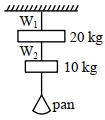
Wires ${W}_{1}$ and ${W}_{2}$ are made of same material having the breaking stress of $1.25 \times 10^{9} \,{N} / {m}^{2}$ ${W}_{1}$ and ${W}_{2}$ have cross-sectional area of $8 \times 10^{-7}\, {m}^{2}$ and $4 \times 10^{-7}\, {m}^{2}$, respectively. Masses of $20 \,{kg}$ and $10\, {kg}$ hang from them as shown in the figure. The maximum mass that can be placed in the pan without breaking the wires is $.....{kg}$ (Use $\left.{g}=10\, {m} / {s}^{2}\right)$