MCQ
Diode can work as:
- AModulator
- BDemodulator
- CRectifier
- DAmplifier
Explanation:
Diode can work as rectifier, While converting AC voltage to DC voltage, we use 4 diodes in the form of wheat stone bridge,It effectively works as rectifier.
Generate a complete, print-ready paper with questions like this in minutes — across 16+ boards, with answer keys.
Three charges each of magnitude q are placed at the corners of an equilateral triangle, the electrostatic force on the charge placed at the center is (each side of triangle is L)
|
(a) Zero |
(b) |
(c) |
(d) |
Three long, straight and parallel wires carrying currents are arranged as shown in figure. The force experienced by 10 cm length of wire Q is
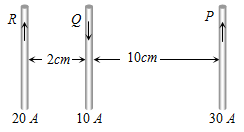
|
(a) 1.4 |
(b) 1.4 |
|
(c) 2.6 |
(d) 2.6 |
The pole strength of a bar magnet is 48 ampere-metre and the distance between its poles is 25 cm. The moment of the couple by which it can be placed at an angle of 30o with the uniform magnetic intensity of flux density 0.15 Newton /ampere-metre will be
|
(a) 12 Newton × metre |
(b) 18 Newton × metre |
|
(c) 0.9 Newton × metre |
(d) None of the above |
If in the experiment of Wheatstone's bridge, the positions of cells and galvanometer are interchanged, then balance points will
|
(a) Change |
|
(b) Remain unchanged |
|
(c) Depend on the internal resistance of cell and resistance of galvanometer |
|
(d) None of these |
$\frac{\triangle\text{l}}{\text{l}}$
$\Big(\frac{\triangle\text{l}}{\text{l}}\Big)^2$
$\sqrt{\frac{\triangle\text{l}}{\text{l}}}$
None of these.


