Question
Discuss graphical method for the measurement of impulse in the following case:
  1. When constant force acts on the body.
  2. When a variable force acts on the body.
Answer

  1.  

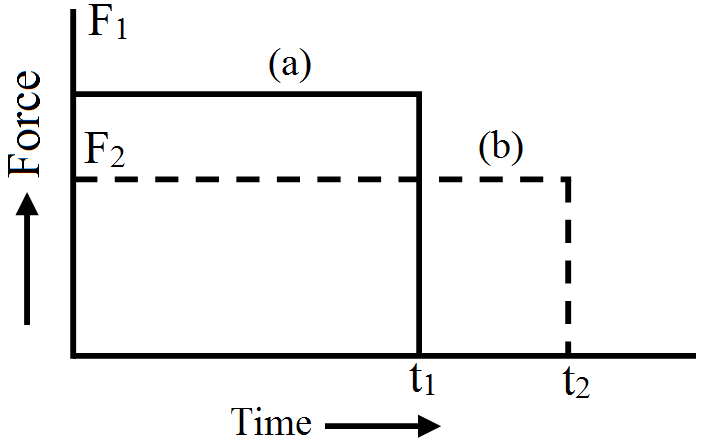
$F_1$ for curve (a) is greater than $F_2$ for curve (b). The time $t_2$ for which $F_2$ acts is greater for curve (b) than time $t_1$ in case of curve (a).
$F_1 \times t_1=F_2 \times t_2$
  1.  

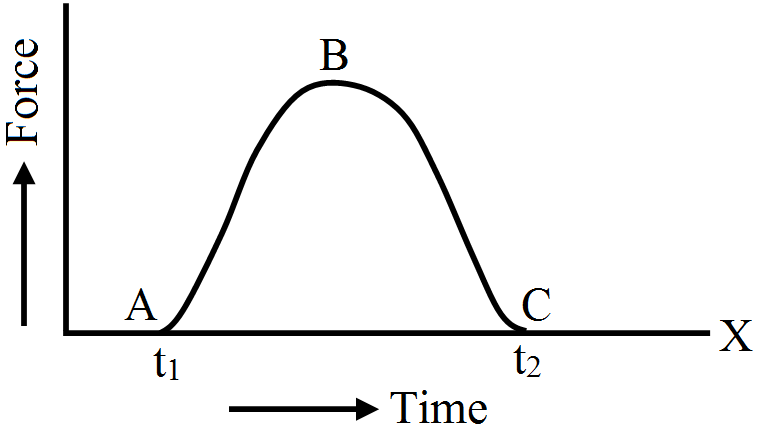
Impulse of variable force
$=\int\limits^{\text{t}_2}_{\text{t}_1}\vec{\text{F}}\text{dt}=\text{aera of }\Delta\text{BCA}$

Need a full question paper?

Generate a complete, print-ready paper with questions like this in minutes — across 16+ boards, with answer keys.
Start Generating Free

Similar questions

A vessel $A$ contains hydrogen and another vessel $B$ whose volume is twice of $A$ contains same mass of oxygen at the same temperature. Compare $(i)$ average kinetic energies of hydrogen and oxygen molecules $(ii)$ root mean square speeds of the molecules $(iii)$ pressure of gases in $A$ and $B$. Molecular weights of hydrogen and oxygen are $2$ and $32$ respectively.
The voltage across a lamp is $\text{V}=(6.0\pm0.1)$ Volt and the current passing through it $\text{I}=(4\pm0.2)$ ampere. Find the power consumed by the electric lamp. Given that power, P = VI
A string of mass 2.50kg is under a tension of 200N. The length of the stretched string is 20.0m. If the transverse jerk is struck at one end of the string, how long does the disturbance take to reach the other end?
Four identical cylindrical columns of steel support a big structure of mass $50,000kg$. The inner and outer radii of each column are $30cm$ and $40cm$ respectively. Assuming the load distribution to be uniform, calculate the compressional strain of each column. The Young's modulus of steel is $2.0 \times 10^{11}Pa$.
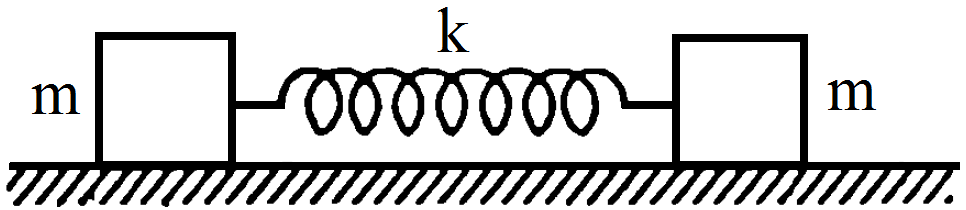
Consider the situation shown in figure Show that if the blocks are displaced slightly in opposite directions and released, they will execute simple harmonic motion. Calculate the time period.
Just as precise measurements are necessary in science, it is equally important to be able to make rough estimates of quantities using rudimentary ideas and common observations. Think of ways by which you can estimate the following (where an estimate is difficult to obtain, try to get an upper bound on the quantity): The mass of an elephant.
Find the kinetic energy of $1g$ of nitrogen gas at $77°C$. Given, $R = 8.31J-mol^{-1}K^{-1}$.
Water is boiled in a container having a bottom of surface area $25cm^2$, thickness $1.0mm$ and thermal conductivity $50\text{wm}^{-1}{^{\circ}}\text{C}^{-1}.$ 100g of water is converted into steam per minute in the steady state after the boiling starts. Assuming that no heat is lost to the atmosphere, calculate the temperature of the lower surface of the bottom. Latent heat of vaporization of water $=0.26\times10^6\text{Jkg}^{-1}.$
Consider a sunlike star at a distance of 2 parsecs. When it is seen through a telescope with 100 magnification, what should be the angular size of the star? Sun appears to be $\Big(\frac{1}{2}\Big)^0$ from the earth. Due to atmospheric fluctuations, eye can’t resolve objects smaller than 1 arc minute.
The efficiency of an ideal engine is $\frac{1}{8}$ access. After reducing the temperature 100 K , increase to $\frac{1}{6}$ of access. Find the original and final temperature.