Question
Discuss the Einstien's explanation for the photoelectric effect.

Answer

$\rightarrow$ In $1905,$ Einstien gave a historical explanation of the photoelectric effect.
For which he was awarded the Nobel prize in physics in $1921$.
$\rightarrow$ Einstein accepted Max Planck's concept of radiation.
$\rightarrow$ According to this concept, the energy of radiation is not continuous.
Radiation is composed of discrete units of energy, $($Bundles of energy$)$
These units of energy are called quanta or photons.
Each quantum (photon) has energy $E =h v$.
Where, $h=$ Planck's constant
$h=6.625 \times 10^{-34} J s$
$v=$ Frequency of radiation
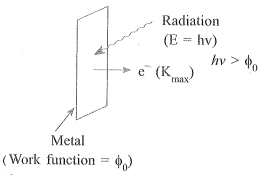
$\rightarrow$ When radiation is incident on a metal surface, the electrons in the metal interact with the quanta of the radiation.
If the energy of quantum $(h v)$ is greater than the work function $\left(\phi_0\right)$ of a given metal, the electron absorbs this quantum. i.e. the full energy of the quantum $(h v)$ is absorbed and is emitted from the metal with a maximum kinetic energy $K _{\max }$.
Thus, $K _{ max }=h v-\phi_0$
$\rightarrow$ This equation is called Einstein's equation of photoelectric effect.
Image
$\rightarrow$ If a photon interacts with an strongly bound electron than electron requires more energy to be ejected.
So it is emitted with less energy than $K _{\max }$.

Need a full question paper?

Generate a complete, print-ready paper with questions like this in minutes — across 16+ boards, with answer keys.
Start Generating Free

Similar questions

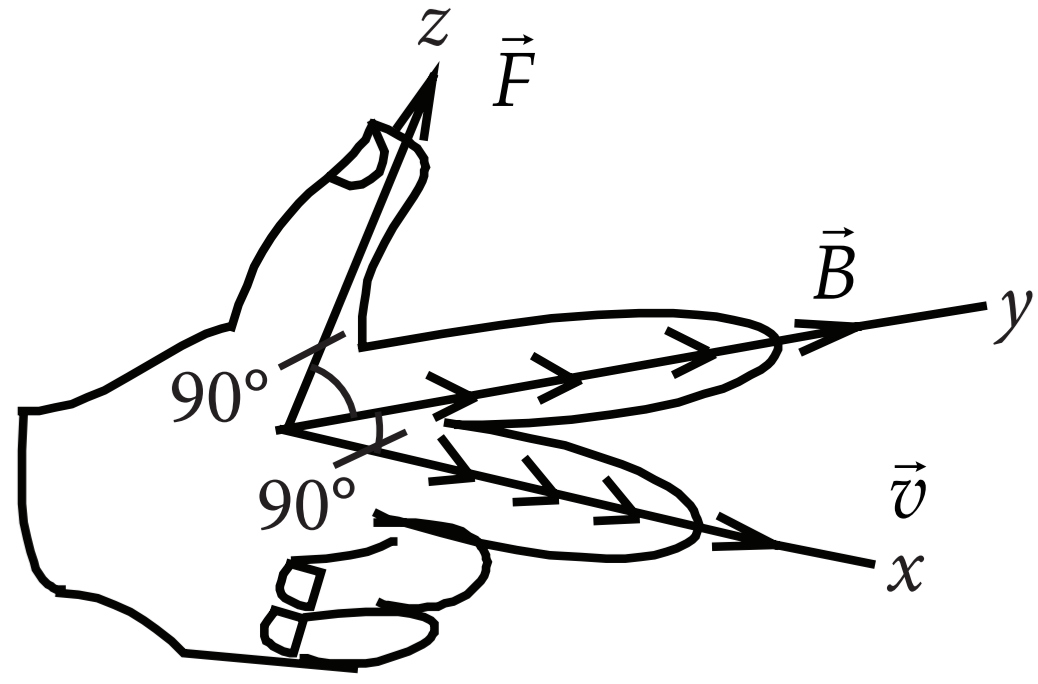
A charged particle moving in a magnetic field experiences a force that is proportional to the strength of the magnetic field, the component of the velocity that is perpendicular to the magnetic field and the charge of the particle. This force is given by $\vec{\text{F}}=\text{q}(\vec{\text{v}}\times\vec{\text{B}})$ where $q$ is the electric charge of the particle, $v$ is the instantaneous velocity of the particle, and Bis the magnetic field $($in tesla$).$ The direction of force is determined by the rules of cross product of two vectors. Force is perpendicular to both velocity and magnetic field. Its direction is same as $\vec{\text{v}}\times\vec{\text{B}}$ if $q$ is positive and opposite of $\vec{\text{v}}\times\vec{\text{B}}$ if $q$ is negative. The force is always perpendicular to both the velocity of the particle and the magnetic field that created it. Because the magnetic force is always perpendicular to the motion, the magnetic field can do no work on an isolated charge. It can only do work indirectly, via the electric field generated by a changing magnetic field.
  1. When a magnetic field is applied on a stationary electron, it:
  1. Electric field only.
  2. Magnetic field only.
  3. Both electric and magnetic field.
  4. None of these.
  5. Moving charge will produce.
  6. In $z-y$ plane.
  7. Along $-y$ axis.
  8. Along $+z$ axis.
  9. Along $-z$ axis.
  10. A charge $q$ moves with a velocity $2m s^{-1}$ along $x-$axis in a uniform magnetic field $\vec{\text{F}}=(\vec{\text{i}}+2\vec{\text{j}}+3\vec{\text{k}})\text{T,}$ charge will experience a force.
  11. The particle is stationary and magnetic field is perpendicular.
  12. The particle is moving and magnetic field is perpendicular to the velocity.
  13. The particle is stationary and magnetic field is parallel.
  14. The particle is moving and magnetic field is parallel to velocity.
  15. A charged particle experiences magnetic force in the presence of magnetic field. Which of the following statement is correct?
  16. The proton will be accelerated along the axis.
  17. The proton path will be circular about the axis.
  18. The proton moves along helical path.
  19. The proton will continue to move with velocity $v$ along the axis.
  20. A proton is projected with a uniform velocity $v$ along the axis of a current carrying solenoid, then,
  21. Remains stationary.
  22. Spins about its own axis.
  23. Moves in the direction of the field.
  24. Moves perpendicular to the direction of the field.
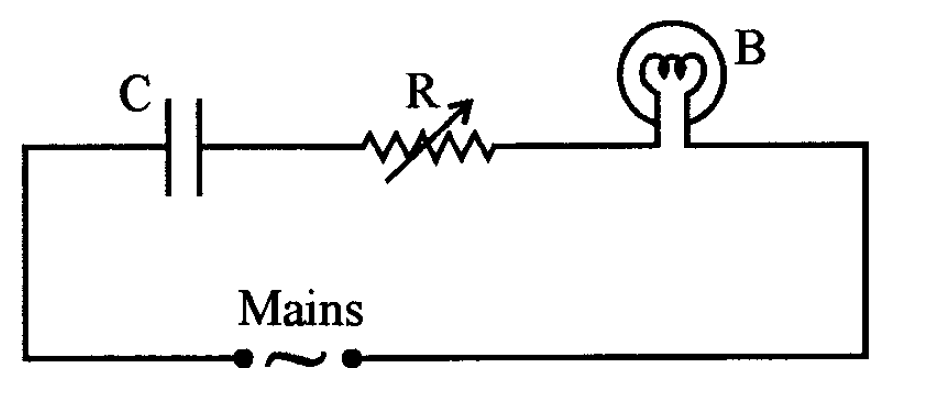
A capacitor'C', a variable resistor 'R' and a bulb 'B' are connected in series to the ac mains in circuit as shown. The bulb glows with some brightness. How will the glow of the bulb change if (i) a dielectric slab is introduced between the plates of the capacitor, keeping resistance R to be the same; (ii) the resistance R is increased keeping the same capacitance?
A hot body is placed in a closed room maintained at a lower temperature. Is the number of photons in the room increasing?
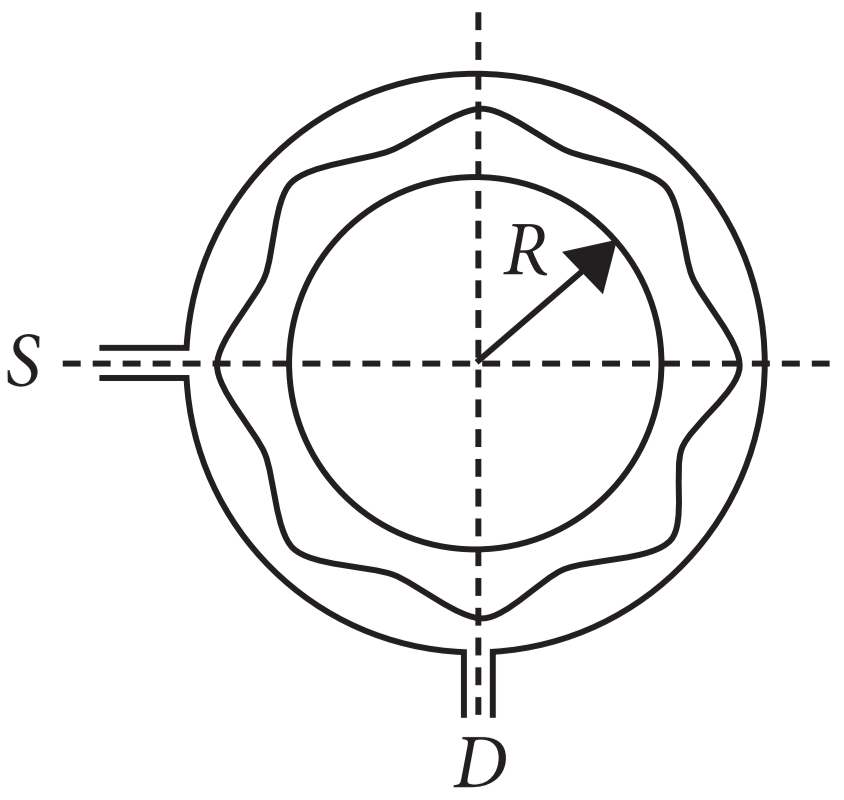
A narrow tube is bent in the form of a circle of radius $R,$ as shown in figure. Two small holes $S$ and $D$ are made in the tube at the positions at right angle to each other. $A$ source placed at $S$ generates a wave of intensity $I_0$ which is equally divided into two parts: one part travels along the longer path, while the other travels along the shorter path. Both the waves meet at point Dwhere a detector is place
  1. If a maxima is formed at a detector, then the magnitude of wavelength $\lambda$ of the wave produced is given by:
  1. $\pi\text{R}$
  2. $\frac{\pi\text{R}}{2}$
  3. $\frac{\pi\text{R}}{4}$
  4. All of these.
  1. If the in tensity ratio of two coherent sources used in Young's double slit experiment is $49 : 1,$ then the ratio between the maximum and minimum intensities in the interference pattern is:
  1. $1 : 9$
  2. $9 : 16$
  3. $25 : 16$
  4. $16 : 9$
  1. The maximum intensity produced at $D$ is given by:
  1. $4I_0$
  2. $2I_0$
  3. $I_0$
  4. $3I_0$
  1. ln a Young's double slit experiment, the intensity at a point where the path difference is $\frac{\lambda}{6} \ (\lambda - $ wavelength of the light$)$ is $I$. If $I_0$ denotes the maximum intensity, then $ I/I_0$ is equal to:
  1. $\frac{1}{2}$
  2. $\frac{\sqrt3}{2}$
  3. $\frac{1}{\sqrt2}$
  4. $\frac{3}{4}$
  1. Two identical light waves, propagating in the same direction, have a phase differenced. After they superpose the intensity of the resulting wave will be proportional to:
  1. $\cos\delta$
  2. $\cos\Big(\frac{\delta}{2}\Big)$
  3. $\cos^2\Big(\frac{\delta}{2}\Big)$
  4. $\cos^2\delta$
A stationary charge produces only an electrostatic field while a charge in uniform motion produces a magnetic field, that does not change with time. An oscillating charge is an example of accelerating charge. It produces an oscillating magnetic field, which in turn produces an oscillating electric fields and so on. The oscillating electric and magnetic fields regenerate each other as a wave which propagates through space.

Magnetic field in a plane electromagnetic wave is given by $\vec{\text{B}}=\text{B}_0\sin(\text{kx}+\omega\text{t}) \hat{\text{j}}\text{T}.$
  1. Expression for corresponding electric field will be $($Where $c$ is speed of light$)$.
  1. $\vec{\text{E}}=-\text{B}_0\text{c}\sin(\text{kx}+\omega\text{t}) \hat{\text{k}}\frac{\text{V}}{\text{m}}$
  2. $\vec{\text{E}}=\text{B}_0\text{c}\sin(\text{kx}-\omega\text{t}) \hat{\text{k}}\frac{\text{V}}{\text{m}}$
  3. $\vec{\text{E}}=\frac{\text{B}_0}{\text{c}}\sin(\text{kx}+\omega\text{t}) \hat{\text{k}}\frac{\text{V}}{\text{m}}$
  4. $\vec{\text{E}}=\text{B}_0\text{c}\sin(\text{kx}+\omega\text{t}) \hat{\text{k}}\frac{\text{V}}{\text{m}}$
  1. The electric field component ofa monochromatic radiation is given by $\vec{\text{E}} = 2\epsilon_0\hat{\text{i}}\cos\text{kz}\cos\omega\text{t}.$ Its magnetic field $\vec{\text{B}}$ is then given by:
  1. $\frac{2\epsilon_0}{\text{c}}\hat{\text{j}}\cos\text{kz}\cos\omega\text{t}$
  2. $\frac{2\epsilon_0}{\text{c}}\hat{\text{j}}\sin\text{kz}\cos\omega\text{t}$
  3. $\frac{2\epsilon_0}{\text{c}}\hat{\text{j}}\sin\text{kz}\sin\omega\text{t}$
  4. $-\frac{2\epsilon_0}{\text{c}}\hat{\text{j}}\sin\text{kz}\sin\omega\text{t}$
  1. A plane em wave of frequency $25MHz$ travels in a free space along $x-$ direction. At a particular point in space and time, $\text{E}=(6.3\ \hat{\text{j}})\frac{\text{V}}{\text{m}}.$ What is magnetic field at that time?
  1. $0.095\mu\text{T}$
  2. $0.124\mu\text{T}$
  3. $0.089\mu\text{T}$
  4. $0.021\mu\text{T}$
  1. A plane electromagnetic wave travelling along the $x-$ direction has a wavelength of $3\ mm$. The variation in the electric field occurs in the $y-$ direction with an amplitude $66Vm^1$. The equations for the electric and magnetic fields as a function of $x$ and tare respectively.
  1. $\text{E}_\text{y}=33\cos\pi\times10^{11}\Big(\text{t}-\frac{\text{x}}{\text{c}}\Big),$
    $\text{B}_\text{z}=1.1\times10^{-7}\cos\pi\times10^{11}\Big(\text{t}-\frac{\text{x}}{\text{c}}\Big)$
  2. $\text{E}_\text{y}=11\cos2\pi\times10^{11}\Big(\text{t}-\frac{\text{x}}{\text{c}}\Big),$
    $\text{B}_\text{y}=11\times10^{-7}\cos2\pi\times10^{11}\Big(\text{t}-\frac{\text{x}}{\text{c}}\Big)$
  3. $\text{E}_\text{x}=33\cos\pi\times10^{11}\Big(\text{t}-\frac{\text{x}}{\text{c}}\Big),$
    $\text{B}_\text{x}=11\times10^{-7}\cos\pi\times10^{11}\Big(\text{t}-\frac{\text{x}}{\text{c}}\Big)$
  4. $\text{E}_\text{y}=66\cos2\pi\times10^{11}\Big(\text{t}-\frac{\text{x}}{\text{c}}\Big),$
    $\text{B}_\text{z}=2.2\times10^{-7}\cos2\pi\times10^{11}\Big(\text{t}-\frac{\text{x}}{\text{c}}\Big)$
  1. A plane electromagnetic wave travels in free space along $x-$ axis. At a particular point in space, the electric field along $y-$ axis is $9.3Vm^{-1.}$ The magnetic induction $(B)$ along $z-$ axis is:
  1. $3.1 \times 10^{-8}T$
  2. $3 \times 10^{-5}T$
  3. $3 \times 10^{-6}T$
  4. $9.3 \times 10^{-6}T$
In an electromagnetic wave both the electric and magnetic fields are perpendicular to the direction of propagation, that is why electromagnetic waves are transverse in nature. Electromagnetic waves carry energy as they travel through space and this energy is shared equally by the electric and magnetic fields. Energy density of an electromagnetic waves is the energy in unit volume of the space through which the wave travels.
(i) The electromagnetic waves propagated perpendicular to both $\vec{E}$ and $\vec{B}$. The electromagnetic waves travel in the direction of
(a) $\vec{E} \cdot \vec{B}$
(b) $\vec{B} \cdot \vec{E}$
(c) $\vec{E} \times \vec{B}$
(d) $\vec{B} \times \vec{E}$

(ii) Fundamental particle in an electromagnetic wave is
(a) photon (b) phonon (c) electron (d) proton

(iii) Electromagnetic waves are transverse in nature is evident by
(a) diffraction (b) interference (c) polarisation (d) reflection

OR

The electric and magnetic fields of an electromagnetic waves are
(a) in opposite phase and parallel to each other
(b) in phase and parallel to each other.
(c) in phase and perpendicular to each other
(d) in opposite phase and perpendicular to each other

(iv) d) in opposite phase and perpendicular to each other
(a) frequency (b) wavelength (c) velocity (d) all these depend on each other
The saturation current from a thoriated$-$tungsten cathode at $2000K$ is $100mA.$ What will be the saturation current for a pure$-$tungsten cathode of the same surface area operating at the same temperature? The constant $A$ in the Richardson$-$Dushman equation is $60 \times 10^4Am^{-2}K^{-2}$ for pure tungsten and $3.0 \times 10^4Am^{-2}k^{-2}$ for thoriated tungsten. The work function of pure tungsten is $4.5eV$ and that of thoriated tungsten is $2.6eV.$
What is the difference between Magnification and Magnifying power ?
A simple pendulum fixed in a car has a time period of $4$ seconds when the car is moving uniformly on a horizontal road. When the accelerator is pressed, the time period changes to $3.99$ seconds. Making an approximate analysis, find the acceleration of the car.
Suppose in an imaginary world the angular momentum is quantized to be even integral multiples of $\frac{\text{h}}{2\pi}$ What is the longest possible wavelength emitted by hydrogen atoms in visible range in such a world according to Bohr's model?