Question
Discuss the health hazards associated with the pollution.

Answer

The impact of pollution on health may be primary or secondary. The primary impact occurs immediately but the secondary impact is delayed and may persist in future.
  1. When contaminated water is supplied to the residents of a locality, it may spread water borne diseases like diarrhea, hepatitis etc.
  2. Release of smoke as vehicular exhaust pollutes the air. When this air is inhaled by the humans it causes asthma and bronchitis.
  3. Large amount of soluble nitrates are released and dissolve in the water. It may contaminate the groundwater including wells of the area. Heavy intake of nitrates by humans may cause serious health hazards.
  4. People who work in the deep coal mines, inhale the fine coal dust. It leads to a disease called black lungs. Many gases are also released in the process of mining like methane and carbon-monoxide.

Need a full question paper?

Generate a complete, print-ready paper with questions like this in minutes — across 16+ boards, with answer keys.
Start Generating Free

Similar questions

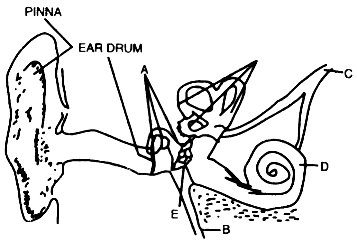
Given below is the diagram of the human ear. Study the same and answer the questions that follow:
(i) Give the biological term for the part labeled ‘A’ and state its function.
(ii) Name the part labeled ‘B’ and state its function.
(iii) Name the part labeled ‘C’ and state its function.
(iv) Give the function of ear wax.
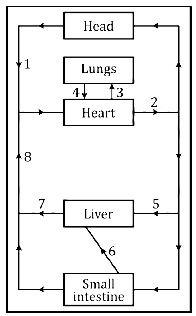
The diagram below represents the simplified pathway of the circulation of blood. Study the same and answer the questions which follow:

(i) Name the blood vessels labelled 1 and 2.
(ii) State the function of blood vessels labelled 5 and 8.
(iii) What is the importance of the blood vessel labelled 6?
(iv) Which blood vessel will contain a high amount of glucose and amino acids after a meal?
(v) Draw a diagram of the different blood cells as seen in a smear of human blood.
Column ‘II’ is a list of items related to ideas in Column ‘I’. Match the term in Column ‘II’ with the suitable idea given in Column ‘I’.
Column I Column II
(i) Auditory canal (a) Channels pressure waves of air into the middle ear.
(ii) Auditory (Eustachian tube) (b) Collects pressure waves of air.
(iii) Auditory nerve (c) Converts pressure waves of air into vibrations of bone.
(iv) Incus (d) Dissipates sound waves.
(v) Malleus (e) Equalizes pressure between the middle ear and the atmosphere.
(vi) Oval window (f) Provide information about the spatial orientation of the head.
(vii) Pinna (g) Transfers vibrations from a bone to a fluid.
(viii) Round window (h) Transfers vibrations from a bone to a membrane.
(ix) Semi-circular canal (i) Transfers vibrations from a bone to a bone.
(x) Stapes (j) Transfers vibrations from a membrane to a bone.
(xi) Tympanic membrane (k) Transmits action potential to the auditory cortex.
Is ozone depletion related to global warming?
Name the three types of transpiration.
Does the sex of the child depend on the father or it is just a matter of chance? Discuss
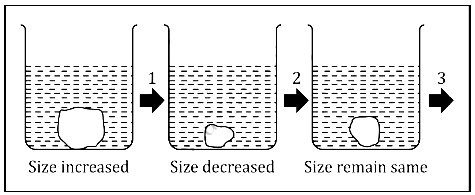
A candidate in order to study the process of osmosis has taken 3 potato cubes and put them in 3 different beakers containing 3 different solutions. After 24 hours, in the first beaker the potato cube increased in size, in the second beaker the potato cube decreased in size and in the third beaker there was no change in the size of the potato cube. The following diagram shows the result of the same experiment:

(i) Give the technical terms of the solutions used in beakers, 1, 2 and 3.
(ii) In beaker 3, the size of the potato cube remains the same. Explain the reason in brief.
(iii) Write the specific feature of the cell sap of root hairs which helps in absorption of water.
(iv) What is osmosis?
(v) How does a cell wall and a cell membrane differ in their permeability?
How is movement in plants different from that in animals?
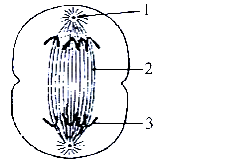
The diagram below represents a stage during cell division. Study the same and then answer the question that follow:

a) Name the parts labelled 1, 2, and 3.
b) Identify the above stage and give a reason to support your answer.
c) Mention where in the body this type of cell division occurs.
d) Name the stage prior to this stage and draw a diagram to represent the same.
Describe the mechanism of focusing the image of a distant object in your eye when you raise your head after reading a book.