Question
Discuss the structure and functions of mitochondria.

Answer


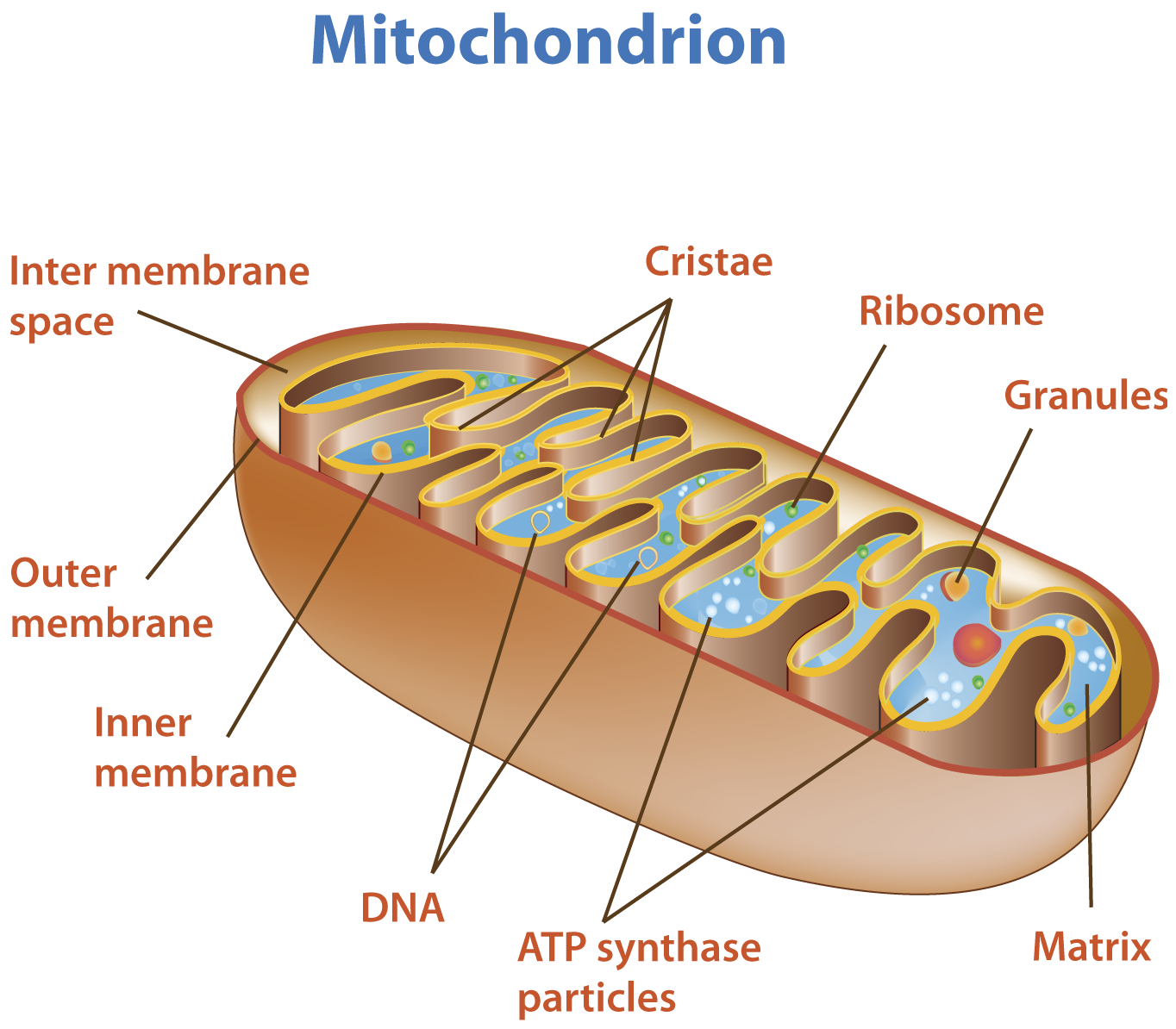
Structure of mitochondria: Mitochondria are tiny bodies of varying shapes and size, found in the cytoplasm. Each mitochondrion is covered by a double-membrane envelope. Outer membrane is smooth and porous while inner membrane is projected with finger-like structures, the cristae. These cristae create a large surface area for ATP-generating chemical reactions. The cristae as well as inner membrane possess small tent like particles called F1 particles or oxysomes.
The cavity of mitochondria is filled with matrix. The mitochondrial matrix contains lipids, proteins, circular DNA and RNA.

Functions of mitochondria:
  1. Mitochondria is the site of cellular respiration or oxidation of food in a cell.
  2. The energy, released in the form of ATP, is used by body cells to synthesise new chemical compounds and to carry out other metabolic activities.

Need a full question paper?

Generate a complete, print-ready paper with questions like this in minutes — across 16+ boards, with answer keys.
Start Generating Free

Similar questions

A liquid compound X of molecular mass 18u can be obtained from a number of natural sources. All the animals and plants need liquid X for their survival. When an electric current is passed through 200 grams of pure liquid X under suitable conditions, then 178 grams of gas Y and 22 grams of gas Z are produced. Gas Y is produced at the positive electrode whereas gas Z is obtained at the negative electrode. Moreover, gas Y supports combustion whereas gas Z burns itself causing explosions.
  1. Name (i) liquid X (ii) gas Y, and (iii) gas Z
  2. What is the ratio to the mass of element Z to the mass of element Y in the liquid X?
  3. Which law of chemical combination is illustrated by this example?
  4. Name two sources of liquid X.
  5. Gate an important use of Y in our life.
Obtain a relation for the distance travelled by an object moving with a uniform acceleration in the interval between 4th and 5th seconds.
Write short notes on:
  1. Mitochondria.
  2. Plastids.

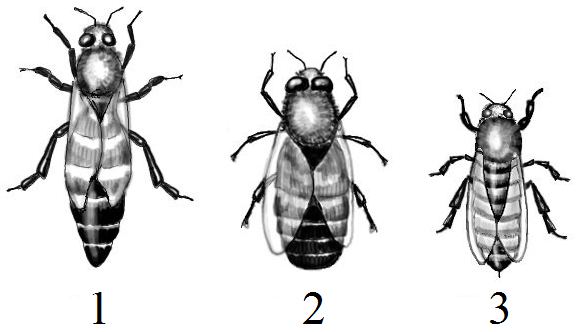
Look at Figures 1, 2 and 3 given alongside and answer the following questions.
  1. What do these figures show all together?
  2. Which one is queen bee?
  3. Which one of them is the haploid, fertile male? What is it called?
  4. What is the status of the insect shown in the figure: individual/ social?
Explain the transformation of energy in the following cases:
  1. A ball thrown upwards.
  2. A stone dropped from the roof of a building.
Draw a flow sheet diagram showing the separation of various components of a mixture containing camphor, sand and iron filings.
What mass of nitrogen $N_2,$ will contain the same number of molecules as $1.8g$ of water, $H_2O?$
$($Atomic masses: $N = 14u; H = 1u; O = 16u)$
Describe the method of separating a mixture containing common salt, sand and ammonium chloride.
Explain the terms 'compression' and 'rarefactions' of a wave. What type of waves consist of compressions and rarefactions?
State Newton’s third law of motion and give two examples to illustrate the law.