Question
Discuss the types of seeds. Also describe its structure.

Answer

On the basis cotyledons seeds are of two types :
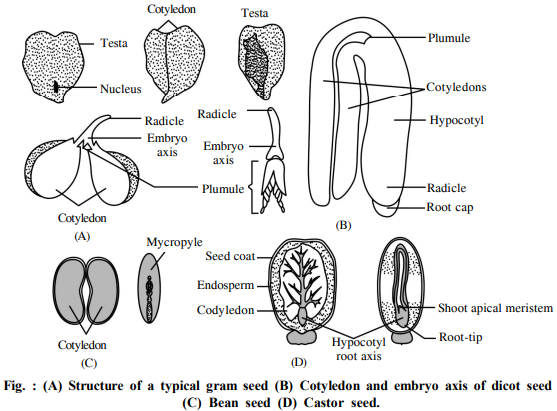
Monocot seed : It has only one cotyledon which is called scutellum in grass family. It is shield shaped. Scutellam is situated on one side of the embryonal axis laterally at the lower and the embryonal axis has the radical and root cap and closed in an undifferentiated sheet called coleorrhiza. The portion of the embryonal above the level of attrachment of scutellum is the epicotyl. Epicotyl has a shoot apex and a few leaf primordia enclosed in a hollow foliar structure, the oleoptile (Fig.).
Image
Dicot Seed : Seed is covered by one or two envelope called seed coat. The outer seed coat is called testa and inner seed coat is tegmen. Some seeds have only one seed coat. Outer covering is thick and hard which protect the embryo in adverse condition and during dormancy period. Tegmen is very thin.
Dicot has two cotyledons situated laterally to embryonal axis on both side. The portion of embryonal axis above the level of cotyledons is the epicotyls which terminates with the plumule or stem tip. The cylindrical portion below the level of cotyledons is hypocotyl terminates at its lower and in the radical or root tip. The root tip is covered with a root cap. Those cotyledons which do not have endosperm they become thick and pulpy by absorbing the endosperm. In some seeds, cotyledons come about the surface of soil during germination and synthesize the food by carrying out photosynthesis till the first leaf be formed.
On the basis of presence or absence of endosperm seeds are of two types:
Endospermic seed : In some sheets embryo is bounded by a special parenchyma tissue which stores the food in plenty and provide nourishment to the developing embryo this tissue is called endosperm and those in which endosperm is present are called endospermic or albuminous seeds. Most of the monocot plant e.g. wheat maize, rice, barley and some of the dicot seed like castor bean are endospermic seeds.
Non-endospermic seed : Some plants like gram peer, bean, bottle gourd sunflower etc. seeds are divided of endosperm as it is used by the developing embryo. The sheets are also called X album in a sheet and they store the food in cotyledons thereby they are thick and pulpy.

Need a full question paper?

Generate a complete, print-ready paper with questions like this in minutes — across 16+ boards, with answer keys.
Start Generating Free

Similar questions

Which type of food would have lactic acid bacteria. Discuss their useful application.
Answer the following questions:
Differentiate between gametogenesis in human males and females on the basis of:
  1. Time of initiation of the process.
  2. Products formed at the end of the process.
Draw a neat diagram of the female reproductive system and label the parts associated with the following (a) production of gamete, (b) site of fertilisation (c) site of implantation and, (d) birth canal.
Why are colour blindness and thalassemia categorised as Mendelian disorders? Write the symptoms of these diseases seen in people suffering from them.
Describe the steps in producing somatic hybrids from protoplast.
Read the following and answer any four questions from (i) to (v) given below:
Gene therapy is the technique of genetic engineering to replace a faulty gene by a normal healthy functional gene. It is a way of treating genetic disease by introducing a piece of DNA into the cells of an affected individual. Liposomes can be used for gene therapy as they target the cells affected by a genetic disease.
  1. A patient suffers from adenosine deaminase (ADA) deficiency, an autosomal recessive immune deficiency in which bone marrow lymphoblasts cannot replicate to generate immuno-competent lymphocytes. The treatment option that would cure the patient is:
  1. Germ-line gene therapy to replace one ADA gene copy.
  2. Germ-line gene therapy to replace both ADA gene copies.
  3. Somatic cell gene therapy to replace both ADA gene copies in circulating lymphocytes.
  4. Somatic cell gene therapy to replace one ADA gene copy in bone marrow lymphoblasts.
  1. Which type of gene therapy is least effective in transferring DNA to the nucleus?
  1. Adenoviruses.
  2. DNA attached to a ligand.
  3. Liposomes.
  4. Retroviruses.
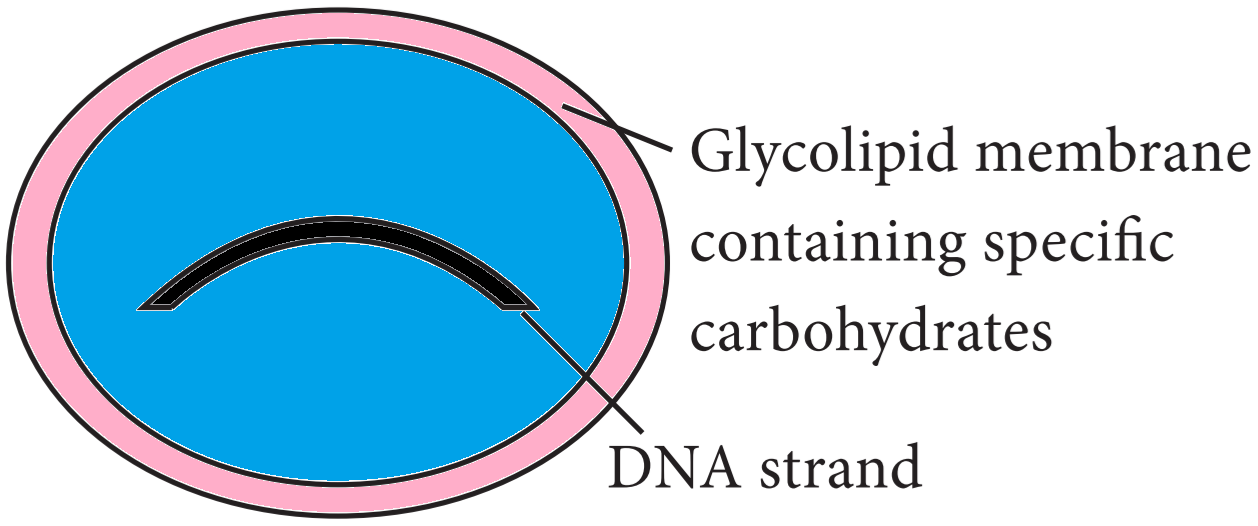
  1. Liposomes can be used for gene therapy as they target the cells affected by a genetic disease. The diagram shows the structure of a liposome.


What feature of a cell surface membrane allows the liposome to target cells affected by a genetic disease?
  1. Carrier molecules.
  2. Phosphate groups.
  3. Protein channels.
  4. Receptor molecules.
  1. Which of the following disorders would gene therapy be least effective?
  1. Cystic fibrosis.
  2. Huntington's disease.
  3. Sickle cell anaemia.
  4. Type II diabetes.
  1. Following are some reasons explaining why gene therapy is not yet fully an effective treatment for genetic diseases.
  1. Lack of knowledge of DNA sequences.
  2. Lack of efficient and safe gene delivery system.
  3. Cost of the technology.
  4. Some diseases involve multiple genes.
  5. Problems with appropriate gene regulation.
Select the correct option.
  1. I, III and V only
  2. II, IV and V only
  3. Ill, IV and V only
  4. I, III and IV only
  1. Draw a simplified model of phosphorus cycling in a terrestrial ecosystem.
  2. Write the importance of such cycles in ecosystems.
Answer the following questions:
When and where does spermatogenesis occur in a human male?
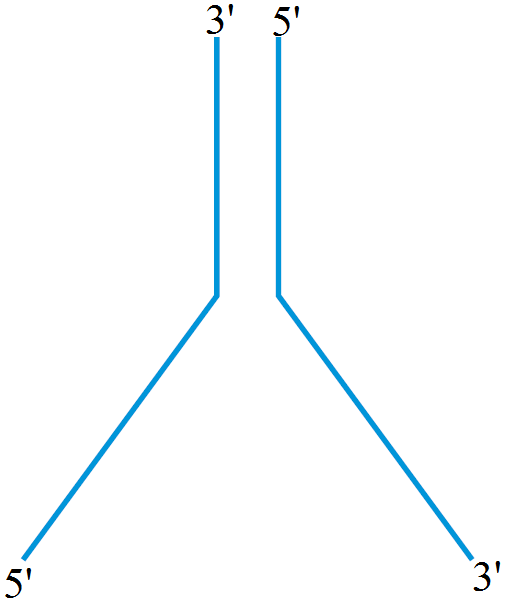
  1. Identify the structure shown above.
  2. Redraw the structure as a replicating fork and label the parts.
  3. Write the source of energy for this replication and list the enzymes involved in this process.
  4. Mention the difference in the synthesis based on the polarity of the two template strands.
How and why is the bacterium Thermus aquaticus employed in recombinant DNA technology? Explain.