Question
Displacement current is continuous:

Answer

  1. when electric field is changing in the circuit
Explanation:
Displacement current is a quantity appearing in Maxwell's equations that is defined in terms of the rate of change of electric displacement field.
When electric field is changing with time continuously, the displacement current is constant.

Need a full question paper?

Generate a complete, print-ready paper with questions like this in minutes — across 16+ boards, with answer keys.
Start Generating Free

Similar questions

Which of the following has its permeability less than that of free space?
Which of the following unit is not free from error?
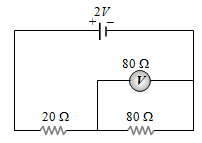
In the adjoining circuit, the e.m.f. of the cell is $2$ volt and the internal resistance is negligible. The resistance of the voltmeter is $80$ ohm. The reading of the voltmeter will be
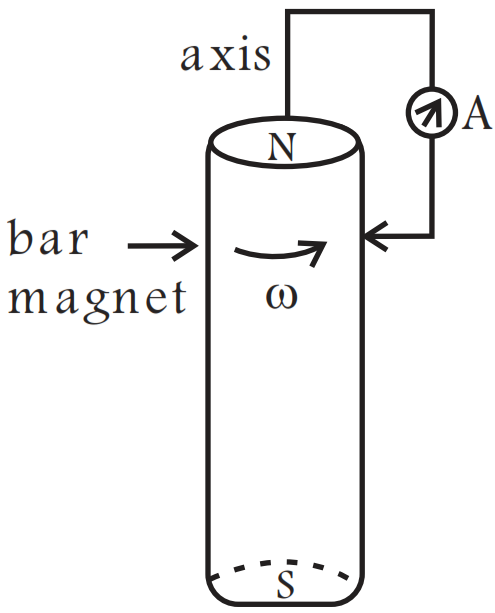
A cylindrical bar magnet is rotated about its axis (Fig). A wire is connected from the axis and is made to touch the cylindrical surface through a contact. Then,
Let $n^p$ and $n^e$ be the number of holes and conduction electrons respectively in a semiconductor. Then
In a working nuclear reactor, Cadmium rods, (control rods) are used to(a) Speed up neutrons(b) Slow down neutrons(c) Absorb some neutrons(d) Absorb all neutrons
   
   
Electronic configuration of germanium is 2, 8, 18 and 4. To make it extrinsic semiconductor small quantity of antimony is added(a) The material obtained will be N-type germanium in which electrons and holes are equal in number(b) The material obtained will be P-type germanium(c) The material obtained will be N-type germanium which has more electrons than holes at room temperature(d) The material obtained will be N-type germanium which has less electrons than holes at room temperature


If the light moving in a straight line bends by a small but fixed angle, it may be a case of:
  1. Reflection.
  2. Refraction.
  3. Diffraction.
  4. Dispersion.
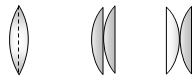
Two similar plano$-$convex lenses are combined together in three different ways as shown in the adjoining figure. The ratio of the focal lengths in three cases will be
A 5cm long solenoid having 10 ohm resistance and 5mH inductance is joined to a 10V battery. At steady state, the current through the solenoid (in ampere) will be.