Questions · Page 1 of 4

M.C.Q (1 Marks)

🎯

Test yourself on this topic

50 questions · timed · auto-graded

Question 11 Mark
If the frequency of EM radiations is halved then the energy of EM radiation will become:
Answer
  1. Becomes half
View full question & answer
Question 31 Mark
The angular frequency of emf wave will be $($in $\frac{\text{rad}}{\text{s}})$
Answer
Frequency of wave $f = 40 \times 106 Hz$
Angular frequency, $\omega=2\pi\text{v}$
$\omega=2\pi\times40\times10^6$
$\Rightarrow\omega=8\pi\times10^7\frac{\text{rad}}{\text{s}}$
View full question & answer
Question 51 Mark
An electric field $\overrightarrow{\text{E}}$ and a magnetic field $\overrightarrow{\text{B}}$ exist in a region. The fields are not perpendicular to each other.
Answer
  1. An electromagnetic wave may be passing through the region.
Explanation:
For an electromagnetic wave,electric field, magnetic field and direction of propagation are mutually perpendicular to each other. We can have a region in which electric and magnetic fields are applied at an angle with each other. In transmission lines Different modes exist. In transverse electric (TE) mode-no electric field exist in the direction of propagation. These are sometimes called H modes because there is only a magnetic field along the direction of propagation (His the conventional symbol for magnetic field).
View full question & answer
Question 61 Mark
Which of the following cannot travel in vacuum?
Answer
  1. Infrasonic waves
Explanation:
Radio waves, gamma waves, and infrared waves are electromagnetic waves and due to this they do not need any material medium to travel and hence, can travel in vacuum. Whereas, infrasonic waves are mechanical waves and so, they need a material medium to travel. Therefore, infrasonic waves cannot travel in vacuum.
View full question & answer
Question 81 Mark
If the magnetic field of an electromagnetic wave is given as $B_{y ​}= 2 \times 10^{-7} \sin(10^3x + 1.5 \times 10^{12}t)$ tesla, the wavelength of the electromagnetic wave is.
Answer
The general equation of an electromagnetic wave is $\text{B = A}\sin(\text{kx + }\omega\text{t})$
Comparing this equation with the given equation, $A = 2 \times 10^{-7}, k = 10^3$ and $\omega = 1.5 \times 10^{12}$
So, $10^3=\frac{2\pi}{\lambda}$
or $\lambda=6.28\times10^{-3}\text{m}$
$=6.28\ \text{mm}$
View full question & answer
Question 91 Mark
A plane electromagnetic wave with a single frequency moves in vacuum in the positive x direction. Its amplitude is uniform over the yz plane. the amplitude of its magnetic field. 
Answer
  1. same
Explanation:
The same amount of energy passes through equal areas parallel to the yz plane as the wave travels in the +x direction, so the amplitude and the intensity, which is proportional to the square of the amplitude, do not change.
View full question & answer
Question 101 Mark
Which of the following is not true for electromagnetic waves?
Answer
  1. They travel at different speeds in air depending on their frequency.
Explanation:
They travel at different speed in air depending on their frequency. At constant as the speed will be same irrespective of frequency. Also frequency is source dependent and doesn't controls speed.
View full question & answer
Question 111 Mark
A plane electromagnetic wave of frequency $28 \ MHz$ travels in free space along the positive $x-$direction. At a particular point in space and time, electric field is $9.3\ V/m$ along positive $y-$direction. The magnetic field $($in $T)$ at that point is
Answer
$\text{B}=\frac{\text{E}}{\text{C}}$
$=\frac{9.3}{3\times10^8}$
$=3.1\times10^{-8}$
View full question & answer
Question 121 Mark
 When is the conduction current the same as the displacement current?
Answer
  1.  When the source is ac
Explanation:
The conduction current is the same as the displacement current when the source is ac.
View full question & answer
Question 131 Mark
An EM wave of intensity I falls on a surface kept in vacuum and exerts radiation pressure p on it. Which of the following are true?
Answer
  1. Radiation pressure is I/c if the wave is totally absorbed.
  1. Radiation pressure is 2I/c if the wave is totally reflected.
  2. Radiation pressure is in the range I/c < p < 2I/c for real surfaces.
Solution:
Key concept: Radiation pressure (p) is the force exerted by electromagnetic wave on unit area of the surface, i.e., rate of change of momentum per unit area of the surface.
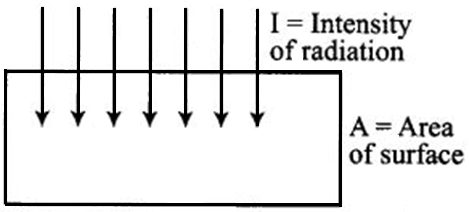
Let us consider a surface exposed to electromagnetic radiation as shown in figure. The radiation is falling normally on the surface. Further, intensity of radiation is I and area of surface exposed to radiation is A.

E = Energy received by surface per second = I.A
N = Number of photons received by surface per second
$\text{N}=\frac{\text{E}}{\text{E}_\text{Photon}}=\frac{\text{E}\lambda}{\text{hc}}=\frac{\text{IA}\lambda}{\text{hc}}$
Now, there are three cases possible which are as follows.
CaseI:
Surface is perfectly reflecting
$\Delta\text{P}_\text{one photon}=\text{Change in momentum}=\frac{2\text{h}}{\lambda}$
$\therefore\ \text{Total force experienced F}=\text{N}\times\Delta\text{P}_\text{one photon}=\frac{2\text{IA}}{\text{c}}$
Also, pressure $\text{P}=\frac{\text{F}}{\text{A}}=\frac{2\text{I}}{\lambda}$
Case II:
Surface is perfectly absorbing
$\Delta\text{P}_\text{one photon}=\frac{\text{h}}{\lambda}$
$\Rightarrow\ \text{F}=\text{N}\times\Delta\text{P}_\text{one photon}=\frac{\text{IA}}{\text{c}}$
Also, Pressure $\text{P}=\frac{\text{F}}{\text{A}}=\frac{\text{I}}{\text{c}}$
Hence radiation pressure is in the range $\frac{\text{I}}{\text{C}}<\text{P}<\frac{2\text{I}}{\text{c}}$ for real surfaces.
Important Points:
If surface is partly reflecting
Let us consider that surface reflects 70% and absorbs 30% of the incident radiation.
$\text{F}=0.7\Big(\frac{2\text{IA}}{\text{c}}\Big)+0.3\Big(\frac{\text{IA}}{\text{c}}\Big)=\frac{1.7\text{IA}}{\text{c}}$
Remarks:
  1. Radiation force/pressure supports photon theory of radiation.
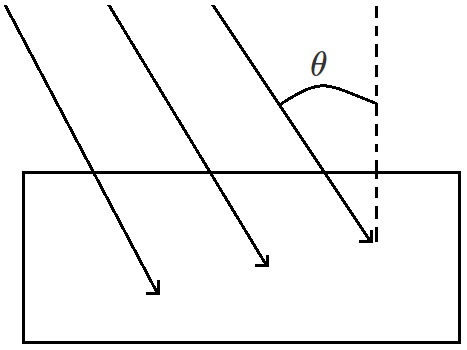
  2. If radiation falls abliquely, then appropriate projection of area vector is taken.

For situation as shown in figure,
$\text{F}=\frac{2\text{IA}\cos^2\theta}{\text{c}}$, for perfectly reflecting surface
$\text{F}=\frac{\text{IA}\cos\theta}{\text{c}}$, for perfectly absorbing surface
$\text{F}=\frac{1.4\text{IA}\cos^2\theta}{\text{c}}+\frac{0.3\text{IA}\cos \theta}{\text{c}}$, for partially reflecting surface.
View full question & answer
Question 141 Mark
An electromagnetic wave, going through vacuum is described by $\text{E}=\text{E}_0\sin(\text{kx}-\omega\text{t}.)$ Which of the following is independent of wavelength?
Answer
  1. $\frac{\text{k}}{\omega}$
Explanation:
$\text{k}=\frac{2\pi}{\lambda}$
$\omega=\frac{2\pi\text{c}}{\lambda},$ where c is the velocity of light 
Hence, $=\frac{\text{k}}{2\pi}=\frac{\omega}{2\pi\text{c}}$
$\Rightarrow\frac{\text{k}}{\omega}$ is independent of the wavelength.
 
View full question & answer
Question 151 Mark
When electromagnetic waves enter the ionised layer of ionosphere, then the relative permittivity i.e. dielectric constant of the ionised layer:
Answer
  1. Appears to decrease
View full question & answer
Question 161 Mark
According to Maxwell's equation, the velocity of light in any medium is expressed as.
Answer
  1. $\frac{1}{\sqrt\mu\epsilon}$
Explanation:
Velocity of light in a medium,
$\text{c}=\frac{1}{\sqrt{\mu_0\epsilon_0\mu_\text{r}\epsilon_\text{r}}}=\frac{1}{\mu_0\epsilon_0}$
View full question & answer
Question 171 Mark
Electromagnetic waves travel only through.
Answer
  1. oscillating electric and magnetic fields whose directions are perpendicular to each other
Explanation:
Electromagnetic waves travel through oscillating electric and magnetic fields whose directions are perpendicular to each other.
View full question & answer
Question 181 Mark
Displacement current goes through the gap between the plates of a capacitor when the charge of the capacitor:
Answer
  1. Increases.
  2. Decreases.
Explanation:
Displacement current inside a capacitor,
$\text{i}_\text{d}=\epsilon_0\frac{\text{d}\phi_\text{E}}{\text{dt}},$ where
$\phi_\text{E}$ is the electric flux inside the capacitor.
Up to the time the electric flux changes, there will be a displacement current. This is possible when the charge on a capacitor changes. Therefore, the displacement current goes through the gap between the plates of a capacitor when the charge of the capacitor or electric field increases or decreases inside the capacitor.
View full question & answer
Question 191 Mark
Which of the following radiations are used to treat muscle ache?
Answer
  1. Infrared Rays
Explanation: 
Infrared rays are used to treat muscle aches.
View full question & answer
Question 201 Mark
Choose the correct answer from the alternatives given.
The amplitude of an electromagnetic wave in vaccum is doubled with no other changes made to the wave. As a result of this doubling of the amplitude, which of the following statement is correct?
Answer
  1. None of the above is correct
Explanation:
As we know, velocity of electromagnetic wave,
$\text{c}=\frac{1}{\sqrt{\mu_0\epsilon_0}}=\frac{3\times10^8\text{m}}{\text{s}}$ 
which is constant
So It is independent of amplitude of electromagnetic wave, frequency and wavelength of electromagnetic wave.
so none of the above is correct.
View full question & answer
Question 211 Mark
A plane electromagnetic wave travels in vacuum along $\hat{\text{k}}$ direction, where $\hat1\hat{\text{j}}$​ and $\hat{\text{k}}$ are unit vectors along the x, y and z directions. The direction along which the electric and the magnetic field vectors point may be respectively.
Answer
  1. $\hat{\text{k}}\text{ and }\hat{\text{j}}$
Explanation:
Electromagnetic wave is a transverse wave that means the electric and magnetic field associated to it will not only be perpendicular to each other but will also be
perpendicular to the direction in which the wave travels.
So, if waves travel along $\hat{\text{k}}$ direction then the electric and the magnetic field will be along $\hat{\text{i}}$ and $\hat{\text{j}}$​ directions.
View full question & answer
Question 221 Mark
Choose the correct answer from the alternatives given.
The conduction current is the same as displacement current when the source is.
Answer
  1. AC only
Explanation:
For a capacitor, we have:
Q = CV
If Q is changing, there will be a current in capacitor plates,
$\text{I}=\frac{\text{dQ}}{\text{dt}}=\frac{\text{CdV}}{\text{dt}}$when voltage across the capacitor is constant, $\frac{\text{dV}}{\text{dt}}=0$
therefore, I = 0
It implies that, for a DC (constant) voltage, the capacitor current is zero.
Hence, for a DC source the conduction current and displacement current (capacitor current) are not same.
Whereas, by Maxwell's equation for a time varying voltage (AC voltage), both conduction and displacement currents are same.
View full question & answer
Question 231 Mark
10cm is a wavelength corresponding to the spectrum of:
Answer
  1. Microwaves
Explanation:
Microwaves have wavelength around 10cm.
View full question & answer
Question 241 Mark
The condition under which a microwave over heats up a food item containing water molecules most efficiently is:
Answer
  1. The frequency of the microwaves must match the resonant frequency of the water molecules.
Explanation:
When frequency of microwave matches with frequency of water molecules i.e., resonant condition. Maximum energy is transferred to water molecules as their K.E. energy.
View full question & answer
Question 251 Mark
Which of the following type of radiations are radiated by on oscillating electric charge?
Answer
  1. Electromagnetic
Explanation:
Any stationary charge produce static electric field. And the field strength is given by:
r, is the radial distance from the point charge.
Q, is the charge in Coulomb.
When electric charge oscillates electric field at any point also oscillates.And according to Maxwell's equations varying electric field produces magnetic field and an oscillating electric field produces oscillating magnetic field. This thing is used in antennas in which oscillating current of certain frequency produces oscillating electric and magnetic field which propagates through space(electromagnetic waves).
View full question & answer
Question 261 Mark
Two opposite charged particles oscillate about their mean equilibrium position in free space, with a frequency of $10^9 \ Hz.$ The wavelength of the corresponding electromagnetic wave produced is $.........:$
Answer
Electromagnetic wave $V = 3\times 10^8m/s$
Given frequency $(f) = 10^9Hz$
$\text{V}=\text{f}\lambda$
$\lambda=\frac{\text{V}}{\text{f}}$
$=\frac{3 \times 10^8} {10^9}$
$​= 0.3m$
View full question & answer
Question 271 Mark
Which of the following effects could not be explained by Maxwell's electromagnetic wave theory?
Answer
  1. All of these
Explanation:
  1. Photoelectric effect was discovered by heinrich Rudoy Hertz.
  2. Compton effect was discovered by Aethur Holl Compton.
  3. Raman effect was discovered by Sir Chandrasekhar Venbata Ram. 
So, none of these effect was discovered by Maxwell.
View full question & answer
Question 281 Mark
A charged particle oscillates about its mean equilibrium position with a frequency of $109 \ Hz.$ The frequency of electromagnetic waves produced by the oscillator is$:$
Answer
$10^9 \ Hz$
View full question & answer
Question 301 Mark
An electromagnetic wave can be produced when the charge is
Answer
  1. Both (a) and (c)
Explanation: 
An accelerated charge is the source of electromagnetic waves (EMWs). When the charge is in a circular motion, the direction of its velocity continuously changes and thus it is in accelerated motion and produces EMWs. A charge falling in an electric field is accelerated by the electric force and thus produces EMWs.
View full question & answer
Question 311 Mark
A $1000\Omega$ resistance and a capacitor of $100\Omega$ resistance are connected in series a 220V source. when the capacitor is 50% charged, the value of the displacement current is.
Answer
  1. 2.2A
Explanation:
Displacement current $=\text{I}_\text{D}=\text{C}\frac{\text{dV}}{\text{dT}}=\text{C}\omega\text{V}_\text{o}=\frac{\text{V}_\text{o}}{\text{X}_\text{c}}=\frac{220\text{V}}{100\Omega}=2.2\text{A}$ 
As we are asked amplitude of displacement current. So, we don't have to worry about charge on capacitor.
View full question & answer
Question 321 Mark
A plane electromagnetic wave of frequency $20 \ MHz$ travels through a space along $x$ direction. If the electric field vector at a certain point in space is $6 \ Vm^{-1},$ what is the magnetic field vector at that point?
Answer
Velocity of $EM$ wave $\text{v}=\frac{3\times10^8\text{m}}{\text{s}}$
Electric field vector $\text{E}=\frac{6\text{V}}{\text{m}}$
Thus magnetic field vector $\text{B}=\frac{\text{E}}{\text{v}}$
$\therefore\text{B}=\frac{6}{3\times10^8}$
$=2\times10^{-8}\text{T}$
View full question & answer
Question 331 Mark
 Which waves are used by artificial satellites for communication?
Answer
  1. Microwaves
Explanation: 
Microwaves are used by artificial satellites for communication.
View full question & answer
Question 341 Mark
The energy contained in a small volume through which an electromagnetic wave is passing oscillates with:
Answer
  1. Double the frequency of the wave.
Explanation:
The energy per unit volume of an electromagnetic wave,
$\text{u}=\frac{1}{2}\in_0\text{E}^2+\frac{\text{B}^2}{2\mu_0}$
The energy of the given volume can be calculated by multiplying the volume with the above expression.
$\text{U}=\text{u}\times\text{V}=\Big(\frac{1}{2}\in_0\text{E}^2+\frac{\text{B}^2}{2\mu_0}\Big)\times\text{V}\ ....(\text{i})$
Let the direction of propagation of the electromagnetic wave be along the z-axls. Then, the electric and magnetic fields at a particular point are given by,
$\text{E}_\text{x}=\text{E}_0\sin(\text{kz}-\omega\text{t})$
$\text{B}_\text{y}=\text{B}_0\sin(\text{kz}-\omega\text{t})$
Substituting the values of electric and magnetic fields in (1) we get,
$\text{U}=\Big(\frac{1}{2}\in_0\big(\text{E}_0^2\sin^2(\text{kz}-\omega\text{t})+\frac{\text{B}^2_0\sin^2(\text{kz}-\omega\text{t})}{2\mu_0}\Big)\times\text{V}$
$\text{U}=\Big(\in_0\text{E}^2_0\frac{(1-\cos(2\text{kz}-2\omega\text{t}))}{4}+\frac{\text{B}_0^2(1-\cos(2\text{kz}-2\omega\text{t}))}{4\mu_0}\Big)\times\text{V}$
From the above expression, it can be easily understood that the energy of the electric and magnetic fields have angular frequency $2\omega$ Thus. the frequency of the energy of the electromagnetic wave will also be double.
View full question & answer
Question 351 Mark
From Maxwell’s hypothesis, a charging electric field gives rise to:
Answer
  1. a magnetic field.
Explanation:
A charging electric field gives rise to a magnetic field.
View full question & answer
Question 361 Mark
Light with an energy flux of $20W/cm^2$ falls on a non$-$reflecting surface at normal incidence. If the surface has an area of $30\ cm^2$. the total momentum delivered $($for complete absorption$)$ during $30$ minutes is:
Answer

Givne energy flux $\phi=20\frac{\text{W}}{\text{cm}^2}$
Area, $A = 30\ cm^2$
Time, $t = 30min = 30 \times 60s$
Now, total energy falling on the surface in time $t$ is,
$\text{U}=\phi\text{At}=20\times30\times(30\times60)\text{J}$
Momentum of the incident light $=\frac{\text{U}}{\text{c}}$
$=\frac{20\times30\times(30\times60)}{3\times10^{8}}=36\times10^{-4}\text{kg-ms}^{-1}$
Momentum of the reflected light $= 0$
$\therefore$ Momentum delivered to the surface
$=36\times10^{-4}-0=36\times10^{-4}\text{kg-ms}^{-1}$
Important points
Mass of photon:
Actually rest mass of the photon is zero. But its effective mass is given as $\text{E}=\text{mc}^2=\text{hv}$
$\Rightarrow\ \text{m}=\frac{\text{E}}{\text{C}^2}=\frac{\text{hv}}{\text{C}^2}=\frac{\text{h}}{\text{c}\lambda}$. Thsi mass is also known as kintic mass of the photon.
Momentum of the photon:
Momentum $\text{p}=\text{m}\times\text{c}=\frac{\text{E}}{\text{c}}=\frac{\text{hv}}{\text{c}}=\frac{\text{h}}{\lambda}$
Number of emitted photons:
The number of photons emitted per second from a source of monochromatic radiation of wavelengh $\lambda$ and power $P$ is given as $\text{(n)}=\frac{\text{P}}{\text{E}}=\frac{\text{P}}{\text{hv}}=\frac{\text{P}\lambda}{\text{hc}}$; where $E =$ energy of each photon
Inrensity of light $(I):$
Energy crossing per unit area normally per second is called intensity or energy flux
i.e. $\text{I}=\frac{\text{E}}{\text{At}}=\frac{\text{P}}{\text{A}}\Big(\frac{\text{E}}{\text{t}}=\text{P}=\text{radiation Power}\Big)$
At a distance r from a point source of power $P$ intensity is given by $\text{I}=\frac{\text{P}}{4\pi\text{r}^2}\Rightarrow\ \text{I}\propto\frac{1}{\text{r}^2}$.

View full question & answer
Question 371 Mark
The frequency of incident light falling on a photosensitive metal plate is doubled, the kinetic energy of the emitted photoelectrons is.
Answer
$v \rightarrow 2v hv − hv_o ​= KG_{max​}$
So, $KG_{max}​ > 2KG_{max​}$
as $hv_o$​ is constant
View full question & answer
Question 381 Mark
What is the frequency of electromagnetic waves in a vacuum that have the same wavelength as a $500.0 \ Hz$ sound wave moving at $\frac{345\text{m}}{\text{s}}$?
Answer
$4.35 \times 10^8 \ Hz$
View full question & answer
Question 391 Mark
The waves which are electromagnetic in nature are:
Answer
  1. Light waves and X-rays
Explanation:
Light waves and X-rays are electromagnetic waves.
View full question & answer
Question 401 Mark
Dimensions of $\frac{1}{(\mu_0\epsilon_0)}$ is:
Answer
  1. $\frac{\text{L}^2}{\text{T}^2}$
Explanation:
The speed of light, $\text{C}=\frac{1}{\sqrt{\mu_0\epsilon_0}}$
The dimensions of $\frac{1}{\sqrt{\mu_0\epsilon_0}}$ are of velocity, i.e., $\frac{\text{L}}{\text{T}}$
Therefore, $\frac{1}{\epsilon_0\mu_0}$ will have dimensions $\frac{\text{L}^2}{\text{T}^2}$
View full question & answer
Question 411 Mark
A. Current flow inside the capacitor due to accumulation of charges on the capacitor walls is called displacement current.
B. Current due to the flow of electrons due to some potential difference is called as conduction current. 
C. Displacement current came into existence when Maxwell observed that if a magnetic compass is placed between the capacitors the needle gets deflected which signifies presence of magnetic fields which would possibly caused due to some changing current.
D. Displacement current change the actual motion of electric charges.
Which of the above statement(s) is/ are correct?
Answer
  1. A, B and C only
Explanation:
Displacement current is a quantity appearing in Maxwell's equations that is defined in terms of the rate of change of electric displacement field. Displacement current came into existence when Maxwell observed that if a magnetic compass is placed between the capacitors the needle gets deflected which signifies presence of magnetic fields which would possibly caused due to some changing current. Current flow inside the capacitor due to accumulation of charges on the capacitor walls is called displacement current.However it is not an electric current of moving charges, but a 'time-varying electric field'.
View full question & answer
Question 421 Mark
Electromagnetic wave of intensity $1400 \ W/m^2$ falls on metal surface on area $1.5m^2$ is completely absorbed by it. Find out force exerted by beam.
Answer
For a perfectly absorbing surface,
$\text{F}=\frac{\text{IA​}}{\text{C}}$
$=\frac{(1400\text{W/m}^2×1.5\text{m}^2)​}{(3×10^8\text{m/s})}$
$=7\times10^{−6}\text{N}.$
View full question & answer
Question 431 Mark
The ratio of contributions made by the electric field and magnetic field components to the intensity of an $\ce{EM}$ wave is:
Answer
The intensity of electromagnetic wave is given by,
$I = U_{av}c,$ where $U_{av} =$ Average energy and $c =$ speed of light
Intensity in relation with electric field $\text{U}_\text{av}=\frac{1}{2}\epsilon_0\text{E}_0^2$
Intensity relation with magnetic field $\text{U}_\text{av}=\frac{1}{2}\frac{\text{B}_0^2}{\mu_0}$
Now taking the intensity in terms of electric field,
$(\text{U}_\text{av})_\text{electric field}=\frac{1}{2}\epsilon_0\text{E}_0^2=\frac{1}{2}\epsilon_0(\text{cB}_0)^2\ \ (\because\ \text{E}_0=\text{cB}_0)$
But, $\text{c}=\frac{1}{\sqrt{\mu_0\epsilon_0}}$
$\therefore\ (\text{U}_\text{av})_\text{Electric field}=\frac{1}{2}\epsilon_0\times\frac{1}{\mu_0\epsilon_0}\text{B}_0^2=\frac{1}{2}\frac{\text{B}_0^2}{\mu_0}$
$=(\text{U}_\text{av})_\text{magnetic field}$
Hence the energy in electromagnetic wave is divided equally between electric field vector and magnetic field vector.
It means the ratio of contributions by the electric field and magnetic field components to the intensity of an electromagnetic wave is $1:1.$
Impotant point:
Propertioe of $\ce{EM}$ waves
Speed: In free, its speed $\text{c}=\frac{1}{\sqrt{\mu_0\epsilon_0}}$
$=\frac{\text{E}_0}{\text{B}_0}$
$=3\times10^8\text{m/s}.$
In medium $\text{v}=\frac{1}{\sqrt{\mu\epsilon}};$
where $\mu_0 =$ Absolute permeability, $\epsilon_0 =$ Absolute permittivity, $E_0$ and $B_0 =$ Amplitude of electric of field and magnetic field vectors.
Energy: The energy in an $\ce{EM}$ waves is divided equally between the electric and magnetic fields.
Energy density of electric field $\text{u}_\text{e}=\frac{1}{2}\epsilon_0\text{E}^2,$
Energy density of magnetic field $\text{u}_\text{B}=\frac{1}{2}\frac{\text{B}^2}{\mu_0}$
It is found that $u_e = u_B.$
Also $\text{u}_\text{av}=\text{u}_\text{e}+\text{u}_\text{B}=2\text{u}_\text{e}=2\text{u}_\text{B}=\epsilon_0\text{E}^2=\frac{\text{B}^2}{\mu_0}$
Intensity $(I):$ The energy crossing per unit area unit time, perpendicular to the direction of propagation of $\ce{EM}$ wave is called intensity.
$\text{I}=\text{u}_\text{av}\times\text{c}=\frac{1}{2}\epsilon_0\text{E}^2\text{c}=\frac{1}{2}\frac{\text{B}^2}{\mu_0}.\text{c}$
Momentum: $\ce{EM}$ waves also carries momentum, if a portion of $\ce{EM}$ wave of energy $u$ propagating with speed $c,$ then linear momentum $=\frac{\text{Energy (u)}}{\text{Speed (c)}}$
When the incident $\ce{EM}$ wave is completely absorbed by a surface, it delivers energy u and momentum $u/c$ to the surface.
When a wave of energy us is totally reflected from the surface, the momentum delivered to surface is $2u/c.$
Poynting vector $(\vec{\text{S}})$: In $\ce{EM}$ waves, the rate of flow of energy crossing a unit area is described by the poynting vector. Its unit is $\ce{watt/m^2}$​​​​​​​ and $\vec{\text{S}}=\frac{1}{\mu_0}(\vec{\text{E}}\times\vec{\text{B}})=\text{c}^2\epsilon_0(\vec{\text{E}}\times\vec{\text{B}})$.
Because in $\ce{EM}$ waves, $\vec{\text{E}}$ and $\vec{\text{B}}$ are perpendicular to each other, the magnitude of $\vec{\text{S}}$ is $|\vec{\text{S}}|=\frac{1}{\mu_0}\text{E B}\sin90^\circ=\frac{\text{EB}}{\mu_0}=\frac{\text{E}^2}{\mu_\text{C}}$.
The direction of the Poynting vector $\vec{\text{S}}$ at any point gives the wave's direction of travel and direction of energy transport the point.
Radiation Pressure: Is the momentum imparted per second per unit area on which the light falls.
For a perfectly reflecting surface $\text{P}_\text{r}=\frac{2\text{S}}{\text{c}}$;
$S =$ Poynting vector; $c =$ speed of light
For a perfectly absorbing surface $\text{P}_\text{a}=\frac{\text{S}}{\text{c}}$.
The radiation pressure is real that's why tails of comet point away from the sun.
View full question & answer
Question 441 Mark
An  AM radio wave is emitted by a radio antenna and travels across flat ground. Find out the direction of the magnetic field component of the wave?
Answer
  1. Parallel to the ground and perpendicular to the direction of propagation
Explanation:
According to Maxwell an accelerated charge produces a sinusoidal time varying magnetic field which in turn produces a time varying electric field .The two fields so produced are mutually perpendicular to each other and constitute an electromagnetic wave and propagate in space in the direction perpendicular to both the fields. An AM wave is also an electromagnetic wave therefore its magnetic field component would be parallel to ground and perpendicular to the direction of propogation.
View full question & answer
Question 451 Mark
The matter-wave picture of electromagnetic wave/radiation elegantly incorporated the:
Answer
  1. Heinsenbergs uncertainty principle
Explanation:
The matter-wave picture of electromagnetic wave/radiation elegantly incorporated the Heisenberg uncertainty principle.
View full question & answer
Question 461 Mark
In the propagation of electromagnetic waves, the angle between the direction of propagation and plane of polarisation is
Answer
Explanation:
Plane of polarization is a confinement of the electric/ magnetic field vector to a given plane along the direction of propagation. Therefore angle between them is 0°.
View full question & answer
Question 481 Mark
Mark the correct option in impure spectrum:
Answer
  1. Colours are overlapped
Explanation:
The order of colours is are straight, hence option a is false.
Order of colours are regular.
Colours are overlapped each other in impure spectrum.
Colours are present in impure spectrum.
View full question & answer
Question 491 Mark
 Which of the following proves that electromagnetic waves are transverse?
Answer
  1. Polarisation
Explanation:
Only transverse waves can be polarised.
View full question & answer
Question 501 Mark
 Which among the following has a frequency range of 500 kHz to 1000 MHz?
Answer
  1. Radio Waves
Explanation:
Radio Waves are generally in the frequency range ➔ 500 kHz to 1000 MHz. Radio waves are used for long-distance communication, such as in television, mobiles, and radios. These devices receive radio waves and convert them to mechanical vibrations in the speaker to create sound waves.
View full question & answer
M.C.Q (1 Marks) - Physics STD 12 Science Questions - Vidyadip