Question
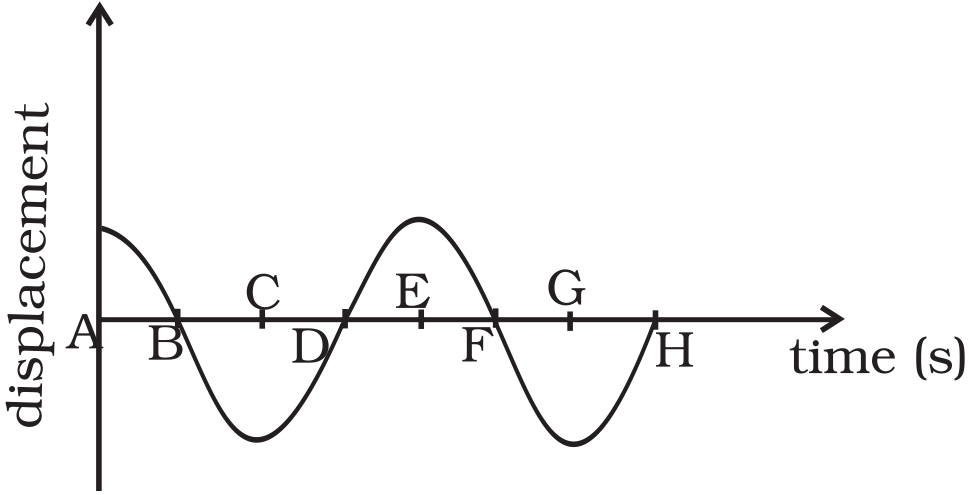
Displacement versus time curve for a particle executing S.H.M. is shown in Fig. Identify the points marked at which,
  1. Velocity of the oscillator is zero,
  2. Speed of the oscillator is maximum.

Answer


Key concept: In displacement-time graph of SHM, zero displacement values correspond to mean position; where velocity of the oscillator is maximum. Whereas the crest and troughs represent amplitude positions, where displacement is maximum and velocity of the oscillator is zero.
  1. The points A, C, E, G lie at extreme positions (maximum displacement, y = A). Hence the velocity of the oscillator is zero.
  2. The points B, D, F, H lie at mean position (zero displacement, y = 0). We know the speed is maximum at mean position.

Need a full question paper?

Generate a complete, print-ready paper with questions like this in minutes — across 16+ boards, with answer keys.

Start Generating Free

Similar questions

Calculate the temperature at which the root mean square velocity of nitrogen molecules will be equal to 8km-s-1.
The temperature of equal masses of three different liquids A, B and C are 12°C, 19°C and 28°C respectively. The temperature when A and B are mixed is 16°C. When B and C are mixed, the temperature is 23°C. What would be the temperature when A and C are mixed?
In the original Fizeau method, the light travelled 8.6km and then returned. What could be the difficulty if this distance is taken as 8.6m?
A parallel-plate capacitor of plate-area A and plate separation d is joined to a battery of emf $\in$ and internal resistance R at t = 0. Consider a plane surface of area $\frac{\text{A}}{2}$ parallel to the plates and situated symmetrically between them. Find the displacement current through this surface as a function of time.
An object falling freely from above is in the last second its total height crosses the division of 16 / 25 then find :
(i) Total height, (ii) Time of fall.
Check by the method of dimensional analysis whether the following relations are correct.
$\text{v}=\sqrt{\frac{\text{P}}{\text{D}}}$ where v = velocity of sound and P = pressure, D = density of medium
$\text{n}=\frac{1}{21}\sqrt{\frac{\text{F}}{\text{m}}},$ where n = frequency of vibration
l = legnth of the string
F = Stretching force
m = mass per unit length of the string.
A square plate of mass 120g and edge 5.0cm rotates about one of the edges. If it has a uniform angular acceleration of 0.2rad/s2, what torque acts on the plate?
The centre of gravity of a body on the earth coincides with its centre of mass for a ‘small’ object whereas for an ‘extended’ object it may not. What is the qualitative meaning of ‘small’ and ‘extended’ in this regard?
For which of the following the two coincides? A building, a pond, a lake, a mountain?
The sufrace tension and vapour pressure of water at 20°C is 7.28 × 10⁻²N m-1 and 2.33 × 10³ Pa, respectively. What is the radius of the smallest spherical water droplet which can form without evaporating at 20°C?
Give examples of a one-dimensional motion where:
The particle moving along positive x-direction comes to rest periodically and moves backward.