Question
Distinguish between: Directional, Stabilizing and Disruptive selection.
| Directional selection | Stabilizing selection | Disruptive selection |
| 1. Natural selection operating in a linear direction is called directional selection. | 1. Natural selection operating to balance or stabilize the population is called stabilizing selection. | 1. Natural selection which disrupts the mean characteristics of a population is called disruptive selection. |
| 2. In directional selection, more individuals acquire characters other than the mean character value. | 2. In stabilizing selection, more individuals of a population acquire a mean character value. | 2. In disruptive selection, more number of individuals acquire extreme or peripheral character value. |
| 3. Directional selection eliminates one of the extremes of the phenotypic range and favour the other. | 3. Stabilizing selection tends to favour the intermediate forms and eliminate both the phenotypic extremes. | 3. Disruptive selection favours extreme phenotypes and eliminate intermediate. |
| 4. It streamlines variations. | 4. It reduces variations. | 4. It increases variations. |
| 5. This kind of selection is the most common. | 5. This kind of selection is common. | 5. This kind of selection is rare. |
| 6. Directional selection operates for many generations, it results in an evolutionary trend within a population and shifting a peak in one direction.E.g. Industrial melanism, DDT resistance in mosquito, etc. | 6. This selection leads to evolutionary change but tend to maintain phenotypic stability within population.E.g. All the populations which have adapted to their environment. | 6. It ensures the effect on the entire gene pool of a population, considering all mating types or systems.E.g. African seed cracker finches with different sized beaks |
Generate a complete, print-ready paper with questions like this in minutes — across 16+ boards, with answer keys.
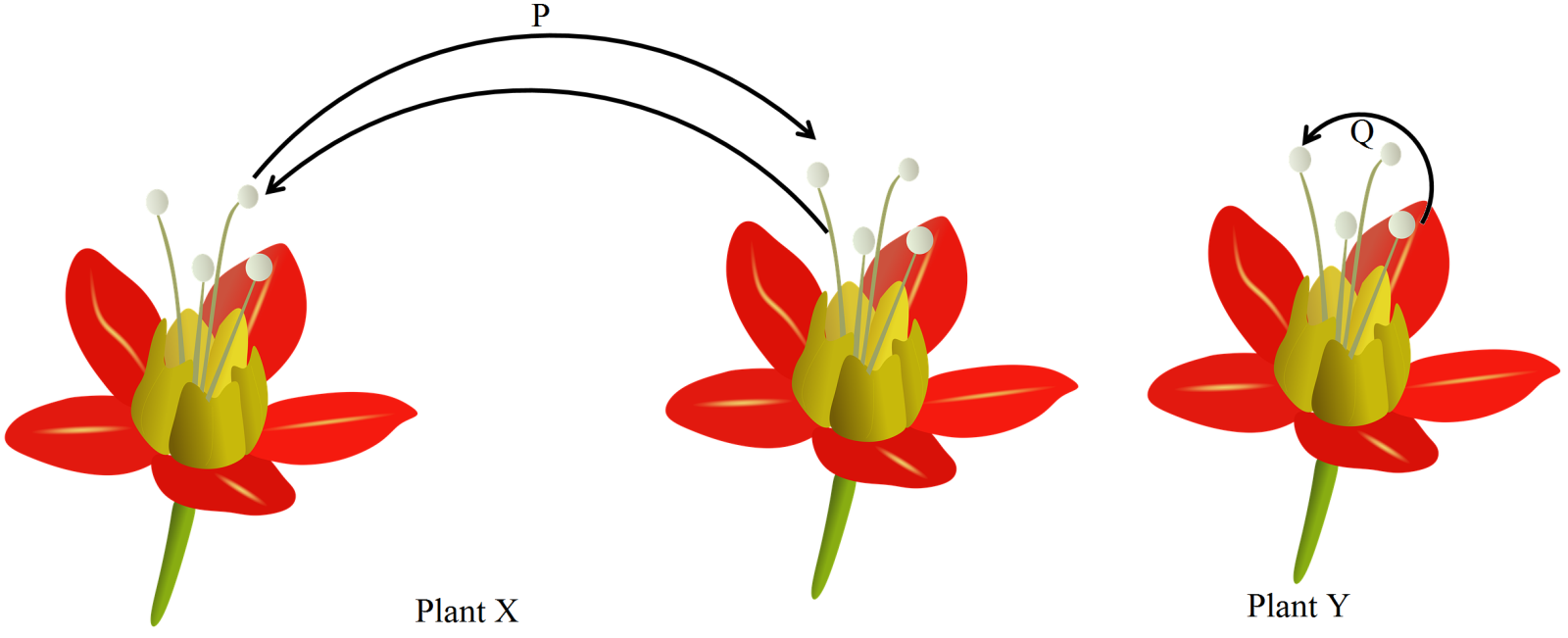
|
S. No
|
P
|
Q
|
R
|
|
(a)
|
Geitonogamy
|
Xenogamy
|
Autogamy
|
|
(b)
|
Allogamy
|
Chasmogamy
|
Cleistogamy
|
|
(c)
|
Autogamy
|
Geitonogamy
|
Xenogamy
|
|
(d)
|
Geitonogamy
|
Allogamy
|
Autogamy
|
| Column A | Column B |
| (1) Walter Rosen | (a) Popularisation of term biodiversity |
| (2) David Tillman | (b) Rivet Popper Hypothesis |
| (3) Paul Ehrlich | (c) Productivity Stability Hypothesis |
| (4) Edward Wilson | (d) Coined |

| Column A | Column B |
| (1) Pioneer species | (a) Entire gradient of communities |
| (2) Climax species | (b) Spatial pattern |
| (3) Succession | (c) Quercus |
| (4) Sere | (d) Crustose lichen |
| Column I (Biofortified crop) | Column II (Nutrient Enrichment) |
| (1) Maize | (a) Five times more iron |
| (2) Rice | (b) Twice the amount of lysine and tryptophan |
| (3) Wheat Atlas-66 | (c) Enriched in vitamin A and minerals |
| (4) Carrots, spinach | (d) High protein content |