Question
Distinguish between : Dura mater and pia mater.

Answer

Dura materpia mater
1. Dura mater is the outermost meninx. 1. Pia mater is the innermost meninx.
2. Dura mater lies on the innermost side of skull or cranium.2. Pia mater lies on outermost side of the brain.
3. Dura mater is tough, thick and fibrous.3. Pia mater is thin and highly vascular.
4. Dura mater is mainly protective in function.4. Pia mater is mainly nourishing in nature.
5. Below dura mater is subdural space.5. Above pia mater is sub-arachnoidal space.

Need a full question paper?

Generate a complete, print-ready paper with questions like this in minutes — across 16+ boards, with answer keys.

Start Generating Free

Similar questions

Read the following and answer any four questions from (i) to (v) given below:
Reerna, Jai and Ankit are suffering from autoimmune diseases of adrenal cortex, joints and thyroid gland, respectively. Their immune system failed to recognise self and non-self and started destroying their body's own proteins. They are seeking proper medical help for their conditions but their condition cannot be cured completely.
Based on the above information, answer the following questions.
  1. Select the option that correctly identifies autoimmune diseases of Reema, Jai and Ankit.
S no.
Reema
Jai
Ankit
(a)
Diabetes
Grave's disease
Rheumatic fever
(b)
Pernicious anaemia
Multiple sclerosis
Myasthenia gravis
(c)
Addison's disease
Rheumatoid arthritis
Hashismoto's thyroiditis
(d)
Systemic lupus erythematosus
Severe combined immunodeficiency disease
AIDS
  1. Reema's autoimmune condition is characterised by
  1. Undersecretion of insulin.
  2. Destruction of RB Cs and low RB C count.
  3. Undersecretion of adrenal cortex hormones.
  4. Low production of intrinsic factor required for absorption of $B_12$
  1. What do you think is the major cause of Jai's condition?
  1. Deterioration of myelin sheath around nerve cells, leading to loss of precise muscle control
  2. Destruction of heart cells, leading to weakening of entire heart wall.
  3. Destruction of beta cells, leading to undersecretion of insulin.
  4. Deposition of immune complexes of IgM, IgG and complement in joints thereby inflaming joints, destroying articular cartilage and fusing bones.
  1. How do you think Ankit's condition got diagnosed?
  1. Low level of thyroid hormone and elevated levels of TSH in Ankit's blood.
  2. Presence of antibodies against thyroid pen oxidase (TPO antibodies) in Ankit's blood.
  3. Elevated erythrocyte sedimentation rate (ESR), reduced C-reactive protein (CRP) in Ankit.
  4. Both (a) and (b)
  1. Assertion: Immunosuppressive drugs often reduce the severity of autoimmune disorders.
Reason: Monoclonal antibodies have been successfully used in the treatment of autoimmune disease.
  1. Both assertion and reason are true, and reason is the correct explanation of assertion.
  2. Both assertion and reason are true, but reason is not the correct explanation of assertion.
  3. Assertion is true, but reason is false.
  4. Both assertion and reason are false.
How is a transgenic tobacco plant protected against Meloidogyne incognita? Explain the procedure.
Column AColumn B
(1) Auxin(a) Bolting in rosette plants
(2) Cytokinin(b) Stimulate flowering in SDP
(3) Gibberellins(c) Promotion of growth of lateral buds
(4) Abscissic acid(d) Apical dominance
Distinguish between : Pharynx and Larynx.
Column AColumn B
(1) Tansley(a) 10% law
(2) C. Elton(b) Ecosystem services
(3) R. Lindemann(c) Ecological pyramids
(4) Millennium Ecosystem Assessment report(d) Ecosystem
Read the following and answer any four questions from (i) to (v) given below:
Population is defined as the total number of individuals of a species present in a particular area at a given time. 'The scientific study of human population is called demography. The rapid increase in population over a relatively short period is called population explosion. Four basic processes are involved in increase or decrease in the population size. Population shows two types of growth; exponential and logistic.
  1. Which of the following factors are responsible for population explosion?
  1. Decrease in number of people of reproducible age.
  2. Decline in infant mortality rate.
  3. Increase in maternal mortality rate.
  4. Rapid decline in death rate.
  1. A and B
  2. B and C
  3. B and D
  4. A and D
  1. What is the shape of curve showing logistic growth?
  1. Sigmoid.
  2. J-shape.
  3. Linear.
  4. Hyperbola.
  1. What is immigration?
  1. Number of individuals of the population who left the habitat.
  2. Number of individuals that have come into the habitat.
  3. Number of individuals of a species per unit area at given time.
  4. Number of births per 1000 individuals.
  1. Equation of Verhulst-Pearl logistic growth is:
  1. $\frac{\text{dN}}{\text{dt}}=\text{rN}$
  2. $\frac{\text{dN}}{\text{dt}}=\frac{\text{K-N}}{\text{k}}$
  3. $\frac{\text{dN}}{\text{dt}}=\text{rN}\Big(\frac{\text{K-N}}{\text{k}}\Big)$
  4. $\frac{\text{dN}}{\text{dt}}=\text{rN}\Big(1-\frac{\text{K-N}}{\text{k}}\Big)\text{r}$
  1. Which of the following contributes to decrease in population?
  1. Fertility.
  2. Natality.
  3. Social mobility.
  4. Emigration.
Column AColumn B
(1) Pioneer species(a) Entire gradient of communities
(2) Climax species(b) Spatial pattern
(3) Succession(c) Quercus
(4) Sere(d) Crustose lichen
CellsFunctions
(1) T-lymphocytes(a) Phagocytic in function
(2) Neutrophils(b) Responsible for Humoral immunity
(3) Eosinophils/Acidophils(c) Responsible for cell-medicated immunity
(4) B-lymphocytes(d) Anti-allergic [Antihistamine] in function
Read the following and answer any four questions from (i) to (v) given below:
Pollen-pistil interaction is the group of events that occur from the time of pollen deposition over the stigma to the time of pollen tube entry into ovule. It is a dynamic process which has checks at several places for promotion or inhibition of pollen growth. Pollen-pistil interaction is a safety measure to ensure that illegitimate crossings do not occur. Compatibility and incompatibility of the pollen-pistil is determined by special proteins. The compatible pollens are able to absorb water and nutrients from the surface of the stigma. They germinate and produce pollen tubes. Pollen tubes grow into the style. Their growth and path through the style are also determined by specific chemicals.
  1. Which of the following parts of gynoecium determines the compatible nature of pollen?
  1. Stigma.
  2. Style.
  3. Ovary.
  4. Thalamus.
  1. In Triforium, which type of self-incompatibility is found?
  1. Gametophytic self-incompatibility (GSI).
  2. Sporophytic self-incompatibility (SSI).
  3. Both GSI and SSI.
  4. None of these.
  1. Select the incorrect statement.
  1. In Asteraceae, incompatibility is due to the genotype of the sporophytic stigmatic tissues.
  2. In members of Brassicaceae, incompatibility is due to the genotype of the pollen.
  3. Nature has imposed self-incompatibility to avoid highly homozygous individuals, which have a very low survival value.
  4. None of these.
  1. Which of the following are examples of self incompatibility?
  1. Tobacco.
  2. Potato.
  3. Crucifers.
  4. All of these.
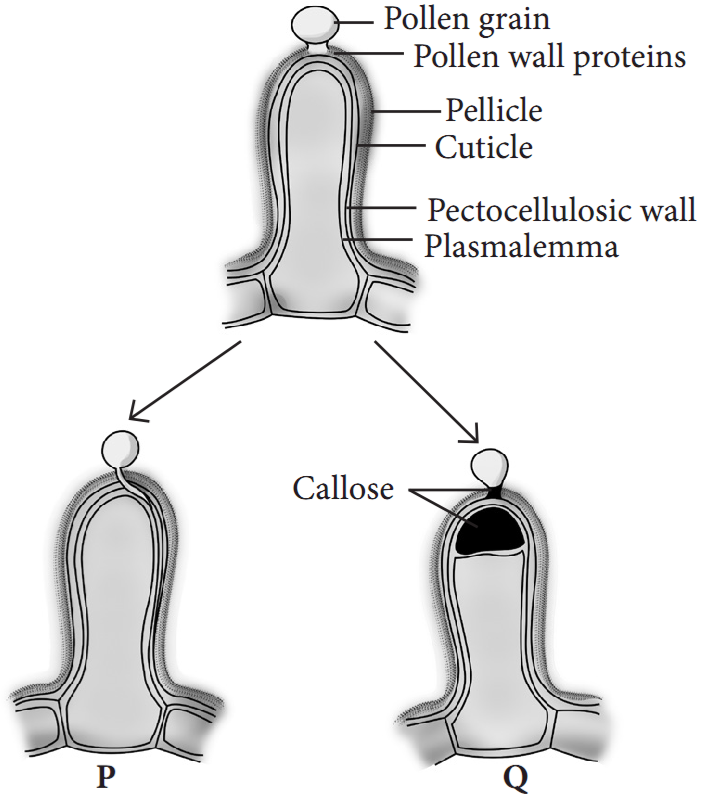
  1. Given figures show the pollen-stigma interaction, where pollen wall proteins are released onto the pellicle of stigmatic papillae, where a recognition reaction occurs.


Which of the following statements drawn from given figures is incorrect?
  1. P indicates compatible reaction in which the pollen tube penetrates the cuticle and grows down the papilla.
  2. Development of callose plug between the plasma membrane and pectocellulosic layer of stigmatic papillae results in the incompatibility reaction in Q.
  3. A callose plug, which appears at the tip of pollen in Q, is dissolved by callase enzyme secreted by stigma resulting in compatibility reaction.
  4. Deposition of callose can be employed as a reliable bioassay to detect compatibility or incompatibility reactions of pollen and stigma.
Column AColumn B
(1) Frederick Griffith(a) Test tube assay
(2) Avery, McCarty and MacLeod(b) Streptococcus pneumoniae
(3) Alfred Hershey and Martha Chase(c) E. coli
(4) Meselson and Stahl(d) Bacteriophages