Question
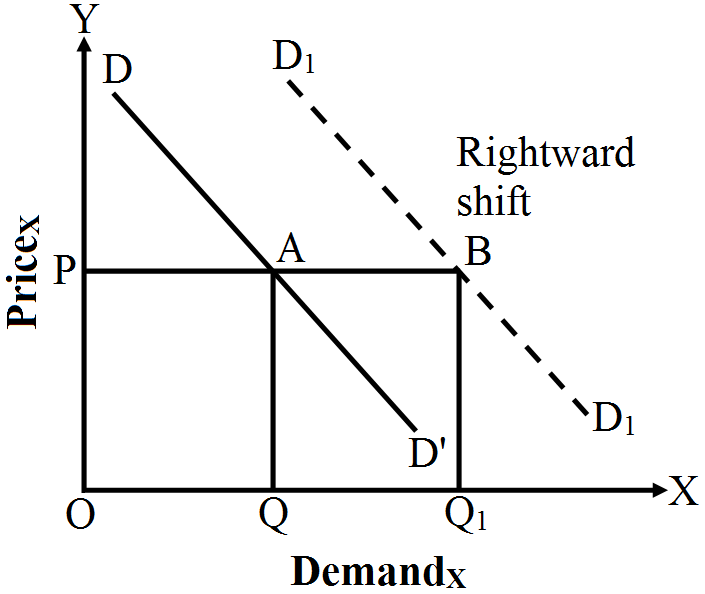
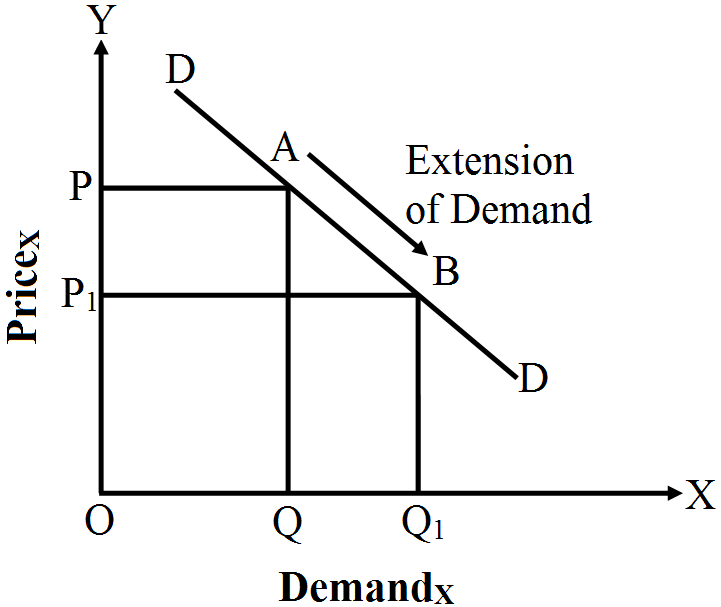
Distinguish between increase in demand and increase in quantity demanded of a good.

Answer

S. No.
Basis
Increase in demand
Increase in quantity demanded
1.
Cause
Increase in demand is due to change in factors other than price of the given good e.g. increase in income, favourable change in tastes etc.
Increases in quantity demanded is due to fall in the own price of the given commodity.
2.
Demand curve
Increase in demand leads to "rightward shift” of the demand curve from $DD$' to $D_1D_1$.
Increase in quantity demanded leads to “downward movement” along a demand curve from point A to point B.
3.
Diagram

Need a full question paper?

Generate a complete, print-ready paper with questions like this in minutes — across 16+ boards, with answer keys.

Start Generating Free

Similar questions

When the price of a commodity falls from 10 per unit to 9 per unit, its quantity supplied falls by 20 percent.
Giving reason, state whether the following statements are true or false.
  1. The demand for a good increases with increase in the income of its buyer.
  2. If the good X and Y are substitutes a rise in the price of X will result in a rightward shift of the demand curve of Y.
Why is AC curve U-shaped in short run?
OR
Why is AC curve U-shaped?
Does production take place only on the PP curve?
Give the meaning of ‘‘inferior’’ good and explain the same with the help of an example.
A firm supplies $200$ units of a good at a price of $5$ per unit. When price changes, it supplies $100$ units less. Price Elasticity of Supply is $2.5$. Calculate price after change.
What can be the effect on equilibrium price of a commodity when its demand and supply curves both shift to left simultaneously? Show three effects with the help of diagrams.
OR
When will the equilibrium price of a commodity not change, if its demand and supply both decrease? Explain with the help of a diagram.
What is shown on X-axis and Y-axis of a graph?
Give reasons for the following statements:
  1. A perfectly competitive firm is a price-taker.
  2. Product differentiation is a characteristic feature of a monopolistic competitive market.
  3. A monopolist cannot fix both the quantity that he likes to produce and the price at which he would like to sell.
An individual is both the owner and the manager of a shop taken on rent. Identify implicit cost and explicit cost ore from this information. Explain.