Question
Distinguish between: Zona pellucida and Corona radiata.

Answer

Zona pellucidaCorona radiata
1. Zona pellucida is inner, thin and transparent layer surrounding the secondary oocyte.1. Corona radiata is the outer thick layer surrounding the secondary oocyte.
2. Zona pellucida is a non-cellular layer.2. Corona radiata is a cellular layer.
3. Zona pellucida is secreted by the ovum itself.3. Corona radiata is formed by follicular cells which are glued together by hyaluronic acid.
4. Zona pellucida is retained for more time after fertilization till the ovum gets implanted in the uterus.4. Corona radiata is retained till the ovum gets fertilized.
5. Zona pellucida is digested by zona lysine or acrosin at the time of fertilization.5. Corona radiata is digested by hyaluronidase enzyme at the time of fertilization.

Need a full question paper?

Generate a complete, print-ready paper with questions like this in minutes — across 16+ boards, with answer keys.

Start Generating Free

Similar questions

Ectomycorrhizae and Endomycorrhizae.
Distinguish between: Passive absorption of Minerals and Active absorption of minerals
Read the following and answer any four questions from (i) to (v) given below:
A 23 year old Sahil has been diagnosed with an infection of reproductive tract caused by bacteria. He complains about burning sensation during urination, pus-containing discharge and pain around genitalia. This infection has incubation period of 2-5 days but can be cured.
  1. From which disease is Sahil suffering?
  1. Chlamydiasis.
  2. Herpes.
  3. Gonorrhoea.
  4. Syphilis.
  1. Which among the following reproductive tract infections is transmitted by bacteria?
  1. Trichomoniasis.
  2. Chancroid.
  3. Genital warts.
  4. Both (a) and (b).
  1. Which mode of treatment would be useful for Sahil?
  1. Cryosurgery.
  2. Use of Podophyllum preparation.
  3. Use of antibiotic ampicillin.
  4. It cannot be treated.
  1. What technique was used to diagnose Sahil's disease?
  1. Gram staining of discharge and culture.
  2. ELISA Test.
  3. Antibody detection.
  4. Antigen test.
  1. Find the odd one out.
  1. Treponema pallidum.
  2. Neisseria gonorrhoeae.
  3. Haernophilus ducreyi.
  4. Trichomonas vaginalis.
Column I [Phases]Column II [Hormonal changes]
(1) Menstrual phase(a) Rapid secretion of LH
(2) Proliferative phase(b) Increased level of FSH and estrogen
(3) Ovulatory phase(c) Increased level of progesterone
(4) Secretory phase(d) Decrease in progesterone and estrogen
Read the following and answer any four questions from (i) to (v) given below:
A typical angiospermic ovule is a small structure attached to the placenta by means of a stalk called funicle. The body of the ovule fuses with funicle in the region called hilum. Each ovule has one or two protective envelopes called integuments. Integuments encircle the nucellus except at the tip where a small opening called the micropyle is formed. Mature ovules are classified on the basis of funiculus. It can be orthotropous, anadromous, hernitropous, campylotropous, etc.
  1. The body of the ovule consists of a mass of parenchymatous cells called:
  1. Integuments.
  2. Nucellus.
  3. Hilum.
  4. Funiculus.
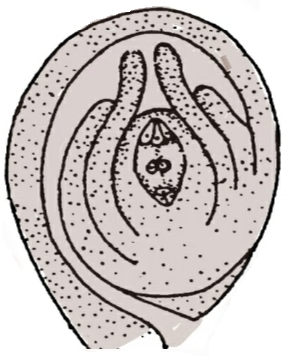
  1. Refer to the given figure and select the correct statement regarding it.
  1. This type of ovule is found in cactus.
  2. The micropyle comes to lie close to the funiculus due to unilateral growth of ovule.
  3. It is most common type of ovule found in the members of Chenopodiaceae.
  4. It is half inverted ovule.
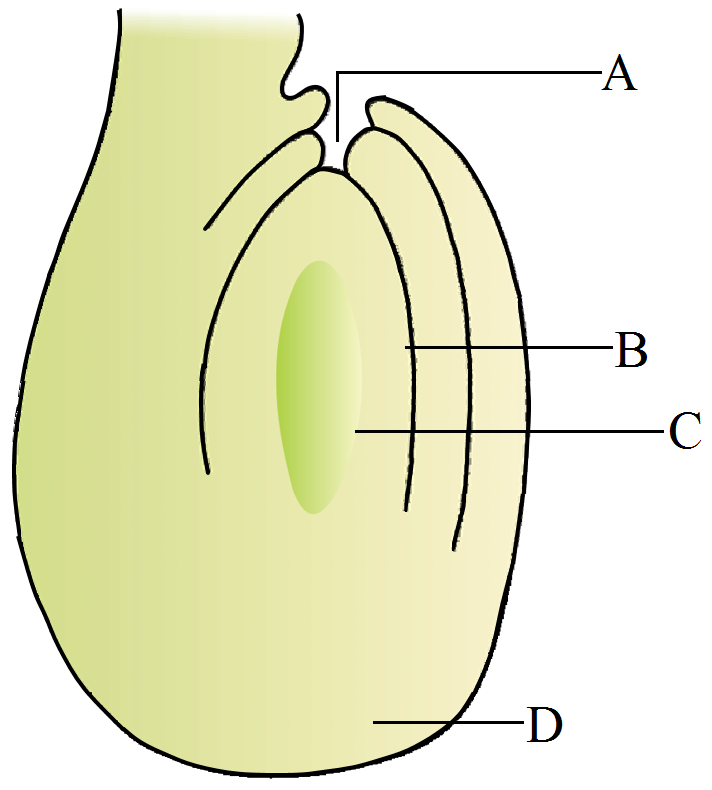
  1. Identify the parts labelled as A, B, C and D in the given figure and select the correct option.
S. No A B C D
(a) Chalaza Female gametophyte Embryo sac Micropyle
(b) Chalaza NuceIIus Embryo sac Micropyle
(c) Micropyle Egg Embryo sac Chalaza
(d) Micropyle Nucellus Embryo sac Chalaza
  1. Mature ovules are classified on the basis of funiculus. If micropyle lie close to the funiculus, the ovule is termed as:
  1. Orthotropous.
  2. Anatropous.
  3. Hemitropous.
  4. Campylotropous.
  1. In Asphodel us, ovule is:
  1. Unitegmic.
  2. Tritegmic.
  3. Bitegmic.
  4. Ategmic.
Read the following and answer any four questions from (i) to (v) given below:
A desert lizard (an ectotherm) and a mouse (an endotherm) are placed inside a chamber at 15ºC and their body temperature [T(L) for the lizard and T(M) for the mouse] and metabolic rates [M(L) for lizard and M(M) for the mouse] are monitored.
  1. Which of the following is correct regardingT(L), M(L), T(M) and M(M)?
  1. T(L) and M(L) will fall while T(M) and M(M) will increase.
  2. T(L) and M(L) will increase while T(M) and M(M) will fall.
  3. T(L) and M(L) will fall, T(M) will remain same and M(M) will increase.
  4. T(L) and M(L) will remain same, T(M) and M(M) will decrease.
  1. It can be said that some animals in their evolutionary development preferred to be ectotherms than endotherms. Which of the following can be the best suited reason for it?
  1. The metabolic reactions of these organisms can occur at a very wide range of temperature.
  2. Maintaining homeostasis is an energetically expensive process.
  3. The enzymes of these organisms are functional at high temperatures.
  4. Both (b) and (c).
  1. Organisms that can maintain a constant internal temperature are called.
  1. Homoeothermic
  2. Poikilothermic
  3. Oligothennic
  4. Heterothennic
  1. An animal that survives at temperature of 10ºC and 40ºC both can be placed under the category of:
  1. Ectotherm.
  2. Endotherm.
  3. Modifiers.
  4. Migratory organisms.
  1. Study the graph carefully and select the correct option.
  1. X could be desert lizard.
  2. Y could be mouse.
  3. Z could be desert lizard.
  4. Both (a) and (b).
Column AColumn B
(1) Organism(a) Large unit with specific climatic zone
(2) Population(b) Different species in particular area
(3) Community(c) Same species in a geographical area
(4) Biome(d) Basic unit of ecological hierarchy
Read the following and answer any four questions from (i) to (v) given below:
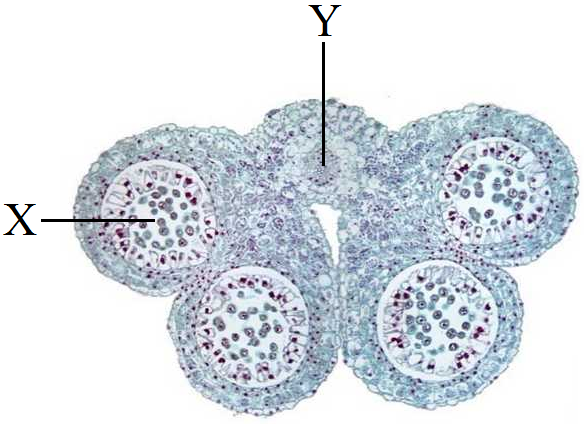
Many adaptations are found in flowers to achieve certain kind of pollination. The pollination achieved by insects is known as entomophily. The given diagram shows the cross-section of an anther of an insect pollinated flower.
  1. Which of the following is/ are the function(s) of structure Y?
  1. To carry waste products away from the anther.
  2. To supply oxygen to the cells of the anther.
  3. To transport food and mineral salts to the anther.
  4. To supply water to the anther.
  1. Conly.
  2. C and D only.
  3. A, B and D only.
  4. A, B, C and D.
  1. Which of the following most accurately describes the structures found in compartment X?
  1. They contain two haploid nuclei resulting from meiosis.
  2. They contain two haploid nuclei resulting from mitosis.
  3. They contain two haploid male gametes, resulting from mitosis.
  4. They contain a vegetative nucleus and pollen tube nucleus.
  1. Which of the following is a distinctive characteristic of insect-pollinated flower?
  1. All of them have nectar guides on their flowers.
  2. They produce sugary fruit.
  3. Their pollen grains tend to have rough surfaces.
  4. They produce abundant quantities of pollen to make up for pollen grains that might be removed by the wind.
  1. Which of the following are likely characteristics of the structures found in X and stamens of this plant?
S. No
Structure of X
Stamens
(a)
Abundant and light
Pendulous
(b)
Rough surfaces
Non-pendulous
(c)
Light and sticky
Pendulous
(d)
Coarse and sticky
Protrude outside the flower
  1. Spiny or sticky pollen grains and large, attractively coloured flowers are associated with:
  1. Hydrophily.
  2. Entomophily.
  3. Ornithophily.
  4. Anemophily.
Read the following and answer any four questions from (i) to (v) given below:
ln a plant species that follows Mendelian inheritance yellow flower colour is dominant over white and round fruits shape is dominant over elongated. Crossing was performed between two purelines-one having yellow-flower and round fruit and another with white flower and elongated fruits. About 20 plants survived in $F_1$ progeny. Plants of $F_1$ were allowed to self fertilise and about 960 plants survived in $F_2$
  1. How many plants would have yellow flower and round fruit in $F_1$ generation?
  1. 20
  2. 10
  3. 5
  4. 0
  1. How many plants would have yellow flower and round fruit in $F_2$​​​​​​​ generation?
  1. 960
  2. 540
  3. 180
  4. 60
  1. Which of the following is correct for the condition when plant heterozygous for yellow flower and round fruit is back crossed with the double recessive parent?
  1. 9 : 3 : 3 : 1 ratio of phenotype only.
  2. 9 : 3 : 3 : 1 ratio of genotype only.
  3. 1 : 1 : 1 : 1 ratio of phenotype only.
  4. 1 : 1 : 1 : 1 ratio of phenotype and genotype.
  1. When the plant heterozygous for yellow flower and round fruit are self crossed, then the plant with yellow flower and elongated fruit will be represented by the genotype?
  1. YyRr, YyRR, YYRr
  2. Yyrr, YYrr, yyrr
  3. yyRr, yyRR
  4. Yyrr, YYrr
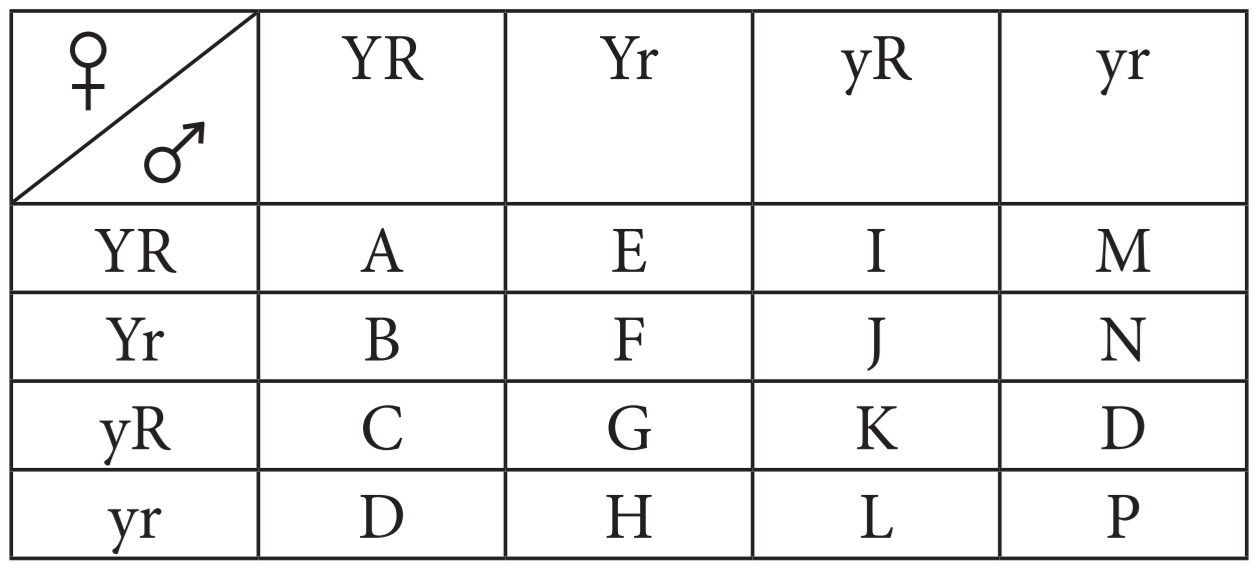
  1. 'Tile given Punnett's square represents the pattern of inheritance in a dihybrid cross where yellow flower and round fruit (R) condition is dominant over white flower (y) and elongated fruit (r) condition.


Plant 'C' will produce fruits with the genotype identical to fruits produced by the plant of
  1. type H
  2. type E
  3. type K
  4. type 1
Restriction enzymeRecognition sequence
(1) Alu I(a) 5′ G-A-A-T-T-C 3′ 3′ C-T-T-A-A-G 5’
(2) Bam HI(b) 5′ G-T-C-G-A-C3′ 3′ C-A-G-C-T-G 5′
(3) Eco RI (c) 5′ A-G-C-T 3′ 3′ T-C-G-A5′
(4) Hind II(d) 5′ G-G-A-T-T-C 3′ 3′ C-C-T-A-A-G 5′