Question
Does a nucleus lose mass when it suffers gamma decay?

Answer

Gamma rays consist of photons that are produced when a nucleus from its excited state comes to its ground state releasing energy. Since gamma rays are chargeless and massless particles, the nucleus does not suffer any loss in mass during the gamma decay.

Need a full question paper?

Generate a complete, print-ready paper with questions like this in minutes — across 16+ boards, with answer keys.
Start Generating Free

Similar questions

Using Gauss’s law in electrostatics, deduce an expression for electric field intensity due to a uniformly charged infinite plane sheet. If another identical sheet is placed parallel to it, show that there is no electric field in the region between the two sheets.
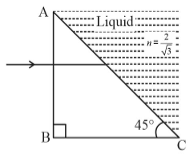
A light ray entering a right $-$ angled prism undergoes refraction at the face $AC$ as shown in Figure
$(I)$ What is the refractive index of the material of the prism in Figure?

Image
$(II) (a)$ If the side $AC$ of the above prism is now surrounded by a liquid of refractive index $\frac{2}{\sqrt{3}}$ as shown in Figure, determine if the light ray continues to graze along the interface $AC$ or undergoes total internal reflection or undergoes refraction into the liquid.

Image
$(b)$ Draw the ray diagram to represent the path followed by the incident ray with the corresponding angle values.
$($Given $,\sin ^{-1}\left(\frac{\sqrt{2}}{\sqrt{3}}\right)=54.6^{\circ} )$
What is the shortest wavelength present in the Paschen series of spectral lines?
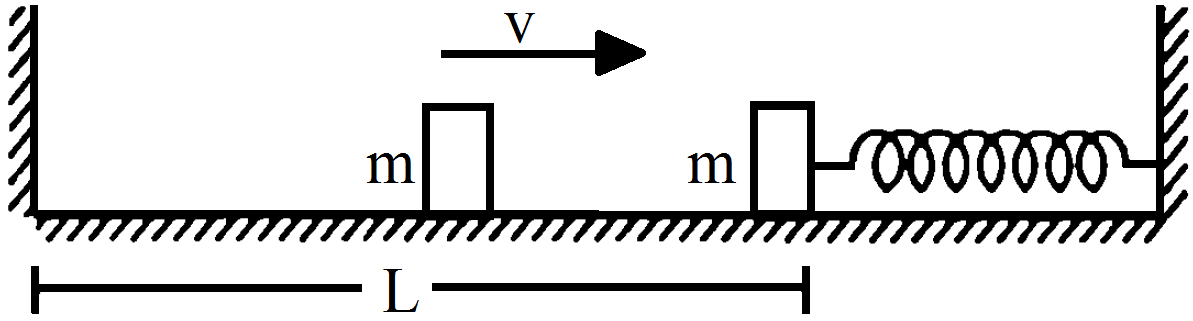
The left block in figure moves at a speed v towards the right block placed in equilibrium. All collisions to take place are elastic and the surfaces are frictionless. Show that the motions of the two blocks are periodic. Find the time period of these periodic motions. Neglect the widths of the blocks.
A 3.0 cm wire carrying of 10 A is placed inside a solenoid perpendicular to its axis. The magnetic field inside the solenoid is given to be 0.27 T. What is the magnetic force on the wire?
A wheel starting from rest is uniformly accelerated at $4 \text{ rad/-s}^2$ for $10$ seconds.It is allowed to rotate uniformly for the next $10$ seconds and is finally brought to rest in the next $10$ seconds. Find the total angle rotated by the wheel.
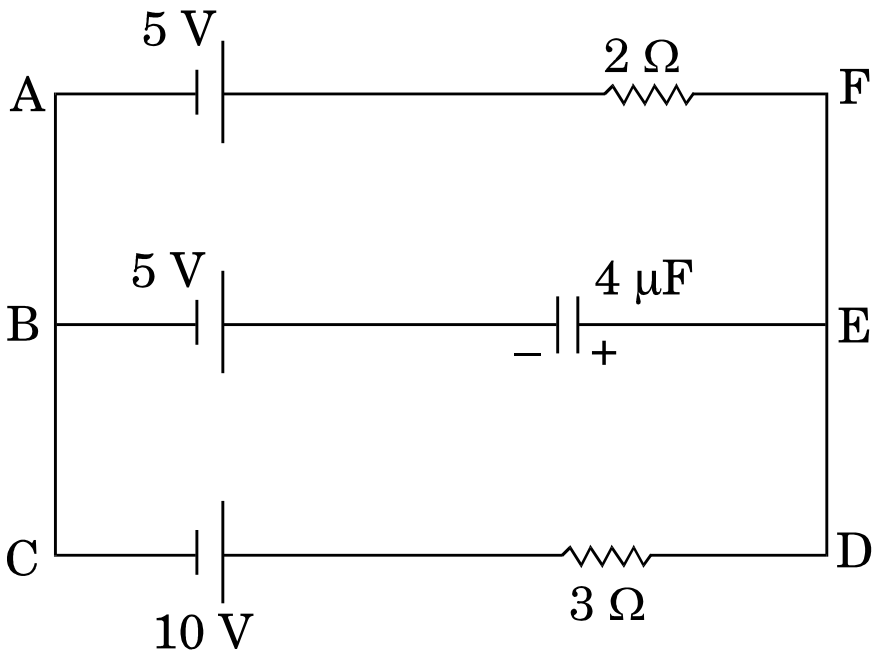
In the given circuit, with steady current, calculate the potential drop across the capacitor in terms of V.
A particle goes in a circle of radius 2.0cm. A concave mirror of focal length 20cm is placed with its principal axis passing through the centre of the circle and perpendicular to its plane. The distance between the pole of the mirror and the centre of the circle is 30cm. Calculate the radius of the circle formed by the image.
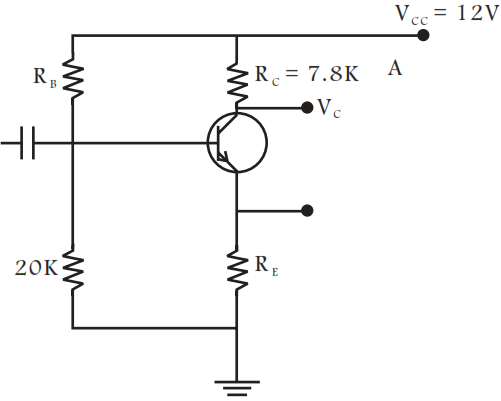
For the transistor circuit shown in Fig, evaluate $V_E, R_B, R_E$ given $I_C = 1 mA, V_{CE} = 3V, V_{BE} = 0.5 V$ and $V_{CC} = 12 V, \beta = 100.$​​​​​​​
  1. Drive the expression for electric field at a point on the equatorial line of an electric dipole.
  2. Depict the orientation of the dipole in (i) stable, (ii) unstable equilibrium in a uniform electric field.