Question
Does a nucleus lose mass when it suffers gamma decay?

Answer

Gamma rays consist of photons that are produced when a nucleus from its excited state comes to its ground state releasing energy. Since gamma rays are chargeless and massless particles, the nucleus does not suffer any loss in mass during the gamma decay.

Need a full question paper?

Generate a complete, print-ready paper with questions like this in minutes — across 16+ boards, with answer keys.
Start Generating Free

Similar questions

Radiation from hydrogen discharge tube falls on a cesium plate. Find the maximum possible kinetic energy of the photoelectrons. Work function of cesium is 1.9eV.
  1. In what way is diffraction from each slit related to the interference pattern in a double slit experiment?
  2. Two wavelengths of sodium light 590 nm and 596 nm are used, in turn, to study the diffraction taking place at a single slit of aperture 2 \times $10^{–4}\ m.$ The distance between the slit and the screen is 1.5 m. Calculate the separation between the positions of the first maxima of the diffraction pattern obtained in the two cases.
The electrostatic force on a small sphere of charge 0.4 μC due to another small sphere of charge –0.8 μC in air is 0.2 N.
  1. What is the distance between the two spheres?
  2. What is the force on the second sphere due to the first?
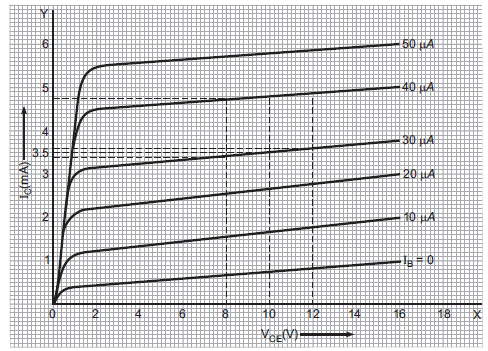
Output characteristics of an n-p-n transistor in CE configuration is shown in the figure. Determine:
  1. Dynamic output resistance.
  2. Dc current gain and.
  3. Ac current gain at an operating point $V_{CE} = 10V$, when $I_B =30 \mu A.$
i. Differentiate between three segments of a transistor on the basis of their size and level of doping.
ii. When is a transistor said to be in active state?
iii. Draw a plot of transfer characteristic ($V _0$ vs. $V _{ i }$ ) and show which portion of the characteristic is used in amplification and why?
iv. Draw the circuit diagram of the base bias transistor amplifier in CE configuration and briefly explain its working.
Find the range of frequency of light that is visible to an average human being $(400\text{nm}<\lambda<700\text{nm}).$
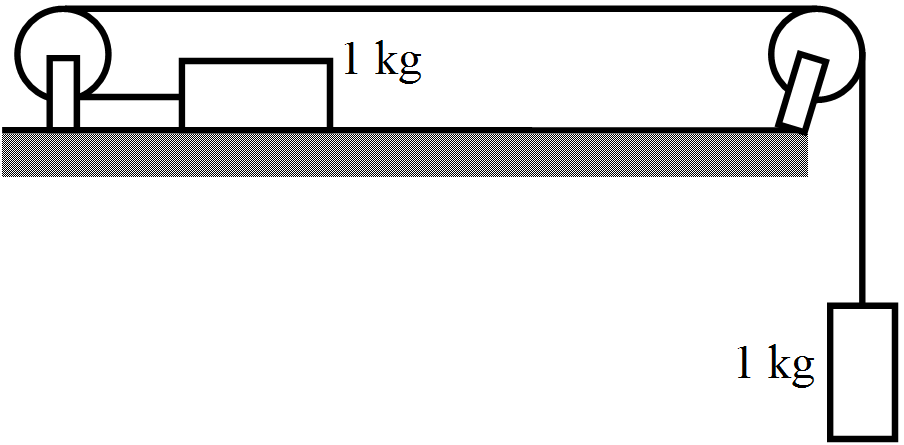
Calculate the tension in the string shown in figure. The pulley and the string are light and all surfaces are frictionless. Take $g = 10m/s^2.$
A transformer has 50 turns in the primary and 100 in the secondary. If the primary is connected to a 220V DC supply, what will be the voltage across the secondary?
A body of mass 2kg suspended through a vertical spring executes simple harmonic motion of period 4s. If the oscillations are stopped and the body hangs in equilibrium, find the potential energy stored in the spring.
What is the magnitude of magnetic force per unit length on a wire carrying a current of 8 A and making an angle of 30º with the direction of a uniform magnetic field of 0.15 T?