MCQ
Donor type impurity is found in
  • A
    Trivalent elements
  • Pentavalent elements
  • C
    In both the above
  • D
    None of these

Answer

Correct option: B.
Pentavalent elements
b
(b)One atom of pentavalent impurity, donates one electron.

Need a full question paper?

Generate a complete, print-ready paper with questions like this in minutes — across 16+ boards, with answer keys.

Start Generating Free

Similar questions

Two positive charges of magnitude $q$ are placed at the ends of a side $1$ of a square of side $2a$. Two negative charges of the same magnitude are kept at the other corners. Starting from rest, if a charge $Q$, moves from the middle of side $1$ to the centre of square, its kinetic energy at the centre of square is
A conducting circular loop of radius r carries a constant current i. It is placed in a uniform magnetic field $\vec B$, such that $\vec B$ is perpendicular to the plane of the loop. The magnetic force acting on the loop is
In photoelectric effect, the electrons are ejected from metals if the incident light has a certain minimum
In a transistor the base is made very thin and is lightly doped with an impurity because
A particle of charge q and mass m moving with a velocity v along the x-axis enters the region x > 0 with uniform magnetic field B along the $\hat k$ direction. The particle will penetrate in this region in the x-direction upto a distance d equal to
A sinusoidal wave $y ( t )=40 \sin \left(10 \times 10^{6} \pi t \right)$ is amplitude modulated by another sinusoidal wave $x ( t )=20 \sin (1000 \pi t )$. The amplitude of minimum frequency component of modulated signal is ...........
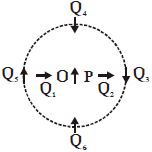
A small magnetised needle $P$ placed at point $O$ and the arrow shows the direction of its magnetic moment. The other arrow show different position (and orientation) of another identical magnets $(Q)$. In which configuration system is not in equilibrium
The photoelectric work function for a metal surface is $4.125\; eV$. The cut-off wavelength for this surface is .......... $\mathring A$
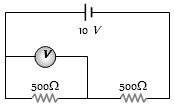
A voltmeter of resistance $1000\,\Omega$ is connected across a resistance of $500\, \Omega$ in the given circuit. What will be the reading of voltmeter .............. $V$
In a moving coil galvanometer, the deflection of the coil $\theta $ is related to the electrical current $i$ by the relation